
The recent European trip by Reza Pahlavi started out in a fairly predictable way.
Meetings in Sweden and Italy focused on familiar themes—democracy in Iran, international pressure on Tehran, and efforts to rally support among European lawmakers.
Up until his arrival in Germany, the tone was controlled and political, almost routine for an exile opposition figure trying to keep Iran on the international agenda.
But Berlin changed that rhythm completely, and not in a way anyone around him seemed prepared for.
Berlin Shifts the Conversation Off Course
In Germany, the visit took a sharp turn during a press interaction in Berlin.
Instead of questions about Iran’s political future or governance reforms, a journalist raised a far more loaded accusation—asking whether Pahlavi was an “agent of Israel.”
The question referenced his engagement with pro-Israel organisations like the Europe-Israel Press Association and the European Jewish Association, but quickly escalated into a broader geopolitical framing that echoed long-standing narratives promoted by Iran’s ruling establishment.
For many observers, the moment felt less like journalism and more like a political trap already set in motion.
Pahlavi Pushes Back on the Narrative
Pahlavi rejected the accusation directly.
He insisted he was not acting on behalf of any foreign government and instead framed himself as a voice for Iranian citizens seeking political change.
He also leaned into history, pointing to Iran’s ancient ties with Jewish communities, referencing Cyrus the Great and the tradition of offering refuge to persecuted groups.
His argument was simple: supporting democracy and human rights does not require foreign sponsorship.
He stressed that legitimacy, in his view, comes from the Iranian people—not external actors.
A Press Moment That Escalated Tension
After the exchange, Pahlavi shifted back toward broader political messaging, discussing governance models and the idea that Iranians should decide their own system through democratic choice.
But the atmosphere around him remained tense.
What should have been a structured press engagement began to feel increasingly fragmented, with focus drifting away from Iran’s internal crisis and toward international suspicion narratives.




The Attack Outside the Venue
The situation escalated shortly after the press interaction ended.
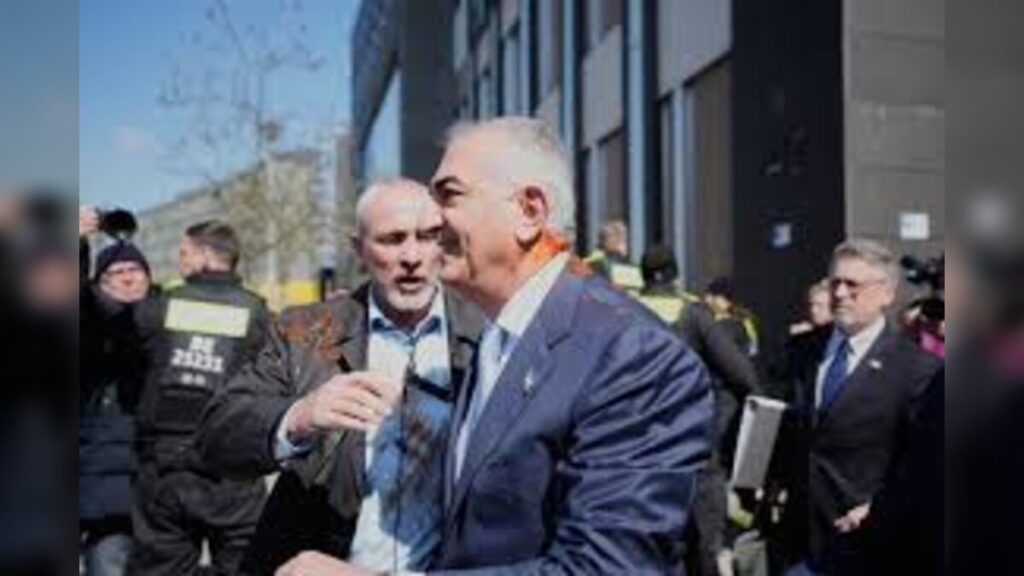
As Pahlavi was leaving the venue, an individual approached him from behind and threw a red liquid at him before being restrained.
Berlin police later confirmed the suspect had no press accreditation or official access.
He was detained and is now under investigation for bodily harm, insult, and property damage linked to political activity.
Security services in Berlin acknowledged that arrangements were being reviewed, but critics argue the breach should never have happened in the first place given Pahlavi’s profile and visibility.
Questions Over Security and Responsibility
The incident has raised uncomfortable questions about how such a breach was possible in the first place.
Pahlavi is not a minor political figure—he is one of the most prominent opposition voices outside Iran advocating for regime change and democratic transition.
His chief of staff, Cameron Khansarinia, later noted that responsibility for security during overseas visits rests primarily with host nation authorities.
That statement has only intensified debate over whether German security protocols were properly enforced.
Germany’s Political Position Adds Another Layer
The response from German officials has also drawn attention.
A government spokesperson reiterated that engagement with Iran continues through official state channels, meaning the Islamic Republic remains the recognised diplomatic counterpart.
That position effectively sidelines opposition figures like Pahlavi, even as he continues to build support in European parliaments.
German political commentary has also reflected broader divisions over how to approach Iran, Israel, and regional security—making Pahlavi’s visit politically sensitive before it even began.
Impact and Consequences
The most immediate consequence is reputational.
The Berlin incident has cast doubt on Germany’s ability to secure high-profile political visitors, especially opposition figures from volatile regions.
Politically, it also shifts attention away from Pahlavi’s message and back toward security failures and media framing.
Instead of discussing democratic transition in Iran, headlines are now dominated by an attack and accusations.
For Iran’s opposition movement abroad, it reinforces how easily messaging can be disrupted by geopolitical narratives and security breakdowns.
What’s Next?
Pahlavi is expected to continue his European outreach, though future visits will likely involve stricter security coordination and tighter media control.
German authorities are expected to complete their investigation into the attacker and review how he gained access so close to the opposition figure.
At a broader level, European policymakers may now face increased pressure to clarify how they engage with Iranian opposition groups versus the official government in Tehran.
Summary
Reza Pahlavi’s European diplomatic tour shifted dramatically in Berlin, where a press exchange escalated into accusations and a subsequent physical attack.
The incident has raised serious questions about security planning, media framing, and how opposition figures are treated in European political spaces.
What began as a structured political outreach has now become a wider debate about safety, legitimacy, and geopolitical narratives.
Bulleted Takeaways
- Reza Pahlavi toured Sweden, Italy, and Germany meeting European lawmakers
- Berlin press event featured accusation of being an “agent of Israel”
- Pahlavi rejected claims and emphasised Iranian democratic legitimacy
- He referenced Iran’s historical ties with Jewish communities
- An attacker later threw red liquid at him outside the venue
- Berlin police arrested suspect with no press credentials
- Security arrangements in Germany are now under scrutiny
- German government continues official engagement with Iran’s regime
- Incident shifts focus from political message to security failure
- Future visits may involve tighter protection and revised protocols

