
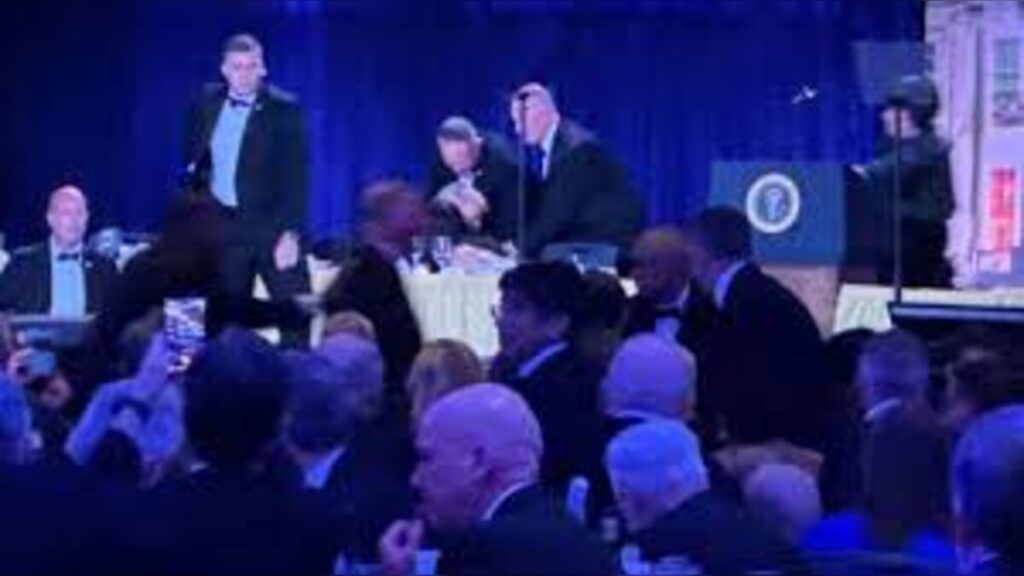
The aftermath of the shooting near a major Washington political gathering quickly turned into something bigger than a security story.
It became another flashpoint in America’s ongoing political blame game, with President Donald Trump and critics of his rhetoric pointing fingers in opposite directions.
In an interview with CBS News’ Norah O’Donnell, Trump revisited the incident involving 31-year-old Cole Tomas Allen, who allegedly opened fire at the Washington Hilton during a large annual event attended by journalists and political figures.
Authorities later said Allen had written a manifesto before the attack, outlining hostility toward members of Trump’s administration and expressing anger tied to online political content.
He had also reportedly attended a “No Kings” protest in the lead-up to the incident.
Trump’s argument: Democrats and “radicalization”
Trump used the interview to suggest that political opponents—specifically Democrats—had contributed to a climate that fuels extremist behavior.
He claimed that certain protest movements, including “No Kings,” were indirectly supported by Democratic-aligned funding networks.
In his words, these groups were part of what he described as a broader pattern of political manipulation.
He also broadened his criticism to the internet itself, arguing that it has played a role in “radicalizing” individuals and worsening mental health issues.
According to him, the political left contributes heavily to violent language and division in public discourse.
At one point, he escalated his critique further, saying he believed “hate speech” from Democrats was particularly dangerous for the country.
MSNBC’s pushback: Trump under scrutiny
Not everyone accepted Trump’s framing of the situation.
On MS NOW’s The Weekend: Primetime, anchor Antonia Hylton offered a very different interpretation of responsibility for the political climate.
While acknowledging Trump’s reflective tone after the shooting, she argued that his own language over time has contributed to rising tensions.
She referenced past statements where Trump referred to political opponents in harsh terms and suggested that such rhetoric helps normalize hostility in public life.
In her view, expressions of unity in moments of crisis can ring hollow if they are not matched by consistent messaging.
Her comments reflected a broader media debate: whether political violence is driven more by individual radicalization or by the tone set by national leaders.

The interview gets personal: Epstein reference and accusations
The conversation became more contentious when Trump responded sharply to a passage from the alleged shooter’s manifesto.
The document reportedly included accusations tied to Trump and Jeffrey Epstein, including inflammatory language about alleged misconduct.
Trump strongly rejected those claims during the interview, calling them false and offensive.
He also insisted he had been “totally exonerated” and criticized the framing of the questions as amplifying what he described as baseless allegations.
Trump has not been charged in connection with Epstein-related crimes and has previously said he distanced himself from Epstein years ago.
How the shooting unfolded inside the hotel
According to accounts shared during the interview, the suspect allegedly rushed past a security checkpoint while armed with multiple weapons and attempted to reach the area where high-profile guests, including the president, were gathered.
Security personnel responded quickly, intercepting and stopping him before he reached the main ballroom.
Trump later described seeing surveillance footage of the suspect moving rapidly through the building, even joking about how fast he appeared on camera.
Inside the ballroom, confusion spread after sounds that attendees believed could be gunfire.
Trump said Secret Service agents eventually moved him and others out of the room once the threat became clearer.
First Lady Melania Trump was also present and reportedly recognized the seriousness of the situation early, appearing visibly alarmed in footage from the event.
Aftermath: reflection, security, and political messaging
In the hours following the incident, Trump praised law enforcement for their response and thanked media outlets for what he called responsible reporting.
He also suggested that the attack highlighted the need for stronger security at future events, especially high-profile political gatherings.
At the same time, he defended his broader political message, arguing that the U.S. remains strong under his leadership and suggesting that his influence makes him a target.
Impact and Consequences
The shooting and the surrounding political commentary immediately intensified debates over political rhetoric in the United States.
On one side, Trump’s supporters view his statements as a critique of what they see as left-wing activism and online radicalization.
On the other, critics argue that focusing blame on political opponents risks deepening polarization rather than reducing it.
The media response also shows how quickly such events become multi-layered narratives—combining security concerns, political messaging, and long-running partisan disputes.
What’s next?
Security reviews are expected for future large political events, especially those involving high-profile figures and media attendance.
The White House Correspondents’ Dinner and similar gatherings may see increased protective measures and revised entry protocols.
Politically, the incident is likely to remain part of a broader argument heading into future election cycles: who is responsible for rising tensions, and how much leaders’ language influences real-world violence.
Expect continued back-and-forth between political figures and media commentators as investigations into the suspect’s motives proceed.
Summary
The shooting at a major Washington political event has evolved into a wider debate about responsibility, rhetoric, and radicalization.
President Trump blamed Democratic-linked activism and online influence for fostering extremism, while critics argued that his own language contributes to a heated political environment.
As security reviews begin, the incident has already become another focal point in America’s ongoing political divide.
Bulleted Takeaways
- A 31-year-old suspect allegedly opened fire near a major Washington political gathering at the Washington Hilton
- Authorities say he had a manifesto targeting Trump administration figures and political grievances
- Trump blamed Democrats and online platforms for contributing to political radicalization
- He also described the internet as a major driver of harmful behavior and mental distress
- MSNBC’s Antonia Hylton argued Trump’s own rhetoric contributes to political tension
- The suspect was stopped by security before reaching the main ballroom
- Trump praised law enforcement response and called for stronger future security measures
- The incident has intensified debate over political speech and responsibility in the U.S.

