
U.S. Central Command says American forces are continuing to enforce a blockade on ships entering or leaving Iranian ports, with the number of redirected vessels now rising to 34.
The latest update describes U.S. Navy assets operating across the Middle East as part of a wider maritime pressure campaign, with warships, helicopters, aircraft carriers, and thousands of personnel involved in the mission.
USS Rafael Peralta Intercepts Iranian-Flagged Ship
One of the latest incidents involved the guided-missile destroyer USS Rafael Peralta, which reportedly enforced the blockade against an Iranian-flagged ship attempting to sail toward a port in Iran on April 24.
The action fits into the wider pattern of U.S. forces stopping or redirecting vessels linked to Iranian port traffic.
The message from Washington is clear: ships attempting to enter or exit Iranian ports remain subject to U.S. military enforcement.
USS Tripoli Supports Mission With Heavy-Lift Helicopter Operations
CENTCOM also highlighted operations from the USS Tripoli, an amphibious assault ship currently involved in the broader regional mission. A CH-53 heavy-lift helicopter was shown lifting off from the ship.
The CH-53 is described as having a 36,000-pound aerial lift capacity, making it capable of moving vehicles, supplies, and other heavy equipment.
That kind of aircraft gives U.S. forces more flexibility at sea, especially during sustained operations where supplies, equipment, and rapid movement are critical.
Three U.S. Aircraft Carriers Operate in the Middle East at Once
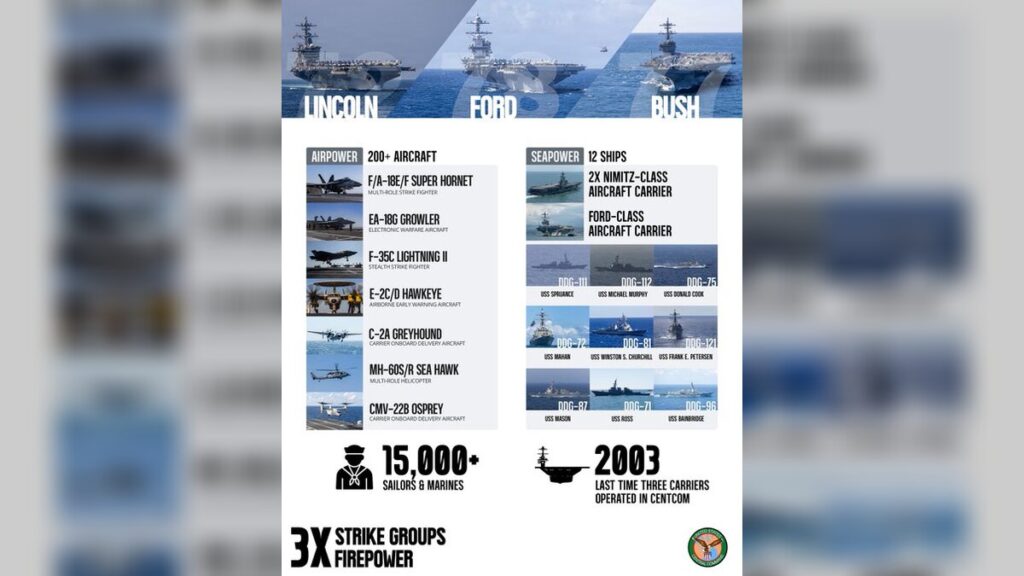
In a separate update, U.S. Central Command said that, for the first time in decades, three aircraft carriers are operating in the Middle East at the same time.
The carriers named were the USS Abraham Lincoln, USS Gerald R. Ford, and USS George H.W. Bush.
Together with their carrier air wings, the force reportedly includes more than 200 aircraft and about 15,000 sailors and Marines.
That level of presence signals a major U.S. military posture in the region and suggests Washington is prepared to sustain large-scale air and naval operations if needed.
Blockade Becomes a Larger Show of Force
The blockade is no longer being framed as a limited maritime operation. With multiple destroyers, amphibious ships, helicopters, and three aircraft carriers in the region, it has become a major display of American military power.



Redirecting 34 vessels also shows that the enforcement campaign is active, not symbolic.
Each vessel turned away adds to the pressure on Iranian maritime access and sends a warning to commercial and state-linked ships operating near Iranian ports.
Strategic Importance of the Middle East Deployment
The Middle East remains one of the world’s most sensitive regions for maritime traffic, especially because of energy exports and key sea lanes.
Any blockade involving Iranian ports can quickly affect shipping calculations, regional security planning, and global market confidence.
By placing three carrier strike groups in the region, the U.S. is not only enforcing a blockade but also building a deterrent posture.
That means the military presence is likely aimed at preventing escalation while also giving U.S. commanders the ability to respond quickly if tensions rise.
Impact and Consequences
The immediate impact is on vessels attempting to move in or out of Iranian ports. With 34 ships already redirected, shipping operators may begin reassessing routes, insurance risks, cargo exposure, and the likelihood of interception.
For Iran, the blockade creates direct pressure on maritime access and could affect trade, oil movement, and military logistics.
For the wider region, the buildup raises the stakes. A large U.S. naval presence may deter some actions, but it also increases the risk that a confrontation at sea could escalate quickly.
The deployment of three aircraft carriers also carries political weight.
It sends a message to Iran, regional allies, and global rivals that the U.S. is willing to commit substantial military resources to the operation.
What’s next?
The next phase will likely depend on whether more ships attempt to challenge the blockade.
If vessels continue heading toward Iranian ports, U.S. forces may keep redirecting them, increasing the total number of affected ships.
Attention will also remain on the three-carrier presence in the Middle East.
If the carriers stay in place, it could suggest a longer enforcement campaign. If more ships, aircraft, or logistics units are added, the blockade may expand further.
Diplomatically, the operation could draw stronger responses from Iran and its partners, especially if Iranian-flagged vessels continue to be intercepted or turned away.
Summary
U.S. Central Command says American forces are still enforcing a blockade against ships entering or leaving Iranian ports, with 34 vessels redirected so far.
The guided-missile destroyer USS Rafael Peralta reportedly acted against an Iranian-flagged ship trying to sail to Iran, while the USS Tripoli continues supporting operations with heavy-lift helicopter capability.
At the same time, three U.S. aircraft carriers — USS Abraham Lincoln, USS Gerald R. Ford, and USS George H.W. Bush — are operating in the Middle East together, bringing more than 200 aircraft and 15,000 sailors and Marines into the regional posture.
Bulleted Takeaways:
- U.S. forces say they are continuing the blockade on ships entering or leaving Iranian ports.
- The number of redirected vessels has now risen to 34.
- USS Rafael Peralta reportedly enforced the blockade against an Iranian-flagged ship on April 24.
- The Iranian-flagged vessel was allegedly attempting to sail to a port in Iran.
- USS Tripoli is supporting the mission with aviation operations.
- A CH-53 heavy-lift helicopter operating from USS Tripoli has a 36,000-pound aerial lift capacity.
- U.S. Central Command says three aircraft carriers are operating in the Middle East at the same time.
- The carriers are USS Abraham Lincoln, USS Gerald R. Ford, and USS George H.W. Bush.
- The carrier force includes more than 200 aircraft.
- Around 15,000 sailors and Marines are involved across the carrier groups.
- The operation represents a major U.S. military show of force in the region.
- The blockade could increase pressure on Iran’s maritime trade and raise tensions across Middle East shipping routes.
