
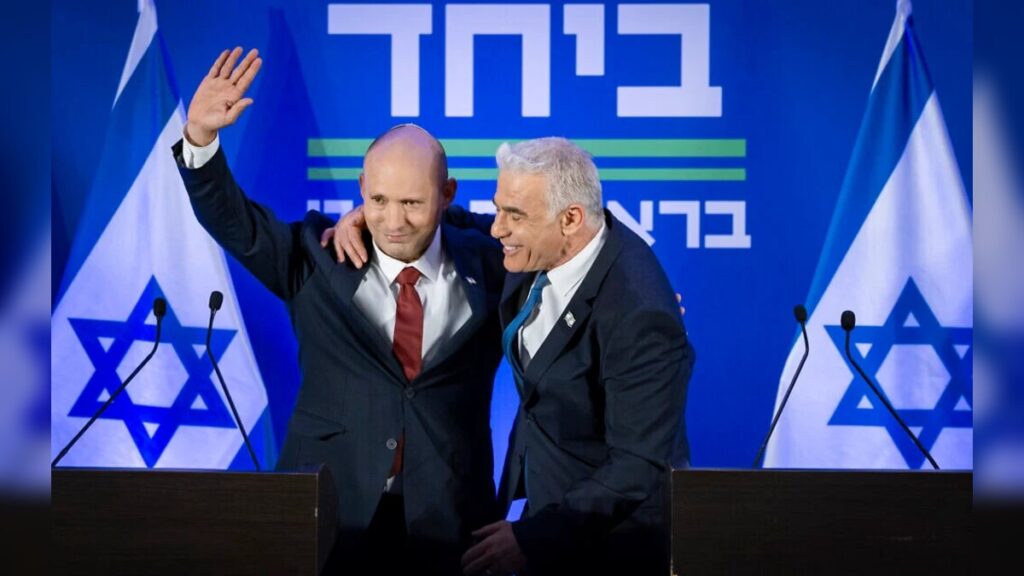
Israeli politics has a habit of turning partnerships into short-lived arrangements, but the relationship between Naftali Bennett and Yair Lapid has always played by slightly different rules.
What began years ago as an unlikely cooperation between two ideological opposites has now evolved into a recurring political partnership built less on ideology and more on trust that has somehow survived every stress test thrown at it.
Their latest joint political appearance in Tel Aviv revived an old phrase they once used to describe their bond—the “covenant of brothers.”
In a political environment known for sudden betrayals and midnight defections, that phrase has become both branding and challenge.
Two Leaders, One Starting Point in a Changing Israel
Both men entered national politics in the same 2013 election cycle, a moment that reshaped Israel’s political map.
Lapid arrived as a media figure turned political force, leading Yesh Atid into an unexpected 19-seat breakthrough.
He immediately found himself in a senior economic role.
Bennett, meanwhile, had transformed the religious Zionist political space through Jewish Home (Bayit Yehudi) and quickly took ministerial responsibilities in economics and religious affairs.
From the beginning, both men were inside the same governing ecosystem under Benjamin Netanyahu, even while representing very different voter bases.
What made their partnership unusual was not just cooperation—it was speed.
Within weeks, they were coordinating legislative pushes on conscription and religion-state issues, effectively acting like informal allies inside a coalition led by their political rival.
Opposites in Theory, Partners in Practice
On paper, the alliance should never have worked.
Lapid represented secular urban Israel, especially Tel Aviv’s middle class.
Bennett came from the ideological right rooted in religious Zionism and settler leadership circles.
Yet politics forced alignment. In Israeli coalition politics, numbers often matter more than ideology, and both men discovered they could advance shared priorities only by working together.
That early cooperation laid the foundation for a relationship that would survive far more complicated political moments later on.
Known political observers often describe this period as the beginning of an unusual trust dynamic—rare in a system where coalition partners frequently collapse under pressure.
The Rotation Deal That Changed Israeli Politics
The most defining moment in their relationship came in 2021, when they formed a coalition that removed Benjamin Netanyahu from power.
Lapid, despite having more seats, agreed to let Bennett become prime minister first under a rotation agreement.




That decision reshaped expectations in Israeli politics, where such agreements are often broken.
When Bennett’s government collapsed in 2022, he handed leadership to Lapid as promised before stepping away from frontline politics for a time.
The exchange stood out because it actually worked. In a system where trust is often theoretical, this arrangement was executed exactly as agreed.
Return to Politics and a New Political Calculation
After a period of political silence, Bennett returned to the scene with Lapid again as a key partner.
The new political environment is significantly different from the one they left behind, especially after the October 7 attacks and the ongoing regional tensions.
The current political landscape has narrowed ideological divides on security, but widened disagreements on leadership, governance, and trust in Netanyahu’s leadership.
This shift has allowed Bennett and Lapid to argue that cooperation is now more practical than ever.
Still, their partnership faces a mathematical challenge: building a coalition capable of reaching a governing majority without relying on politically difficult alliances.
Internal Opposition Fractures and Electoral Arithmetic
One of the biggest obstacles to their strategy is fragmentation within the opposition bloc itself.
Several parties that might otherwise cooperate remain divided over leadership, ideology, and voter identity.
Figures such as Avigdor Lieberman are now positioned as alternative right-leaning options outside Netanyahu’s orbit, further complicating the coalition landscape.
The result is a crowded opposition field where unity is constantly discussed but rarely achieved.
Netanyahu’s Counter Strategy and Political Pressure
Prime Minister Benjamin Netanyahu remains central to the equation, both as the incumbent and as the main political rival shaping opposition strategy.
His Likud party continues to adjust its internal candidate selection process in response to shifting voter sentiment, especially among long-time supporters who feel politically displaced.
This has created a dynamic where Bennett and Lapid are not only competing against Netanyahu’s government, but also against his ability to reorganize his political base.
Impact and Consequences
The Bennett–Lapid alliance, if it holds, could reshape Israeli coalition politics by reinforcing the idea that ideological opposites can govern together if trust is strong enough.
It also challenges the long-standing assumption that Israeli politics is permanently locked into rigid ideological blocs.
However, the risks are equally significant.
A failed coalition attempt could deepen voter fatigue and reinforce cynicism about opposition unity.
It could also further fragment the political centre, making future coalition building even harder.
Internationally, the alliance is being watched as a test case for post-crisis political cooperation in deeply divided democracies.
What’s Next?
The immediate future depends on whether Bennett and Lapid can expand their alliance into a broader electoral platform that attracts additional centrist and right-leaning figures.
Negotiations with other political actors remain fluid.
Much will also depend on voter response in the coming months.
Polling trends, candidate lists, and public perception of trust between the two leaders will determine whether the partnership becomes a viable governing path or remains a symbolic political experiment.
Summary
Bennett and Lapid have built one of the most unusual political partnerships in modern Israeli politics, grounded not in ideology but in repeated acts of trust.
Their alliance has survived government collapse, leadership rotation, and long political separation. Now, they are atte
mpting to turn that personal trust into a viable governing coalition in a deeply fragmented political environment.
Bulleted Takeaways
- Bennett and Lapid first cooperated in the 2013 Israeli election cycle
- Lapid leads Yesh Atid while Bennett emerged from Jewish Home (Bayit Yehudi)
- The two formed an unusual cross-ideological political partnership early in their careers
- In 2021, they led a coalition that ended Netanyahu’s rule through a rotation agreement
- Bennett served first as prime minister, later handing power to Lapid as agreed
- Their partnership is based on rare political trust in Israeli coalition politics
- The current political landscape is more fragmented after recent national crises
- Opposition parties remain divided over unity and leadership strategies
- Netanyahu remains a central figure shaping electoral competition
- The success of their alliance depends on forming a viable coalition path to 61 seats

