
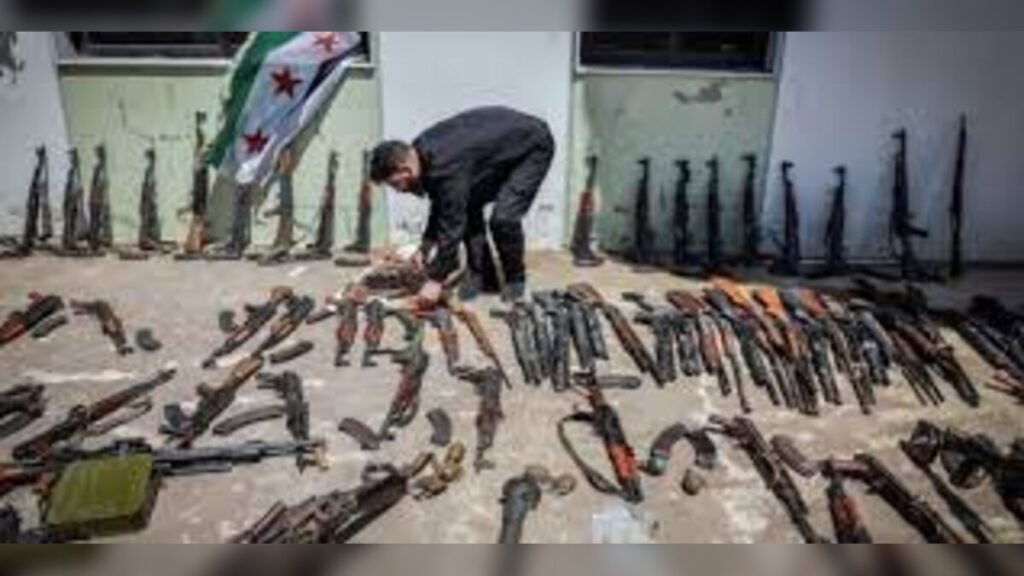
What was expected to be a routine security sweep in the Aadshit al-Qusayr area turned into a disturbing find when authorities uncovered a weapons storage site hidden inside a child’s bedroom.
The scene immediately raised concerns about how deeply armed groups have embedded military stockpiles within civilian spaces.
Inside the room, instead of toys or school items, investigators reportedly found a carefully concealed collection of heavy weaponry and combat supplies.
A Children’s Room Turned Into an Arsenal
The most unsettling detail was the location itself.
A space meant for childhood had allegedly been converted into a storage point for military equipment.
Among the items discovered were explosives, Kalashnikov-style rifles, grenades, rocket-propelled grenades, machine guns, ammunition, and assorted combat gear.
The variety suggested the room was being used as more than just temporary hiding space — it appeared to function as part of a broader weapons network.
Such discoveries are not uncommon in conflict zones where armed groups attempt to conceal materials in residential buildings to avoid detection.
Why Weapons End Up in Civilian Areas
Over years of conflict in parts of Syria, reports from international observers have repeatedly highlighted the use of homes, schools, and other civilian structures for military storage.
The logic is often tactical: blending in reduces the chance of airstrikes or raids targeting known military facilities.
But the consequences are severe. When weapons are stored in places where families live, the risk to civilians increases dramatically, especially children who may not even understand the danger around them.
Human rights organizations have long warned that this practice violates international humanitarian principles, which stress the separation of military assets from civilian life.




Security Forces Tighten Response
Following discoveries like the one in Aadshit al-Qusayr, security operations in similar regions typically intensify.
Raids and inspections often expand to nearby homes suspected of being linked to armed networks.
Authorities generally aim to dismantle hidden stockpiles before they can be redistributed or used in active fighting.
However, such operations also highlight how difficult it is to fully eliminate underground weapons storage systems once they become embedded in local areas.
A Pattern Seen in Conflict Zones
Incidents like this are not isolated. Across multiple conflict-affected regions, weapons caches have been found in basements, abandoned shops, and even residential bedrooms.
The pattern reflects a broader reality of modern asymmetric warfare, where armed groups rely on concealment within populated areas.
It also explains why civilians often find themselves caught in the middle of security operations and retaliatory strikes.
Impact and Consequences
The immediate impact of such discoveries is increased tension in already fragile communities.
Residents may face heightened security checks, disruptions, and fear of further raids.
On a broader level, the presence of weapons inside civilian homes deepens mistrust between local populations and armed actors.
It also complicates reconstruction efforts, as safe housing becomes harder to guarantee when military materials are hidden in residential zones.
For children, the psychological impact can be lasting — growing up in environments where bedrooms can become weapon storage areas blurs the boundary between normal life and conflict.
What’s next?
Security forces are likely to continue sweeping operations in surrounding areas to trace the origin of the weapons cache and identify those responsible.
Investigations typically aim to map supply routes and dismantle storage networks.
At the same time, humanitarian groups often push for stronger protections for civilians and stricter enforcement against the use of homes for military purposes.
Longer-term stability efforts depend heavily on reducing this overlap between civilian life and armed activity.
Summary
The discovery of a weapons stockpile inside a child’s room in Aadshit al-Qusayr highlights the harsh realities of living in conflict zones.
What should have been a safe domestic space was reportedly used to store heavy weapons, reflecting a broader pattern of militarization within civilian areas.
Bulleted Takeaways
- Weapons cache reportedly found inside a child’s bedroom in Aadshit al-Qusayr
- Items included explosives, rifles, grenades, RPGs, machine guns, and ammunition
- Civilian homes are sometimes used for concealment in conflict zones
- Such practices raise serious safety and humanitarian concerns
- Security operations are expected to intensify in surrounding areas
- Presence of weapons in homes increases risk to civilians, especially children
- Incident reflects wider challenges of separating combat activity from civilian life

