
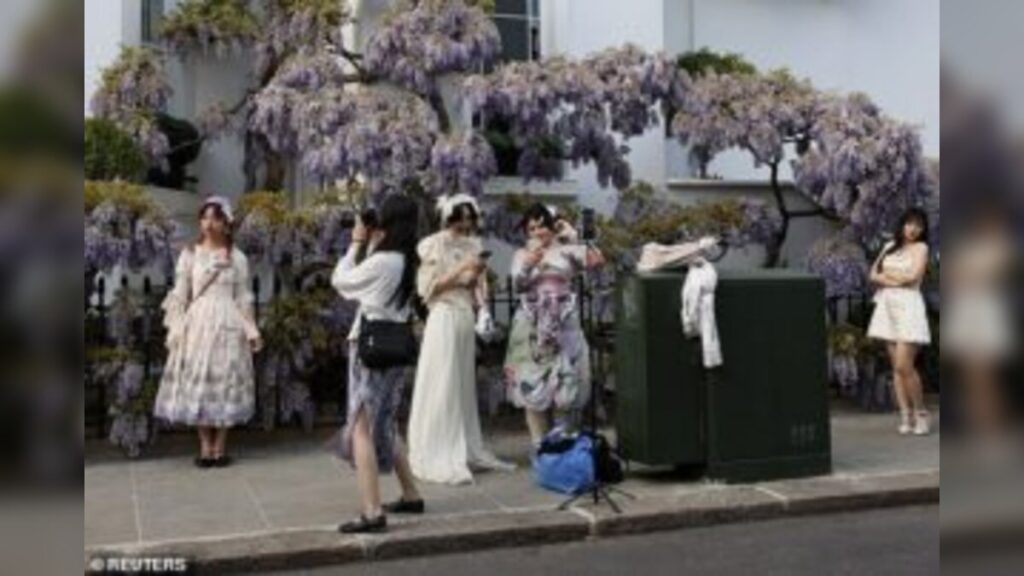
In parts of West London where you’d normally expect silence broken only by passing buses, something unusual is happening.
Minibuses packed with young Chinese tourists now roll into streets near Kensington and Notting Hill, not for Buckingham Palace or Big Ben—but for flower-covered mansions and perfectly framed Instagram backdrops.
It’s a different kind of sightseeing altogether.
Less about history lectures and more about visuals, outfits, and the right angle for a photo.
The App That’s Rewriting Britain’s Tourist Map
At the centre of this shift is Xiaohongshu, widely referred to in English as RedNote or “Little Red Book.”
The platform has quietly become a digital travel bible for millions of young Chinese users.
With over 350 million monthly users, it mixes lifestyle content, travel inspiration, fashion tips, and location guides—all heavily driven by visuals.
What’s interesting is how it now functions like a crowdsourced tour guide.
If a place trends on the app, it can quickly turn into a real-world destination overnight.
From Landmarks to Lavender Hedges and Wisteria Walls
Instead of traditional sightseeing routes, many visitors are now following curated “aesthetic trails.”
That includes wisteria-covered houses in Kensington, pastel streets in Notting Hill, and even countryside villages like Bibury and Bourton-on-the-Water.
York and the North York Moors are also drawing attention, while shopping destinations like Bicester Village in Oxfordshire have become almost mandatory stops for many Asian tourists.
Some travellers even arrive with portable clothing racks and outfit changes, treating each location like a staged photoshoot rather than a casual visit.
When Tourism Becomes a Production Set
Locals in West London have noticed that it’s not just casual visitors anymore. Entire groups now arrive with tripods, lighting setups, and even stylists.
One homeowner described how professional photographers sometimes treat private homes like film sets, rearranging scenes and using furniture as props.




At one point, even a car dealership reportedly used a residential street as a backdrop for advertising shoots.
It’s flattering to a point—but also disruptive when everyday spaces start feeling like commercial studios.
Japan, Influencers, and the Global Ripple Effect
Interestingly, many of the visitors drawn to wisteria-lined streets come from Japan, where the flower originally has cultural roots.
But the trend has been amplified globally through influencers and short-form video content.
Platforms like RedNote and similar apps have blurred the line between travel inspiration and viral destination marketing.
Once a location is posted enough times, it can suddenly become a “must-see” stop.
This same pattern has already been seen in places like Paris cafés, Bali rice terraces, and now British suburban streets.
Pushback From Residents Feeling Overwhelmed
Not everyone is comfortable with the attention.
In some streets, homeowners have had to put up signs asking visitors not to pick flowers, lean on walls, or step into private gardens.
In Bourton-on-the-Water and Bibury in the Cotswolds, frustration has grown as narrow roads and small public spaces struggle to handle heavy foot traffic.
Locals report congestion, littering, and long queues at cafés and pubs during peak months.
A recent local survey even suggested that a majority of residents feel tourism is negatively affecting daily life and community balance.
Impact and Consequences
The rise of social-media-driven tourism is reshaping how destinations function.
On the positive side, it boosts local economies—shops, cafés, and transport services see increased revenue.
But the downsides are harder to ignore. Residential areas become overcrowded, privacy is reduced, and historic villages risk turning into “open-air photo studios” rather than living communities.
There’s also the cultural tension: residents want visibility and tourism income, but not at the cost of losing their sense of normal life.
What’s next?
Tourism boards are now being forced to rethink how they manage viral destinations.
Some local councils are considering crowd control measures, signage rules, and stricter guidelines for commercial photography in residential zones.
At the same time, platforms like RedNote continue to grow, meaning the flow of digitally-driven tourists is unlikely to slow down anytime soon.
The challenge ahead is balance—keeping places open and welcoming without letting them become overwhelmed by their own popularity.
Summary
What started as casual travel inspiration on a social media app has evolved into a powerful tourism engine.
West London streets, Cotswold villages, and Yorkshire towns are now part of a global visual trend cycle, driven by Xiaohongshu users seeking the perfect aesthetic moment.
But as popularity rises, so does pressure on local communities trying to maintain everyday life.
Bulleted Takeaways
- Xiaohongshu (RedNote) is driving new tourism patterns in the UK
- West London streets and countryside villages are viral photo destinations
- Tourists often arrive in organised groups with outfit changes and equipment
- Local residents report disruption, overcrowding, and privacy concerns
- Some homes now display signs restricting photography and access
- Tourism boosts local economies but strains small communities
- Social media trends are reshaping global travel behaviour rapidly
- Authorities may introduce new rules to manage viral location tourism

