
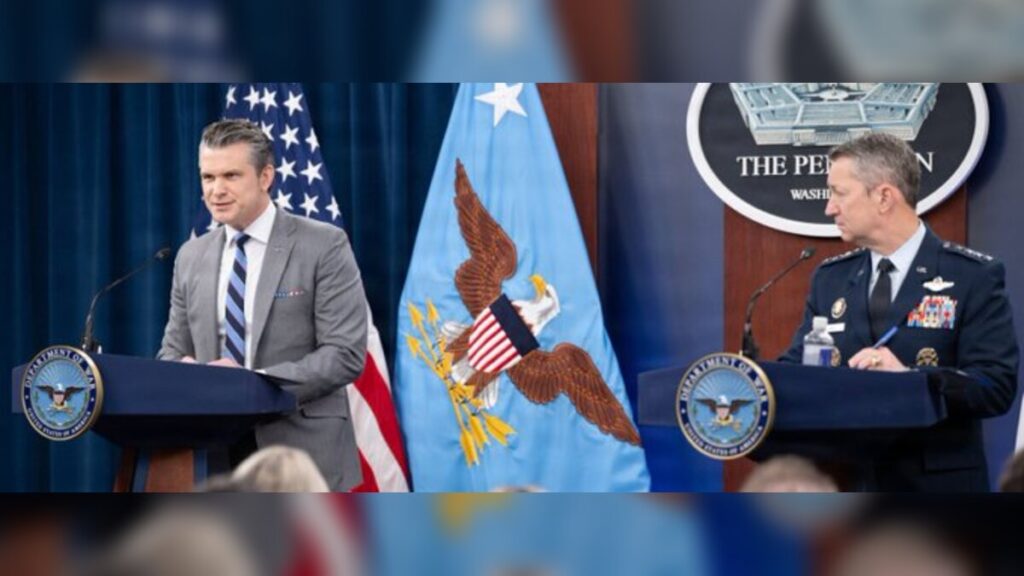
The United States says its maritime blockade targeting ships linked to Iran is expanding beyond the Strait of Hormuz and the Gulf of Oman, with U.S. forces now enforcing restrictions across wider international waters.
According to Defense Secretary Pete Hegseth, the blockade is growing stronger and is being applied to ships connected to Iranian ports or Iranian-flagged vessels wherever U.S. forces can reach them.
34 Ships Have Been Turned Around So Far
Hegseth said the U.S. Navy has already turned around 34 ships without incident.
He described the operation as an “ironclad blockade” and said vessels that meet U.S. criteria — either Iranian ships or ships traveling to or from Iranian ports — have been redirected rather than allowed to continue.
The blockade was first stood up last week against ships moving through the Strait of Hormuz that had been doing business with Iran or were headed toward Iranian ports.
U.S. officials now say the operation has widened, with enforcement stretching from the Gulf of Oman into open-ocean routes.
Second Aircraft Carrier Expected to Join the Mission
The Pentagon says the U.S. military presence supporting the blockade is also expanding. Hegseth said a second aircraft carrier is expected to join the blockade within days, strengthening an already significant naval posture around the region.
That move suggests Washington is preparing for a sustained operation rather than a short-term show of force. The carrier addition would give U.S. commanders more aircraft, surveillance capability, and strike options as the blockade continues.
U.S. Says Blockade Has Gone Global
Beyond the Middle East, U.S. officials say they are also targeting vessels that left Iranian ports before the blockade began.
Hegseth said U.S. forces seized two Iranian “dark fleet” ships in the Indo-Pacific region, arguing that ships already at sea may still be stopped if they fall within the scope of U.S. enforcement.
That marks an important shift in the operation. Rather than only blocking ships at or near Iranian access points, the U.S. is now presenting the blockade as a global maritime campaign against sanctioned ships and Iranian-linked traffic.
Trump Authorizes Destruction of Threatening Iranian Fast Boats
Hegseth also said President Donald Trump has authorized U.S. Central Command to destroy Iranian fast boats in the Gulf of Oman if they threaten U.S. or commercial vessels.
He said the rules of engagement allow U.S. forces to “shoot to destroy” if Iranian vessels attempt to lay mines, disrupt passage through the Strait of Hormuz, or otherwise threaten American forces or commercial shipping.
The warning sharply raises the stakes around the blockade. It sends a message that the U.S. is not only redirecting ships, but is also prepared to use force against activity it defines as a direct maritime threat.
Touska Interdiction Involved Warning Shots and Disabling Fire
Air Force Gen. Dan Caine, chairman of the Joint Chiefs of Staff, detailed one of the recent interdictions involving the Touska, an Iranian-flagged container ship about 965 feet long.
The ship was intercepted by U.S. Central Command on April 19 after allegedly ignoring repeated warnings from a U.S. Navy destroyer.



Caine said the confrontation lasted around six hours. After the crew continued to ignore U.S. warnings, the Navy fired five warning shots.
When that failed to stop the vessel, CENTCOM authorized disabling fire. U.S. sailors warned the crew to leave the engine room, then fired nine inert rounds from the destroyer’s Mark 45 5-inch guns into the ship’s engine area, leaving the vessel dead in the water.
Marines later boarded the ship by helicopter fast-rope insertion and took custody of it.
Tifani and Majestic X Were Also Seized
U.S. officials also described two additional interdictions outside the immediate CENTCOM area.
One involved the Tifani, a crude oil tanker intercepted on April 20–21 while carrying about 2 million barrels of sanctioned Iranian oil.
U.S. military and law enforcement teams boarded the ship by rotary-wing aircraft, secured it, and later placed a Navy control team aboard.
Another operation took place on April 22 against the Majestic X in the Indian Ocean, inside the INDOPACOM area of responsibility.
Caine said U.S. forces again used helicopters to reach the vessel, board it, and secure the bridge. The Tifani, Majestic X, and their crews remain in U.S. custody, according to the Pentagon account.
Pentagon Frames Operation as a Test of U.S. Reach
Caine said the interdictions show the discipline and global reach of U.S. combat power. He framed the operations as part of a broader effort to stop Iran from harming U.S. interests or those of American allies and partners.
Hegseth delivered a similar message, saying the blockade is growing stronger and that Washington’s position remains firm.
He said Iran still has a chance to reach a serious deal, but warned that the U.S. military is ready for whatever comes next.
Impact and Consequences
The immediate impact is on maritime traffic connected to Iran. With 34 vessels redirected and multiple ships seized, operators moving cargo to or from Iranian ports now face a much higher risk of being stopped, searched, turned around, or taken into custody.
That could disrupt shipping schedules, oil movement, insurance coverage, and commercial decision-making across routes linked to Iran.
The wider consequence is the risk of escalation.
A blockade that now stretches from the Gulf of Oman to the Indo-Pacific creates more points of possible confrontation.
The authorization to destroy Iranian fast boats if they threaten shipping raises the danger further, especially in sensitive waters around the Strait of Hormuz.
At the same time, the planned arrival of another aircraft carrier signals that the U.S. is preparing to sustain and expand pressure rather than scale it back.
What’s next?
The next phase will likely involve more interdictions, especially against vessels U.S. officials identify as Iranian, sanctioned, or linked to Iranian ports.
Ships that left before the blockade began may also remain targets if American forces can locate and intercept them.
Attention will also turn to Iran’s response. If Iranian forces attempt to challenge the blockade, lay mines, or use fast boats to disrupt shipping, U.S. commanders now say they have clear authority to respond with force.
Diplomatically, pressure may grow for either a negotiated off-ramp or a wider confrontation, depending on how both sides act in the coming days.
Summary
The U.S. says its blockade against Iranian-linked maritime traffic is expanding from the Strait of Hormuz and Gulf of Oman into global waters.
Officials say 34 ships have been redirected, several vessels have been seized, and another aircraft carrier is expected to join the mission soon.
Recent operations included the seizure of the Iranian-flagged Touska, the oil tanker Tifani, and the Majestic X in the Indian Ocean.
The Pentagon says the operation is meant to deny passage to Iranian-linked vessels and protect U.S. interests, while warning that threatening Iranian fast boats may be destroyed.
Bulleted Takeaways:
- The U.S. says its maritime blockade against Iran-linked shipping is ongoing and expanding.
- The blockade began around ships passing through the Strait of Hormuz linked to Iranian ports.
- U.S. officials say 34 ships have been turned around without incident.
- Defense Secretary Pete Hegseth said a second aircraft carrier will join the blockade within days.
- The U.S. says the blockade has now gone global, including actions in the Indo-Pacific.
- President Trump has authorized U.S. forces to destroy Iranian fast boats that threaten U.S. or commercial shipping.
- The Iranian-flagged Touska was disabled after ignoring warnings and warning shots.
- U.S. Marines boarded the Touska by helicopter after the vessel was disabled.
- The Tifani tanker was seized while carrying about 2 million barrels of sanctioned Iranian oil.
- The Majestic X was interdicted in the Indian Ocean.
- U.S. officials say the Tifani, Majestic X, and their crews remain in U.S. custody.
- The operation could increase pressure on Iran but also heighten the risk of confrontation at sea.
