
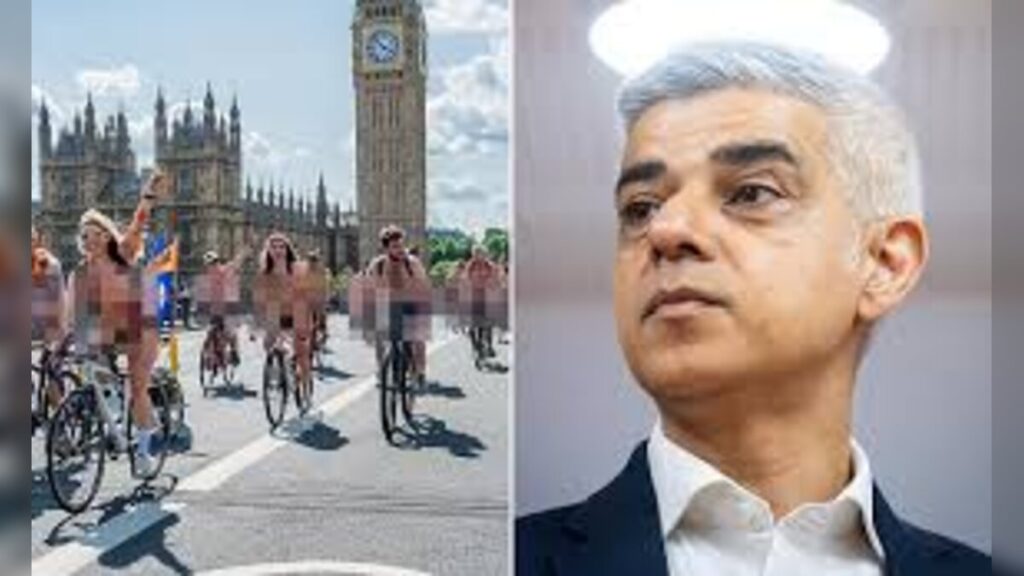
What began years ago as a niche protest about car culture has now become a recurring flashpoint in London’s cultural and legal conversation.
The World Naked Bike Ride London has grown into a widely recognised demonstration, but it is also now drawing sharp criticism over safeguarding concerns.
At the centre of the latest debate is whether public nudity during the event is being properly regulated—especially in a busy capital city where children and families may unexpectedly encounter it.
Campaigners Say the Rules Are Too Confusing
Emma Jane Taylor, founder of the sexual abuse charity Project 90-10, has raised concerns that the legal boundaries around the event are not clearly enforced.
Her argument is simple but controversial: outside the event, public nudity can lead to arrest, but during the ride it is effectively tolerated.
She says this creates a “grey area” that leaves room for inconsistency in safeguarding standards.
Taylor also argues that there are no identity checks or formal safeguarding systems in place for participants, making it difficult to distinguish genuine protesters from people who may take advantage of the situation.
The Mayor Under Pressure
The criticism has also reached City Hall.
London Mayor Sadiq Khan is being accused by campaigners of not doing enough to protect children and families who may be exposed to nudity during the event.
Taylor has even launched a petition calling for a government review of the legal framework surrounding the ride, arguing that public safety should not be left to interpretation or informal arrangements.
Her position is careful to separate protest rights from safeguarding concerns, insisting that free expression should still come with consistent rules.
How the Ride Positions Itself
Organisers of the World Naked Bike Ride London strongly reject claims that the event is unsafe or unregulated.
They describe it as a peaceful, lawful protest focused on body positivity and environmental awareness, particularly opposition to oil dependency and car dominance in cities.
According to organisers, participants are encouraged to respect public boundaries, and any children present are expected to be fully clothed and accompanied by adults.
They also argue that the event is not intended to shock or cause distress, but rather to challenge body image stigma and promote acceptance of natural human diversity.




The Legal Line Everyone Keeps Debating
Under UK law, public nudity is not automatically illegal.
However, the Sexual Offences Act 2003 states that indecent exposure becomes a criminal offence when there is intent to cause alarm or distress.
That legal nuance is exactly where the debate sits.
Supporters of the ride argue that the event is carefully structured to avoid that intent.
Critics argue that intention is difficult to control in a public, open-access environment.
This legal ambiguity is one reason the discussion keeps resurfacing every year.
Tensions, Incidents, and Public Reactions
Over the years, the event has occasionally led to misunderstandings and confrontations.
One widely reported incident involved a participant being attacked by a passerby who mistook him for someone acting inappropriately.
These moments, while not representative of the entire event, have added to concerns about how the public interprets what they see during the ride.
At the same time, supporters say the event is generally peaceful and heavily policed, with riders emphasising safety and non-aggression.
Why the Debate Keeps Coming Back
Part of the tension comes from the event’s visibility.
The ride passes through busy parts of London, meaning exposure to families, tourists, and commuters is unavoidable.
That raises ongoing questions about consent in public spaces—who agrees to see what, and when does personal expression become public discomfort?
These questions have no simple answer, which is why the debate continues to resurface each year.
Impact and Consequences
The controversy is now influencing how public events are discussed in London, especially those involving protest, nudity, or body-related expression.
For campaigners, the impact is increased pressure on authorities to tighten safeguarding rules.
For organisers, it raises concerns about potential restrictions on a long-running protest tradition.
For the public, it adds another layer to the conversation about balancing freedom of expression with child protection and public comfort in shared spaces.
What’s Next?
Several developments could follow in the coming months:
- Government review of legal safeguards for open-access public events
- Possible updated guidance from the Metropolitan Police on enforcement at protests
- Continued debate over participant screening and safeguarding standards
- Ongoing public discussion ahead of the next scheduled ride
The next edition of the World Naked Bike Ride London is already scheduled for June 14, and attention is likely to intensify as the date approaches.
Summary
A growing dispute has emerged over London’s naked bike ride, with campaigners arguing that safeguarding rules are unclear and children may be exposed to nudity in public spaces.
Organisers defend the event as a peaceful protest promoting body positivity and environmental awareness.
Meanwhile, political and legal questions remain unresolved as calls for a formal review increase.
Bulleted Takeaways
- The World Naked Bike Ride London has run since 2004 as a protest and body positivity event
- Campaigners from Project 90-10 say safeguarding rules are too weak
- London Mayor Sadiq Khan is being urged to take stronger action
- Legal debate centres on the Sexual Offences Act 2003 and intent-based indecent exposure laws
- Organisers insist the ride is peaceful, lawful, and not aimed at children
- No formal participant registration or ID checks are currently required
- Public incidents and misunderstandings have fueled ongoing controversy
- The issue highlights broader tensions between protest rights and public safeguarding
- Galatasaray attack referees after crushing Fenerbahçe in Istanbul derby sparks outrage in Turkish Süper Lig
- Real Zaragoza goalkeeper Esteban Andrada punches Huesca defender Jorge Pulido during violent Aragon derby clash in Spain as match descends into chaos
- Tottenham Hotspur lose Xavi Simons to devastating knee injury in London as Premier League survival battle intensifies for Spurs
- Chelsea crush Leeds United FA Cup dream at Wembley as midfield dominance seals painful London defeat
- Cristiano Ronaldo invests in UD Almería in Spain while Lionel Messi buys UE Cornellà in Catalonia shifting football rivalry off the pitch
- Antonio Conte criticises Romelu Lukaku at Napoli in Italy after striker misses training and sparks dressing room tension
- Tigst Assefa Wins London Marathon Race and Breaks World Record in Stunning Finish at London United Kingdom Event
- Marcus Rashford thrives at FC Barcelona in Spain while transfer rumours circulate about Manchester United forward future uncertainty
- Orlando Pirates Host Kaizer Chiefs at FNB Stadium as Soweto Derby Decides Title Race in Johannesburg South Africav
- Harry Styles fans spark wild theory as Daddy Pig runs London Marathon and raises charity funds across London streets
- Fikile Mbalula accuses Helen Zille of using Orlando Pirates football support for black votes campaign in Johannesburg South Africa
- Sabastian Sawe shatters marathon barrier and stuns London race as he runs historic sub two hour finish at London Marathon course

