
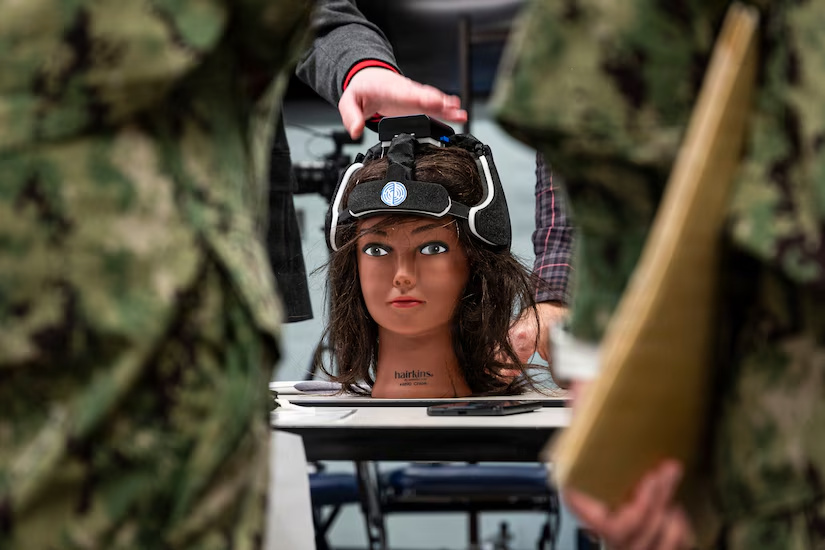
A Defense Health Agency medical development team is working on a new field assessment program that could transform how traumatic brain injuries are detected and treated near the battlefield.
The effort is designed to give frontline medical providers faster, more objective tools for spotting brain injuries before casualties are moved to higher levels of care.
Why Traumatic Brain Injury Is a Major Military Concern
Traumatic brain injury remains one of the most serious health issues facing service members.
Since 2000, more than 505,000 traumatic brain injuries have been reported across the War Department, ranging from mild cases to severe trauma.
Many of these injuries do not show obvious outward symptoms, which makes early detection especially difficult in field conditions.
That hidden nature is what makes the problem so dangerous. Internal injuries such as intracranial hemorrhage, subdural hematomas, or other nonvisible brain damage can have serious short- and long-term effects if they are not identified quickly and treated properly.
The Program Aims to Bring Objective Testing Closer to the Point of Injury
The Traumatic Brain Injury Field Assessment Program is being developed to simplify a process that has often been difficult, subjective, and resource-heavy.
According to the program team, current field assessment options often rely on checklist-style cognitive evaluations, while more definitive tools such as MRI or CT scans are usually only available at advanced medical facilities.
That gap creates a major challenge. If a casualty has to be transported before providers know whether a serious brain injury is present, commanders may lose time, personnel, and evacuation resources without having objective information to guide the decision.
Portable Hemorrhage Detection Is Central to the Plan
One of the main components of the program is a portable brain hemorrhage detection device.
The planned system is expected to be lightweight, durable, and suitable for field use.
It would rely on noninvasive technologies, including options such as radiofrequency or near-infrared methods, to assess casualties for possible intracranial hemorrhage.
The goal is to give medics and other frontline providers the ability to detect possible internal brain bleeding quickly, without having to wait for access to hospital-based imaging.
Digital Cognitive Assessments Will Support Frontline Decisions
The program also includes a software component built for tablets or phones.




These applications would provide digital cognitive assessments that medics, corpsmen, and medical officers could use in the field.
The aim is to move beyond purely subjective evaluations and deliver accurate, objective data within minutes.
By combining hemorrhage detection with cognitive testing, the system could help providers make more confident decisions about whether a service member needs evacuation, further monitoring, or possible return to duty.
End-User Feedback Is Shaping the Technology
The Defense Health Agency’s Operational Medical Systems Program Management Office is engaging with military medical providers, industry partners, academic experts, and stakeholders across the War Department to refine the program.
These conversations are designed to make sure the tools actually fit the needs of medics and clinical teams who would use them in demanding environments.
That feedback is especially important because battlefield medicine is different from hospital medicine. Equipment has to be rugged, fast, easy to use, and useful under pressure.
Program Leaders Say the Tool Could Preserve Combat Power
Damien Hoffman, a product manager working on warfighter readiness, performance, and brain health, said the program is meant to support proper care for casualties while also helping keep warfighters in the fight and returning recovered personnel to duty more quickly.
In practical terms, the system could help commanders and medical teams manage scarce assets such as evacuation platforms, medical personnel, and treatment capacity during large-scale combat operations.
Impact and Consequences
If successful, this program could significantly change the way brain injuries are handled in combat and other operational settings.
Faster, field-based assessment could help medics identify which casualties need urgent evacuation and which can be safely monitored closer to the point of injury.
That could save time, reduce unnecessary evacuations, and improve outcomes for service members with hidden brain injuries.
The program could also reduce reliance on subjective judgment in chaotic environments.
Instead of depending mainly on checklists or waiting for access to advanced imaging, frontline providers would have additional data to support decisions. For military operations, that means better care and smarter use of limited resources.
What’s next?
The program is still being refined through collaboration with military users, industry partners, and academic experts.
The next step is continued development and evaluation of field-ready tools, including possible hardened versions of commercial technologies adapted for military environments.
Once fully developed, the technology is expected to be delivered to medics, medical officers, commanders, and other frontline users.
The demand across the services is already described as significant, so the pressure will be on to move quickly while still making sure the tools are reliable, accurate, and practical in real-world conditions.
Summary
The Defense Health Agency is advancing a Traumatic Brain Injury Field Assessment Program designed to help military medical teams detect brain injuries faster and closer to the point of injury.
The program combines portable hemorrhage detection with tablet- or phone-based cognitive assessment tools, giving medics more objective information within minutes.
With more than 505,000 traumatic brain injuries reported since 2000, military leaders see the technology as a potential breakthrough for battlefield care, evacuation decisions, and warfighter readiness.
Bulleted Takeaways:
- The Defense Health Agency is developing a field program to improve traumatic brain injury assessment.
- More than 505,000 traumatic brain injuries have been reported across the War Department since 2000.
- Many brain injuries do not show obvious outward symptoms.
- The program includes a portable hemorrhage detection device.
- The device may use noninvasive technologies such as radiofrequency or near-infrared methods.
- Tablet- or phone-based cognitive assessment apps are also part of the program.
- The tools are meant to provide objective data within minutes.
- Current options often rely on checklist assessments or advanced imaging such as MRI and CT scans.
- The program could help medics decide when evacuation is truly needed.
- Officials say the system could improve casualty care while preserving medical and operational resources.
