
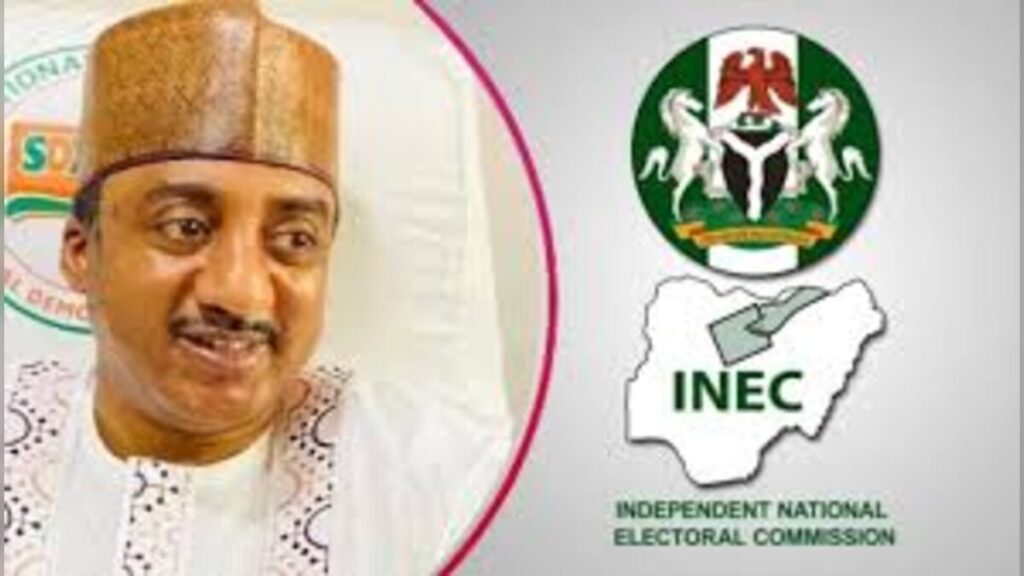
A new storm has hit Nigeria’s political space after the Independent National Electoral Commission officially listed the Shehu Gabam-led leadership of the Social Democratic Party on its website.
What looked like a routine administrative update quickly turned into a heated internal crisis within the party.
For many observers, it wasn’t just a name update—it was a signal that the long-running leadership battle inside the party had tilted in a new direction, with legal backing now playing a central role.
The Names That Changed Everything
On INEC’s updated portal, Shehu Gabam was clearly listed as National Chairman of the Social Democratic Party, alongside Olu Agunloye as National Secretary.
Other key figures such as Hajia Maggie Mariam and Aderemi Abimbola were also displayed as part of the National Working Committee.
What caught attention, however, was a bold note placed beside the list: “By Court Order.” That small phrase became the centre of a much bigger political argument.
Court Ruling Behind the Decision
INEC’s position is tied to a recent judgment from the Court of Appeal in Abuja.
In a case marked CA/ABJ/CV/126/2026, the appellate court delivered a ruling on March 27, 2026, that reshaped the party’s leadership narrative.
The judgment stemmed from a dispute filed by party member Fayemi Babatunde, challenging the legitimacy of earlier leadership decisions and internal primaries.
The court partially upheld the appeal, effectively invalidating some earlier declarations about the party structure.
While the ruling did not settle every issue, it created enough legal ground for INEC to adjust its records.
SDP Pushes Back Hard
But inside the party, the reaction was anything but calm.
The Social Democratic Party leadership immediately rejected INEC’s recognition of Gabam, calling it unconstitutional and an intrusion into internal party affairs.
Party spokesperson Rufus Aiyenigba accused the electoral body of overstepping its boundaries and insisted that no valid court order had been formally served on the party.
He also argued that INEC had effectively replaced a duly elected chairman with someone no longer recognised by the party structure.




Accusations of Foul Play and Internal Tension
The SDP didn’t stop at rejection—it raised deeper concerns.
According to Aiyenigba, the decision reflects what he described as “back-door dealings” and manipulation of party structures.
He maintained that Gabam had already been removed from the party and therefore could not legally assume any leadership role.
The party insists its internal executive structure remains largely intact, aside from a few minor changes.
The dispute has now widened into a full-blown legitimacy battle, with both sides claiming legal and moral authority.
The Legal Twist That Complicated Everything
Interestingly, the Federal High Court in Abuja had earlier upheld a different position, recognising another leadership arrangement led by Prof. Sadiq Gombe.
But that ruling was later challenged and partially overturned on appeal.
The appellate court ruled that the lower court lacked jurisdiction to make certain declarations, effectively resetting parts of the case.
It also relied on INEC’s monitoring report confirming that the disputed primary election produced a valid winner.
This legal back-and-forth has left the party in a complicated middle ground where no single interpretation is fully settled.
Why This Matters Beyond One Party
Party leadership disputes are not new in Nigeria’s political system, but they often have wider consequences.
Control of a party structure determines who can field candidates, sign nomination forms, and influence elections.
That means this isn’t just about names on a website—it directly affects electoral strategy, internal democracy, and future political alignments within the Social Democratic Party.
Impact and Consequences
The immediate impact is deeper fragmentation inside the SDP, with competing factions now openly questioning legitimacy.
This could weaken the party’s ability to present a united front ahead of future elections.
For INEC, the controversy adds pressure to justify how court orders are interpreted and applied in politically sensitive disputes.
Any perception of bias or inconsistency could trigger broader trust issues in electoral administration.
There is also a risk that prolonged internal conflict may reduce the party’s electoral competitiveness and push members toward rival platforms.
What’s Next?
Several key developments are expected in the coming weeks:
- Possible further legal filings challenging INEC’s recognition
- Internal reconciliation attempts within the SDP structure
- Additional court clarification on leadership legitimacy
- Increased scrutiny of how INEC implements court rulings
The situation may ultimately return to the judiciary for final interpretation if political negotiations fail.
Summary
INEC’s recognition of Shehu Gabam as SDP National Chairman has triggered a fresh leadership crisis within the Social Democratic Party.
While the decision is backed by a court of appeal ruling, the party strongly disputes it, claiming unconstitutional interference.
With conflicting legal interpretations and internal resistance, the dispute remains unresolved and highly volatile.
Bulleted Takeaways
- Independent National Electoral Commission updated SDP leadership records citing a court order
- Shehu Gabam listed as National Chairman of the Social Democratic Party
- Party strongly rejects INEC’s action, calling it unconstitutional
- Dispute linked to Court of Appeal ruling in case CA/ABJ/CV/126/2026
- Federal High Court earlier gave a conflicting ruling before appeal reversal
- SDP accuses INEC of interference and internal manipulation claims
- Leadership crisis deepens internal divisions within the party
- Outcome could affect future elections and candidate nominations
- Further court action and political negotiations are expected

