
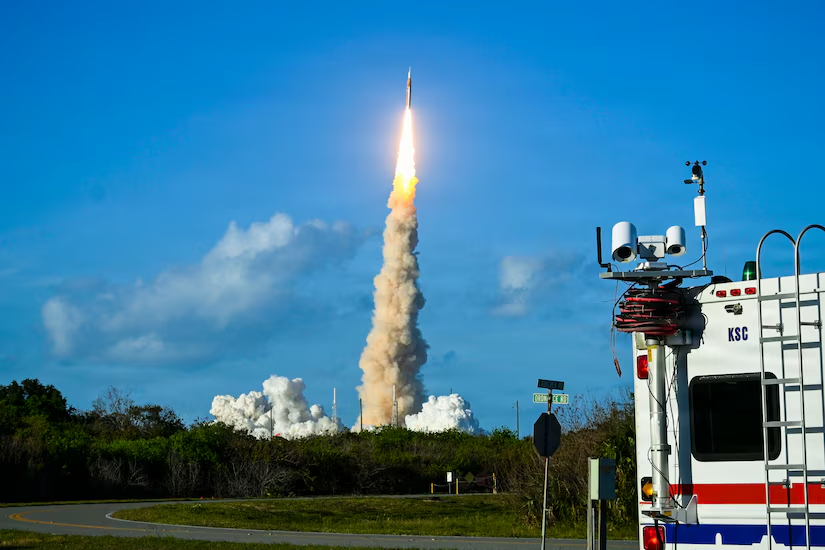
The Armed Forces Medical Examiner System is playing a quiet but important role in NASA’s Artemis II mission, helping prepare for the kind of emergency no one wants to see.
Human spaceflight involves enormous planning, and while most attention goes to the rocket, astronauts, and launch countdown, there are also teams preparing for worst-case scenarios behind the scenes.
For Artemis II, that includes AFMES personnel who support contingency planning, triage operations, and forensic response preparations for crewed launch days.
Why AFMES Is Involved in Human Spaceflight
AFMES is the federal government’s only medicolegal death investigation system. Because of that role, it can provide specialized support to other federal agencies, including NASA.
According to AFMES medicolegal death investigator Kate Grosso, the agency has a memorandum of understanding with NASA.
That agreement means AFMES must maintain a plan and trained personnel who can respond during contingency operations and provide forensic pathology services if needed.
Artemis II Brings Extra Historical Weight
Artemis II is not just another NASA mission. It is expected to be NASA’s first crewed flight beyond low Earth orbit since 1972. That makes the mission a major milestone in America’s return to deep-space human exploration.
Because the stakes are so high, support teams must be ready for every possible outcome.
AFMES personnel are part of that readiness effort, providing technical expertise as launch day approaches and joining triage teams alongside other medical responders.
AFMES Joins Launch-Day Medical and Emergency Teams
On crewed launch days, AFMES investigators work with a wide range of support personnel. These include NASA medical officers, Kennedy Space Center medical teams, regional medical units, and other contingency planners.
Their role is not to take center stage, but to help ensure that emergency plans are realistic and complete.
They advise on what a medicolegal response would involve, including casualty triage, fatality management, recovery response, decontamination, and hazardous-material concerns.
Training Happens Right Before Launch
One of the striking parts of the process is how much preparation happens on the same day as the launch.
AFMES and its partners conduct just-in-time training before liftoff to refresh everyone’s roles and responsibilities in the immediate launch environment.
A launch medical readiness briefing is also held with all support partners.
That briefing lays out the timeline, triage site locations, expected activities, and emergency procedures.
Grosso noted that some of this can happen around seven hours before launch, meaning launch days can stretch beyond 12 hours if there is a delay or scrub.
Work Continues Even After a Successful Launch
Even when everything goes smoothly, the job is not over. After a successful launch, support teams conduct post-launch training exercises to keep their skills sharp.

Those exercises involve walking through what would happen in a real contingency, breaking down the response process, and making sure every agency understands its role.
In a field where emergencies are rare but consequences can be enormous, that kind of repetition matters.
Jurisdiction Is One of the Biggest Challenges
One of the most complicated issues for AFMES is jurisdiction. A launch from Kennedy Space Center does not stay local for long. As Grosso explained, an ascent track can stretch from Florida toward Ireland within minutes.
That means emergency planning may involve the entire U.S. East Coast and even foreign partners.
AFMES must think through which agencies could be involved, what authority each one has, and how a response would work if an incident crossed multiple jurisdictions.
Columbia Disaster Still Shapes Planning
The 2003 Space Shuttle Columbia disaster remains an important example of why this preparation matters.
That tragedy produced one of the largest debris fields in mishap investigation history, stretching across Texas and Louisiana and covering nearly 2,000 square miles.
AFMES took primary authority for the cases after the investigation was federalized, and pre-existing relationships with local, state, and federal partners helped support the recovery of roughly 82,000 pieces of debris and the identification of all seven crew members.
Specialized Experience Makes AFMES Valuable
AFMES medicolegal death investigators are certified by the American Board of Medicolegal Death Investigation.
They also bring experience in aviation mishap investigations and mass fatality management, both of which are relevant to crewed spaceflight contingency planning.
Grosso said AFMES is especially well positioned because of its authority in aerospace pathology and mishap response. Spaceflight incidents are rare, complex, and unlike routine investigations, meaning every possible scenario requires careful planning.
AFMES Hopes Its Services Are Never Needed
Despite all the preparation, AFMES personnel are clear about one thing: success means they are not called into action.
Grosso described the emotional contrast of the work. She understands the responsibility and seriousness of her role, but she also said she is grateful every time a launch succeeds and AFMES can walk away without being needed.
For her, watching years of work lead to a safe launch is powerful precisely because it means the contingency plan stayed only a plan.
Impact and Consequences
AFMES support gives NASA an added layer of emergency readiness for crewed missions.
While the public usually sees the launch, the countdown, and the astronauts, agencies behind the scenes are preparing for medical, legal, forensic, and recovery challenges that could arise if something goes wrong.
The involvement of AFMES also shows how complex modern human spaceflight has become.
A mission like Artemis II is not only a science and engineering project.
It is also a national operation involving medical teams, emergency responders, federal investigators, local authorities, and sometimes international partners.
If a contingency ever occurred, the planning done before launch could shape how quickly agencies respond, how families receive answers, how evidence is preserved, and how future missions learn from the event.
What’s next?
As Artemis II moves forward, AFMES will continue supporting launch-day readiness through planning, training, and coordination with NASA and Kennedy Space Center partners.
The agency will also remain prepared for future crewed missions as NASA pushes deeper into human space exploration.
As missions become more ambitious, contingency planning will likely become even more important, especially when astronauts travel farther from Earth and response options become more complex.
Summary
The Armed Forces Medical Examiner System is supporting NASA’s Artemis II mission by helping prepare for possible launch-day contingencies.
Through an agreement with NASA, AFMES provides medicolegal expertise, triage support, forensic planning, and coordination with other emergency teams.
Its work is shaped by lessons from past spaceflight disasters, especially Columbia, and by the unique jurisdictional challenges that come with crewed launches.
The goal is simple: be ready for the worst, while hoping the team is never needed.
Bulleted Takeaways:
- AFMES is supporting contingency planning for NASA’s Artemis II mission.
- Artemis II is NASA’s first crewed mission beyond low Earth orbit since 1972.
- AFMES has a memorandum of understanding with NASA.
- The agency provides medicolegal death investigation and forensic pathology support if needed.
- AFMES joins triage and emergency planning teams on crewed launch days.
- Launch-day preparation includes just-in-time training and medical readiness briefings.
- Jurisdiction is a major challenge because launch paths can quickly cross states and even international areas.
- The Columbia disaster remains a key example of why recovery and investigation planning matter.
- AFMES investigators bring expertise in aerospace pathology, aviation mishaps, and mass fatality management.
- Officials say the best outcome is a successful launch where AFMES never has to activate its emergency role.
