
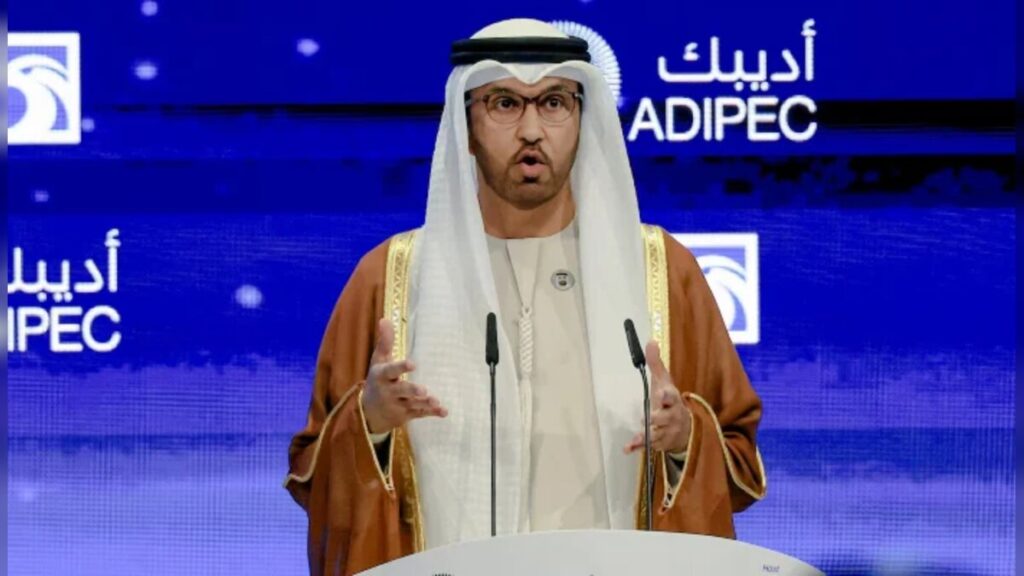
When news broke that the OPEC structure was being left by the United Arab Emirates, it immediately sent ripples through global energy markets.
The decision wasn’t framed as a confrontation, but it still landed like a shock—especially given how closely the UAE has worked within the oil alliance for decades.
What makes it more striking is that this move didn’t come with loud political messaging.
Instead, officials are describing it as a strategic realignment, not a break with allies.
“Not Directed at Anyone” — UAE Tries to Cool the Temperature
At the center of the explanation is Sultan Al Jaber, who wears multiple hats as both head of the state oil giant ADNOC and UAE minister for industry and advanced technology.
He was careful in his wording, stressing that the exit is not aimed at any specific country, even as tensions have reportedly been building behind the scenes for months.
According to him, the focus is purely domestic—energy strategy, industrial growth, and long-term economic planning.
It’s a diplomatic way of saying: this is about us, not you.
Years of Quiet Friction Behind the Scenes
While the official tone is calm, the backdrop is anything but.
Relations within Gulf oil politics have been under pressure, particularly between the UAE and Saudi Arabia, the region’s dominant producer and leading voice in OPEC decisions.
Disagreements have reportedly simmered over oil production quotas, regional foreign policy, and broader Middle East conflicts.
At times, cooperation has looked more like controlled rivalry than alignment.
Some analysts say the strain has been building since late last year, when Gulf unity was tested by disagreements over Yemen and production strategy.
Why Oil Quotas Became a Flashpoint
One of the key frustrations for the UAE has been production limits.



Within OPEC, output is coordinated to stabilize global prices, but member states often feel restricted by assigned quotas.
The UAE, for example, has long argued that its production ceiling—around 3.4 million barrels per day—doesn’t reflect its real capacity or ambitions.
Now, with the exit, Abu Dhabi appears more focused on scaling up toward a target of 5 million barrels per day by 2027.
A Bigger Economic Strategy Beneath the Headlines
This isn’t just about oil barrels. The UAE has been steadily shifting its economic model toward diversification—pushing heavily into AI, advanced manufacturing, logistics, and technology sectors.
Officials say additional oil revenue will help fund that transition.
One recent commitment alone saw ADNOC outline a $55 billion investment plan over the next two years, signalling long-term expansion rather than contraction.
The idea is simple: use traditional energy strength to build a post-oil economy faster.
Market Power and Global Implications
Leaving OPEC is not a small move. The UAE was one of the group’s largest producers, and its departure changes the internal balance of influence inside the cartel.
Even though OPEC is designed to coordinate output rather than enforce strict control, losing a major producer weakens its ability to manage global supply as a unified bloc.
This could have ripple effects on oil pricing strategies and production coordination worldwide.
Impact and Consequences
The immediate consequence is political and economic uncertainty within global oil markets.
Traders and governments alike will be watching how production decisions shift now that the UAE has more independence.
Regionally, the move could deepen strategic divergence between Gulf states, especially if Saudi Arabia and the UAE continue to disagree on output and energy policy direction.
Economically, however, the UAE gains flexibility.
It can now pursue aggressive production targets without needing consensus from a wider group.
What’s Next?
The key question now is whether this signals a broader reshaping of global energy alliances or simply a restructuring of one major producer’s strategy.
In the short term, the UAE is expected to continue expanding production capacity while accelerating investment into non-oil sectors.
For OPEC, the challenge will be maintaining cohesion and influence without one of its top producers.
Summary
The UAE’s exit from OPEC marks a major shift in global energy politics, framed officially as a sovereign economic decision rather than a political break.
While tensions with Saudi Arabia and quota disagreements form part of the backdrop, UAE leadership insists the move is about national growth, industrial expansion, and long-term strategic independence.
Bulleted Takeaways
- UAE exits OPEC in major energy policy shift
- Decision described as non-hostile by UAE minister Sultan Al Jaber
- Move linked to national economic strategy and industrial expansion
- Longstanding tensions with Saudi Arabia over oil quotas and policy
- UAE aims to increase production capacity to 5 million barrels per day by 2027
- ADNOC plans $55 billion investment over next two years
- Exit weakens OPEC’s influence as UAE was a major producer
- UAE shifting focus toward AI, tech, and diversified economy
- Global oil markets may face increased volatility and uncertainty
- Step reflects broader realignment of Gulf economic and energy strategy

