
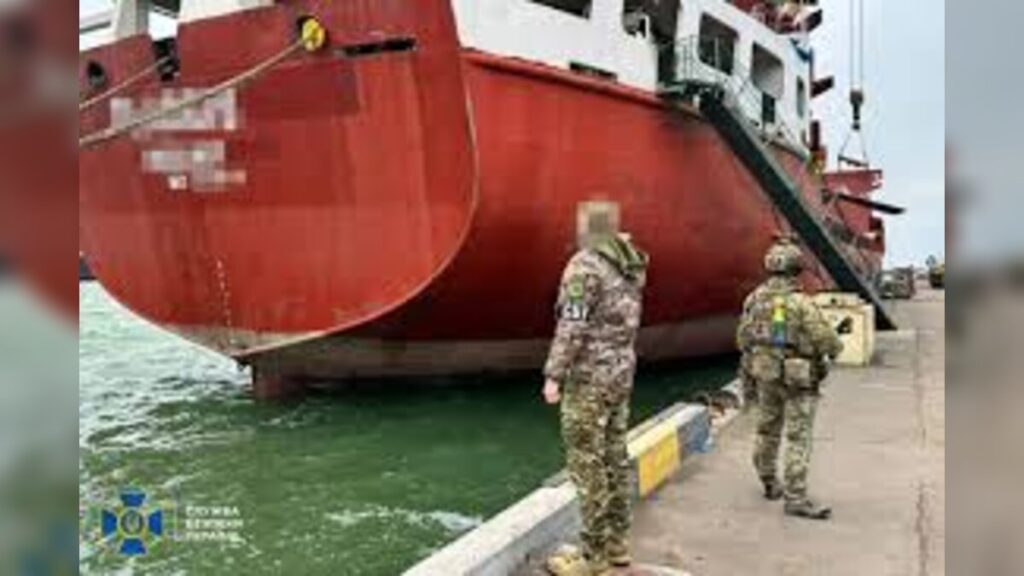
A maritime inspection off the Swedish coast has taken a sharper turn after authorities confirmed the arrest of a Chinese ship captain linked to a vessel suspected of operating within Russia’s so-called “shadow fleet.”
The incident centres on the 182-metre cargo ship Jin Hui, which Swedish authorities boarded over the weekend amid concerns about its identity, documentation, and possible links to sanctions evasion networks at sea.
What began as a routine enforcement check has now become a full criminal investigation.
Why Swedish Authorities Stopped the Vessel
The operation was carried out by Sweden’s coast guard after suspicions grew that the ship may have been sailing under a false Syrian flag.
Officials believe the vessel could be part of a wider maritime network often described by Western governments as Russia’s “shadow fleet”—a group of ships allegedly used to bypass international sanctions.
These vessels are typically old, difficult to trace in terms of ownership, and sometimes operate with questionable insurance coverage, raising concerns about safety and environmental risk in busy shipping lanes.
Arrest of the Captain Raises Legal Stakes
Swedish prosecutors confirmed that the ship’s captain, a Chinese national, was detained on suspicion of using falsified documents and violating maritime safety regulations.
Authorities say the charges also include concerns about seaworthiness, suggesting the vessel may not have met required operational standards for safe navigation.
The prosecution service indicated that questioning of the captain would continue while coordination with international authorities was underway, signalling that the case may extend beyond Sweden’s borders.
Sanctions Pressure and the Shadow Fleet Question
The Jin Hui is reportedly already listed under sanctions frameworks in the European Union, the United Kingdom, and Ukraine.
That detail has intensified scrutiny, as it places the vessel within a broader geopolitical effort to restrict maritime trade routes believed to support sanctioned Russian economic activity.



The concept of a “shadow fleet” has become increasingly prominent since sanctions were imposed following Russia’s full-scale invasion of Ukraine, with enforcement agencies warning that such fleets can blur ownership, routing, and cargo transparency.
Maritime Safety Concerns Add Another Layer
Beyond sanctions enforcement, there are growing concerns about safety at sea.
Many of these vessels are ageing, and experts have warned that unclear insurance arrangements and poor maintenance could increase the risk of maritime accidents or environmental disasters.
Sweden’s recent actions suggest a more proactive approach to inspecting and detaining vessels that appear irregular, especially in strategically sensitive waters in Northern Europe.
A Pattern of Increased Naval Enforcement
This is not an isolated case. Swedish authorities have carried out several similar boardings in recent months as European countries step up monitoring of shipping activity in the Baltic Sea.
The region has become more strategically important in recent years, with heightened NATO presence and increased attention to energy routes, shipping security, and potential sanctions evasion by sea.
Impact and Consequences
The arrest could have diplomatic implications, particularly given the involvement of a Chinese national and a vessel linked to broader geopolitical tensions.
For Sweden and its partners, the case reinforces a tougher stance on maritime enforcement and sanctions compliance, especially in Northern European waters.
It also signals increased risk for shipping operators suspected of opaque ownership structures, as inspections and detentions become more frequent and more aggressive.
On a broader scale, the incident highlights how maritime law enforcement is increasingly being used as a tool in global geopolitical disputes.
What’s Next?
The immediate next step will be formal interrogation of the detained captain and a deeper investigation into the ship’s documentation, ownership structure, and voyage history.
Swedish authorities are also expected to coordinate with international partners to determine whether further legal or sanctions-related action is necessary.
If the vessel is confirmed to be part of a sanctions-evasion network, it could be seized, fined, or barred from future operations in European waters.
More broadly, increased inspections of suspicious vessels in the Baltic and North Sea regions are likely to continue.
Summary
Swedish authorities have arrested the captain of a Chinese-operated vessel suspected of links to Russia’s “shadow fleet” after boarding the ship Jin Hui over concerns about false documentation and maritime safety violations.
The case is now under investigation, with potential implications extending beyond Sweden due to international sanctions and geopolitical sensitivities.
Bulleted Takeaways
- Sweden’s coast guard boarded the 182-metre vessel Jin Hui over suspected irregularities
- The ship is believed to be linked to Russia’s “shadow fleet” used to evade sanctions
- The captain, a Chinese national, was arrested for alleged forged documents and safety violations
- Authorities also raised concerns about seaworthiness and maritime compliance
- The vessel is listed under EU, UK, and Ukrainian sanctions
- “Shadow fleet” ships are often older, poorly insured, and difficult to trace
- Sweden has increased maritime inspections in the Baltic Sea region
- The case may involve coordination with multiple international authorities
- The arrest could have diplomatic and geopolitical consequences
- Enforcement actions against suspected sanction-evading ships are likely to continue increasing

