
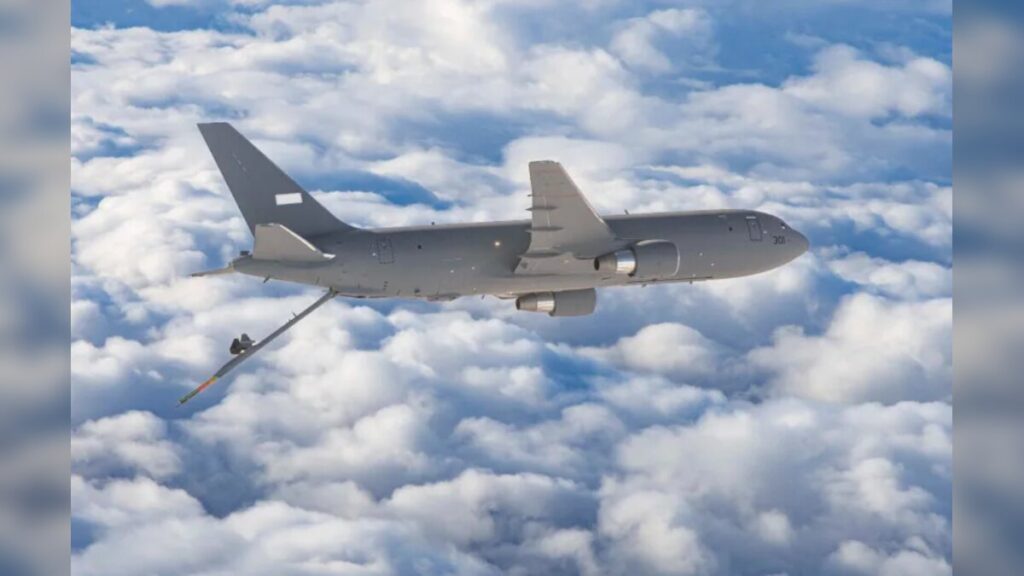
A significant development is unfolding behind the scenes of global military aviation: the United States is preparing to deliver the first of at least six KC-46 aerial refuelling aircraft to Israel, a move that could reshape long-range operational capability in the Middle East.
The announcement came from Israel’s Defence Ministry, confirming that the first aircraft has already completed its maiden test flight in the United States.
Delivery is expected within about a month, marking a key milestone in a long-delayed procurement process tied to Israel’s broader military modernisation effort.
These aircraft are not just upgrades — they represent a structural shift in how far and how independently Israel can project air power.
“Gideon” Takes Flight as Israel Expands Its Reach
The incoming aircraft, known locally as “Gideon,” is based on the Boeing KC-46 Pegasus platform, a next-generation refuelling tanker designed to support long-range air operations.
With this capability, Israeli fighter jets such as the F-35, F-16, and F-15 will be able to extend their range significantly, allowing them to operate far beyond their current limits.
Geographically, this matters more than it sounds on paper.
Iran lies roughly 1,500 to 2,000 kilometres away from Israel depending on the target zone, while Yemen is also well beyond typical strike range.
Without aerial refuelling, sustained operations in these areas become extremely limited or even impossible.
Why Aerial Refuelling Changes the Military Equation
Israel has long relied on a smaller and more restricted fleet of refuelling aircraft, but operational demands have grown faster than capacity.
The KC-46 changes that equation by allowing multiple aircraft to be refuelled mid-air during long missions.
Military officials describe it as a “mobile fuel hub” in the sky — one that can support extended air operations, reduce mission constraints, and improve endurance during combat or surveillance missions.
There is also a strategic layer here.
Even when diplomatic relationships shift, especially with Washington, having independent refuelling capability means Israel is less constrained by external approval for long-distance operations.




Inside the Capability Boost
According to technical assessments shared during defence briefings, each KC-46 can carry massive fuel loads and support a range of aircraft types.
In operational terms, a single tanker can service multiple jets on a single mission cycle depending on planning and fuel allocation.
The aircraft itself is also designed for long endurance flights, staying airborne for well over half a day under certain conditions, especially when supported by additional refuelling.
Beyond combat roles, it can also transport troops and perform medical evacuation missions, adding logistical flexibility during crises.
A Long Procurement Journey With Global Competition
This delivery did not happen overnight.
Israel’s procurement process faced delays that allowed other countries, including Japan and Italy, to move ahead in receiving similar aircraft.
Originally, earlier delivery windows were possible, but shifting defence budgets and procurement timelines pushed the schedule into 2026.
The programme is part of a wider defence expansion strategy tied to a long-term investment plan reportedly worth hundreds of billions of shekels, which also includes new fighter jets like upgraded F-15 variants and additional F-35 aircraft.
Strategic Context: Iran, Yemen, and Long-Range Planning
The central driver behind this acquisition is long-range operational independence.
Israel’s military planning has consistently factored in scenarios involving Iran and allied regional groups, including the Houthis in Yemen.
While past operations have involved varying degrees of external support, defence planners continue to assume that future missions may need to be conducted with limited or no allied assistance.
This is where aerial refuelling becomes decisive — it determines whether missions are short, limited strikes or extended, multi-phase operations.
Impact and Consequences
The arrival of the KC-46 fleet could reshape regional military dynamics in several ways:
- Significantly expands Israel’s long-range strike capability
- Reduces reliance on external logistical support
- Increases flexibility for multi-theatre operations
- Strengthens deterrence against distant adversaries
- Raises strategic concerns among regional rivals
At the same time, it may also heighten geopolitical tension, as improved reach often changes how adversaries interpret military intent.
What’s Next?
The next step is phased delivery and integration into Israeli Air Force operations.
This includes:
- Full induction of the first KC-46 unit into service
- Installation of Israeli-specific communication and defence systems
- Pilot training and mission simulation exercises
- Gradual scaling up to the full fleet of at least six aircraft
Over time, the aircraft are expected to become a core part of long-range operational planning rather than a supplementary asset.
Summary
Israel is nearing the delivery of its first KC-46 aerial refuelling aircraft from the United States, marking a major step in expanding its long-distance military capabilities.
The aircraft will allow Israeli fighter jets to operate farther, longer, and with greater independence, particularly in relation to regional hotspots like Iran and Yemen.
While the immediate urgency of such capability has eased slightly due to recent operational developments, long-term strategic planning continues to drive the programme forward.
Bulleted Takeaways
- Israel is set to receive its first Boeing KC-46 Pegasus within weeks
- At least six tanker aircraft are planned for delivery
- The aircraft will be locally designated “Gideon”
- It significantly extends range for Israeli fighter jets
- Key targets of strategic concern include Iran and Yemen
- Each tanker can support multiple aircraft during missions
- The programme is part of a broader multi-billion defence expansion
- Delays allowed other countries to receive similar aircraft earlier
- Integration will include Israeli systems and operational upgrades
- The shift increases Israel’s long-term independence in air operations

