
Long before CCTV and digital databases, crime records looked very different.
In Edwardian Britain, police relied on early photography to document offenders, creating haunting mugshots that still exist more than a century later.
Now preserved in archives held by North East Museums, these images show a mix of petty thieves, hardened criminals, and migrants who arrived in the UK through ports like Newcastle—many hoping for work, some ending up on the wrong side of the law.
What makes the collection so striking isn’t just the crimes—it’s the human faces behind them, frozen in time with their court records still attached.
When Migration and Survival Collided With Law
A number of those photographed were foreign sailors and workers who came to Britain seeking opportunity. Newcastle, in particular, was a busy industrial port, attracting migrants from across Europe and beyond.
But life in Edwardian port cities wasn’t easy. Harsh working conditions, low wages, and unstable employment often pushed people into desperation.
For some, that desperation led to theft, fraud, or violence.
Historical records from the time show that courts frequently treated foreign offenders harshly, often linking nationality with criminal behaviour in ways that reflect the attitudes of the era rather than objective reality.
A Murder That Shocked Newcastle
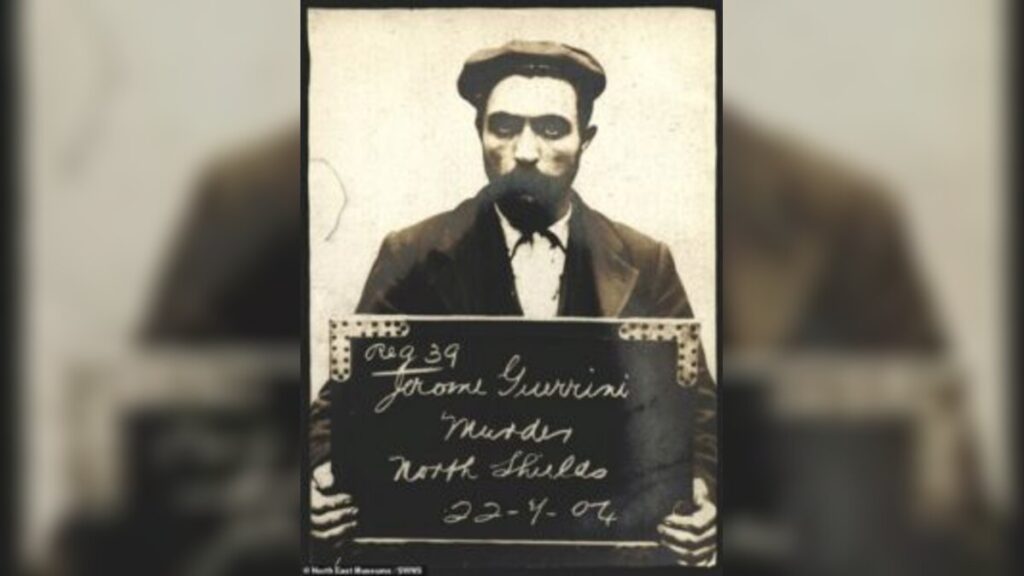
One of the most chilling cases in the archive is that of Corsican-born Jerome Guerrini.
A former fireman working as a labourer in Newcastle, he became involved in a violent altercation in July 1904.
The incident escalated quickly after a confrontation with local residents, ending with the fatal stabbing of Patrick Gillighan.
Court testimony described how the victim staggered away before collapsing, declaring he had been stabbed.
Guerrini was convicted of murder, and the case became one of several used at the time to reinforce strict views on violent crime among migrant workers.
Ice Cream Seller, Stolen Pony, and a Bitter Courtroom
Another striking figure is Italian migrant Andrea Laudano, an ice cream seller arrested in 1904 for stealing a pony from his employer.
His mugshot shows him almost theatrically dressed, holding his identification board while wearing a patterned suit and hat.
But the story behind it was far less playful.
Court records revealed he stole the pony after being dismissed from his job, later selling it for a fraction of its value.




The judge sentenced him to 15 years, reportedly linking his behaviour to cultural stereotypes about violence and temperament.
Repeat Offenders and Harsh Sentences
Not all cases were as dramatic, but many show repeated cycles of petty crime and punishment.
Lucio Pelliza, another Italian migrant, was convicted in 1906 of burglary and theft, including jewellery and cash taken from a home in North Shields.
He had prior convictions and was sentenced to hard labour.
Swedish national Bernard Anderson was jailed for “indecent conduct” in 1905, while Chilean seaman Daniel Lagarieta received a short sentence for pickpocketing a watch from a dock worker.
These cases reflect how tightly controlled working-class and migrant life was in port cities at the time.
Life on the Docks: Opportunity and Temptation
The docks were central to many of these stories.
Sailors from Finland, Greece, Norway, and Italy passed through constantly, working on ships or staying in boarding houses near the Tyne.
Some, like Finnish-born John Renstrom, were caught stealing clothing from ships.
Others, like Greek sailor Manolis Cammins, were convicted of breaking into lodgings and taking garments.
Even minor thefts were treated seriously, often resulting in imprisonment with hard labour.
The Mugshots That Still Speak Today
What makes these records so compelling is how modern they feel despite their age.
The photographs—stern faces, handwritten labels, and numbered boards—resemble early versions of today’s criminal databases.
They also reflect the beginnings of forensic identification systems that would later evolve into fingerprinting and national police records used across the UK.
For historians, they offer more than crime stories—they reveal migration patterns, labour conditions, and social attitudes of the early 20th century.
Impact and Consequences
These archives highlight how crime reporting and policing have evolved over time.
In Edwardian Britain, nationality and occupation often shaped how justice was applied, especially for migrants in industrial cities.
They also show how early policing systems began to formalise identity tracking, laying groundwork for modern criminal databases.
At the same time, they raise uncomfortable questions about bias, punishment, and how immigrant communities were treated under the law.
What’s Next?
Interest in historical crime archives continues to grow, especially as museums digitise collections for public access.
More of these mugshots and court records are expected to become available online, allowing researchers and the public to explore them in greater detail.
There is also increasing academic focus on re-examining these cases through a modern lens—separating crime facts from the cultural prejudice of the time.
Summary
A collection of Edwardian-era mugshots from North East England reveals the lives of migrant offenders, local criminals, and port workers caught up in crime over a century ago.
Preserved by North East Museums, these records offer insight into early policing, migration, and social attitudes in industrial Britain.
Bulleted Takeaways
- Edwardian mugshots preserved by North East Museums show early crime documentation
- Many offenders were migrants working in Newcastle and other port cities
- Cases include murder, theft, burglary, and petty crime from early 1900s Britain
- Jerome Guerrini convicted of murder after fatal stabbing in 1904
- Andrea Laudano jailed for stealing and selling a pony after job loss
- Lucio Pelliza sentenced for burglary and repeated theft offences
- Finnish, Greek, Norwegian, Swedish, and Chilean sailors appear in records
- Courts often linked nationality with criminal behaviour in sentencing narratives
- Mugshots reflect early development of modern police identification systems
- Archives offer insight into migration, labour, and justice in Edwardian Britain

