
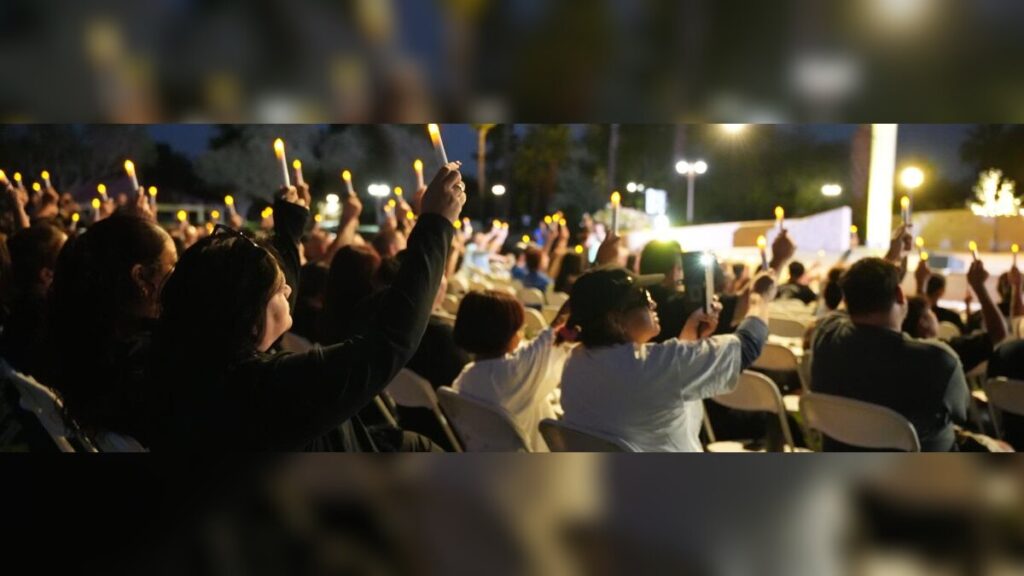
Communities across Riverside County gathered this week to remember victims of violent crime and support the families still carrying the weight of those losses.
The Riverside County District Attorney’s Office hosted two public candlelight vigils, one in Palm Desert on April 21 and another in Riverside on April 23.
At both events, victims’ names were read aloud, candles were lifted in remembrance, and speakers shared personal stories of grief, survival, and strength.
Vigils Mark National Crime Victims’ Rights Week
The gatherings were held as part of National Crime Victims’ Rights Week, which this year carried the theme “Holding Shadow, Choosing Light.”
That theme shaped the tone of the ceremonies. The candles represented both sorrow and hope — a way to acknowledge pain while also pointing toward healing, community support, and the ongoing fight for justice.
District Attorney Says Victims Must Remain at the Center of Justice
Riverside County District Attorney Mike Hestrin said the work of his office is not limited to courtroom accountability.
He said prosecutors and victim advocates must also stand with victims and families throughout the difficult process that follows violent crime.
Hestrin said the vigils help the community recognize lives changed by crime while reminding survivors and grieving families that they are not alone.
Palm Desert Speaker Remembered Her Brother
At the Palm Desert vigil, Melissa Chavez spoke in memory of her brother, who was murdered at a gas station in 2014 while he was on his way to visit his sister.
She described the emotional toll of the criminal justice process, including the pain of hearing the details of the crime more than once after the case was returned on appeal.
Her remarks highlighted how trauma can continue long after the initial loss, especially when families must relive painful evidence in court.
Riverside Speaker Shared Her Fight After Losing Her Son
At the Riverside vigil, Laura Gardhouse spoke about losing her son to gang violence in 2006.




Since then, she has become an advocate for victims’ rights. Her work has included supporting Marsy’s Law, training criminal justice professionals on the needs and rights of victims, and participating in the parole process to speak up for herself and others affected by violent crime.
Healing H[arts] Exhibit Offers Another Space for Reflection
The community was also invited to visit the fifth annual Healing H[arts] exhibit, a traveling art display presented by Stories Told Or Read In Empowering Spaces, also known as S.T.O.R.I.E.S.
The exhibit runs from April 20 through May 22 and uses art to show the resilience of victims and survivors. Through personal creative expression, the display turns painful experiences into messages of strength, remembrance, and empowerment.
The exhibit will appear at different locations across Riverside County, with dates and locations available through the District Attorney’s website and social media pages.
Victim Services Emphasizes Support and Guidance
Melissa Donaldson, director of the Division of Victim Services, said her team considers it a privilege to walk alongside victims and families as they cope with loss.
She said the vigils give families a public place to grieve, honor loved ones, and feel the support of the wider community. For many families, that recognition can be an important part of the long healing process.
Impact and Consequences
The vigils gave victims’ families a visible platform to honor loved ones and speak about the lasting harm caused by violent crime.
These events also reminded the public that the effects of crime do not end with an arrest, conviction, or sentencing. Families often continue to face grief, trauma, court proceedings, appeals, parole hearings, and emotional strain for years.
The broader impact is community awareness.
By bringing survivors, advocates, prosecutors, and residents together, Riverside County is reinforcing the idea that victim support must remain part of the justice system, not an afterthought.
The Healing H[arts] exhibit also expands that message beyond a single night, giving people another way to process loss through art and storytelling.
What’s next?
The Healing H[arts] exhibit will continue traveling across Riverside County through May 22, giving more residents the chance to engage with survivor stories and artwork.
The District Attorney’s Office and its Division of Victim Services are also expected to continue supporting families through the criminal justice process, including court proceedings, advocacy, referrals, and parole-related support when needed.
Summary
Riverside County held candlelight vigils in Palm Desert and Riverside to honor victims of violent crime during National Crime Victims’ Rights Week.
Families, advocates, and community members gathered to read victims’ names, raise candles, and share stories of loss and resilience.
Speakers included Melissa Chavez, who remembered her murdered brother, and Laura Gardhouse, who spoke about losing her son to gang violence and becoming a victims’ rights advocate.
The events were paired with the Healing H[arts] exhibit, which uses art to highlight survivor strength and healing.
Bulleted Takeaways:
- Riverside County held two candlelight vigils for victims of violent crime.
- The vigils took place on April 21 in Palm Desert and April 23 in Riverside.
- The events were hosted by the Riverside County District Attorney’s Office.
- Victims’ names were read aloud during the ceremonies.
- Community members raised candles in tribute.
- The events marked National Crime Victims’ Rights Week.
- This year’s theme was “Holding Shadow, Choosing Light.”
- District Attorney Mike Hestrin said victims’ voices must remain central to justice.
- Melissa Chavez honored her brother, who was murdered in 2014.
- Laura Gardhouse spoke about losing her son to gang violence in 2006.
- Gardhouse has advocated for victims’ rights, including through Marsy’s Law.
- The fifth annual Healing H[arts] exhibit runs from April 20 to May 22.
- The exhibit uses art to highlight survivor resilience and empowerment.
- The Division of Victim Services said the vigils help families grieve publicly and feel community support.
