
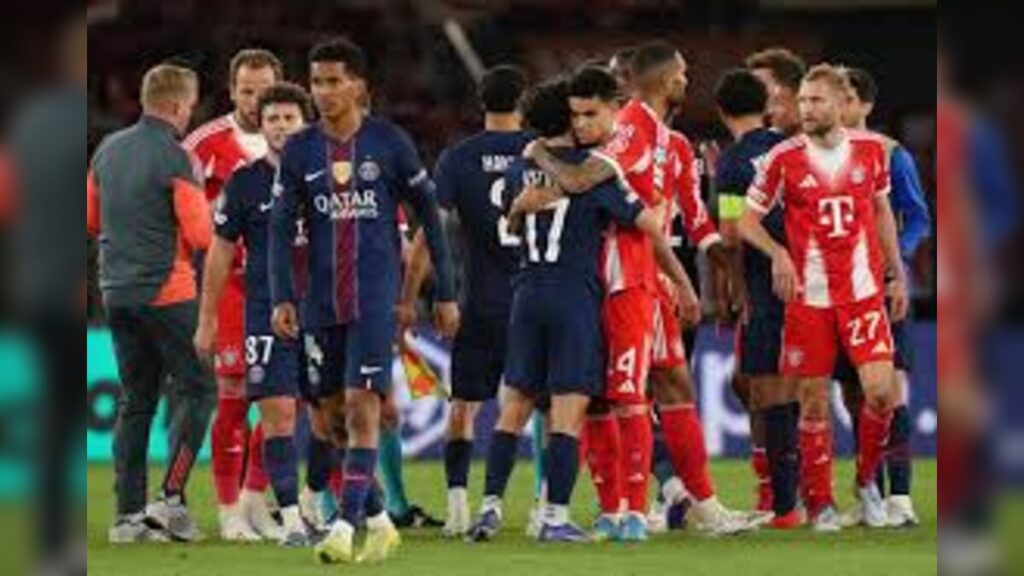
The UEFA Champions League is back under the lights at the Allianz Arena, and this one feels far from settled.
Defending champions Paris Saint-Germain carry a narrow advantage into the second leg, but nothing about this tie feels comfortable for either side.
Across the tunnel stands Bayern Munich, six-time European champions, with their home crowd ready to turn the stadium into something closer to a pressure cooker than a football ground.
The first leg already did most of the talking anyway—a wild, end-to-end 5–4 thriller in Paris that barely felt real at times.
Attack vs Attack: No One Planning to Blink First
If you listen to the players, neither side is interested in slowing things down.
PSG forward Ousmane Dembélé made it clear that there won’t be any tactical retreat.
Both teams, he suggested, are wired to attack, which usually means the game ends up exploding into something chaotic rather than controlled.
That idea was echoed in different tones by Bayern striker Harry Kane, who framed the tie as a matter of timing—whoever takes their chances when they appear will likely survive the night.
It’s not about domination anymore. It’s about moments.
Managers Add Fire Before Kickoff Even Begins
Bayern’s head coach Vincent Kompany didn’t try to downplay the challenge.
He leaned into it, calling the match the kind of occasion players live for, especially in a stadium with Bayern’s history.
He made it clear the tie is still open, but also hinted that home support could be the difference when tension rises.
On the other side, PSG manager Luis Enrique acknowledged the damage from conceding four goals in the first leg, but didn’t sound like someone planning to defend a lead.
Instead, he spoke about scoring again—specifically, needing at least three goals to feel secure.
That alone tells you how unstable this second leg is expected to be.
First Leg Chaos Still Hanging Over the Tie
The opening match in Paris wasn’t just entertaining—it was historically unhinged.



Nine goals, constant swings in momentum, and neither defence really managing to take control for long periods.
PSG edged it 5–4, snapping a long winless run against Bayern in the process.
It also pushed both teams deeper into Champions League record territory, with each side already above 40 goals in the competition this season.
That kind of attacking output is rare even at this level, where knockout matches are usually tighter and more cautious.
Star Power Everywhere You Look
This tie isn’t just about systems—it’s about individuals who can change games in seconds.
PSG’s attacking threat is led by players like Kylian Mbappé, who continues to sit at the top of the scoring charts this season, while Bayern rely heavily on the finishing consistency of Kane and the creative sparks around him.
On PSG’s side, winger Khvicha Kvaratskhelia adds another layer of unpredictability, especially in transition moments where space opens up quickly.
When both teams are already scoring freely, one individual moment can tilt the entire tie.
Leadership Voices on Both Sides Keep Expectation High
PSG captain Marquinhos summed up the feeling in the dressing room: both sides know exactly what kind of match this is going to be—fast, emotional, and unpredictable.
There’s no illusion of control anymore. Just execution under pressure.
And that’s what makes this second leg feel less like a tactical chess match and more like a high-speed exchange where mistakes matter as much as brilliance.
Impact and Consequences
This tie has already reshaped expectations for modern Champions League football.
The sheer number of goals across both legs highlights how attacking systems are now overpowering traditional defensive caution at elite level.
For Bayern, another early exit at home would raise serious questions about defensive stability against top-tier European opposition.
For PSG, even with attacking dominance, failure to manage leads could reinforce long-standing concerns about game control under pressure.
Commercially and culturally, matches like this also strengthen the Champions League’s identity as the most entertainment-driven club competition in world football.
What’s Next?
The second leg will decide who advances to the final, but the bigger question is whether either team can actually slow the game down when it matters.
Bayern will rely heavily on home intensity and early pressure to flip the tie.
PSG will likely look to exploit space on the counter, knowing Bayern will be forced forward at some point.
Either way, the winner won’t just be the better team—it will likely be the team that handles chaos more efficiently.
Summary
PSG travel to Munich with a narrow lead over Bayern Munich in a high-scoring UEFA Champions League semi-final second leg.
After a dramatic 5–4 first-leg win for PSG, both sides remain heavily focused on attacking football.
With star players, aggressive managers, and record-breaking goal numbers, the tie remains finely balanced heading into a decisive night at the Allianz Arena.
Bulleted Takeaways
- PSG lead Bayern Munich heading into Champions League semi-final second leg
- First leg ended 5–4 in a dramatic, high-scoring match in Paris
- Both teams have scored over 40 goals in the competition this season
- Harry Kane and Ousmane Dembélé highlight attacking expectations
- Vincent Kompany and Luis Enrique both expect an intense, open game
- Kylian Mbappé remains top scorer in the tournament
- Bayern rely on home advantage at Allianz Arena for comeback push
- Defensive concerns remain key issue for both sides
- Winner advances to Champions League final in a tightly balanced tie

