
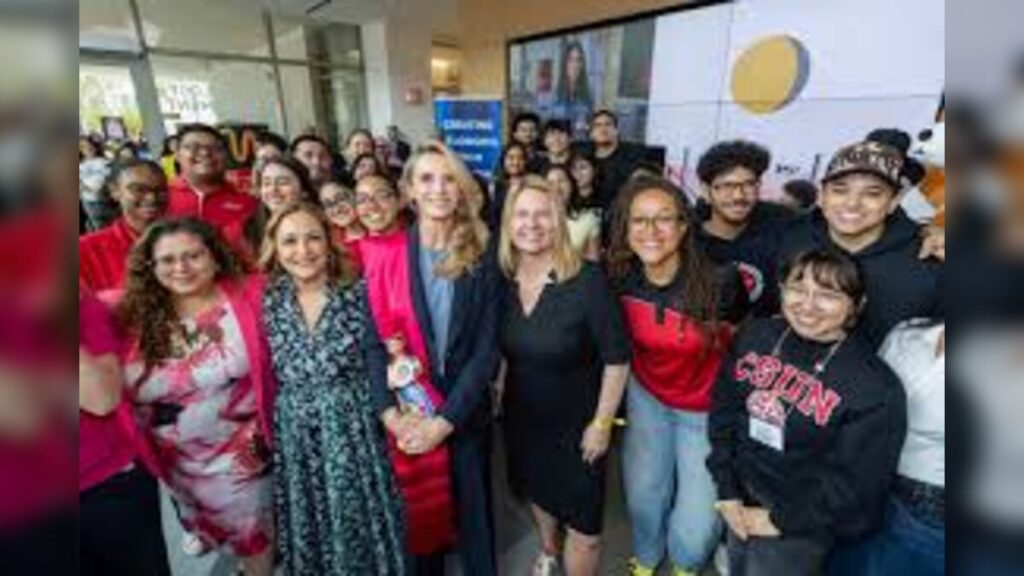
At California State University, Northridge (CSUN), the mood was less about ceremony and more about direction.
First Partner Jennifer Siebel Newsom arrived for a national convening designed to connect students—especially those at Hispanic-Serving Institutions (HSIs)—with real-world tools for financial independence and career growth.
The event, held during Financial Literacy Month, wasn’t just another policy stop.
It marked the launch of a broader push under the “California Love, California Strong” initiative, aimed at helping students build income, understand money management, and adapt to fast-changing industries.
A Conversation About Opportunity and Economic Power
One of the central moments of the day was a fireside chat featuring Jennifer Siebel Newsom, CSUN President Dr. Erika D. Beck, and Beatriz Acevedo, co-founder and CEO of SUMA Wealth.
The discussion centered on how education systems can better prepare students not just to find jobs, but to build wealth.
The First Partner framed the effort as part of a wider mission to support long-term community well-being.
She highlighted programs like CalKIDS savings accounts and financial literacy courses introduced earlier in education, describing them as building blocks for economic mobility that start from birth and continue into adulthood.
The tone of the conversation reflected a shift in thinking: financial literacy is no longer treated as optional knowledge—it’s being positioned as a survival skill in a modern economy shaped by technology and uncertainty.
CSUN’s Innovation Hub Steps Into a Bigger Role
A major driver of the initiative is CSUN’s Global HSI Equity Innovation Hub, which is working with partners such as SUMA Wealth, Super{Power}, Apple, and others.
The goal is ambitious: scale the model across more than 500 Hispanic-Serving Institutions nationwide and reach tens of thousands of students within the next two years.
CSUN President Erika D. Beck emphasized that the program is designed to prepare students not just for the AI-driven workforce, but to lead within it.
The idea is to merge digital skills, financial literacy, and entrepreneurship into one connected learning ecosystem.




That includes helping students understand emerging industries early, so they’re not catching up later.
Hands-On Programs Built for Real Income Opportunities
Beyond speeches and panels, the initiative introduced practical tools students can actually use. Among them:
- A Side Hustle Bootcamp that teaches students how to turn ideas into income-generating projects
- A “Culture is Currency” challenge linking cultural identity with entrepreneurship
- A Virtual Immersive Platform designed to connect students across institutions and industries
These programs reflect a growing trend in education: shifting from theory-based learning to skills that can directly translate into income, even while students are still in school.
Beatriz Acevedo of SUMA Wealth noted that financial literacy alone isn’t enough anymore—it has to be paired with technology access and real-world opportunity.
Why This Approach Is Getting Attention
The initiative sits at the intersection of education, technology, and economic policy.
It also ties into broader state efforts, including California’s expansion of personal finance education in schools and investment programs like CalKIDS.
Another layer is equity. The focus on Hispanic-Serving Institutions reflects an attempt to close wealth gaps that have persisted across generations.
Programs like this aim to make entrepreneurship and investing feel less distant and more achievable for students who may not have traditional financial safety nets.
Impact and Consequences
If successful, the initiative could reshape how students from underserved communities enter the workforce.
Instead of relying solely on traditional employment pathways, they may graduate with both job skills and income-generating abilities already in motion.
There’s also a wider economic implication.
By embedding financial literacy and entrepreneurship into higher education, California is effectively treating students as early-stage economic participants rather than passive learners.
However, scaling the model nationally will require consistent funding, institutional cooperation, and long-term engagement—challenges that often determine whether programs like this thrive or fade after launch.
What’s Next?
The next phase involves expanding the program beyond California and refining its digital platforms to reach more students remotely.
Partnerships with technology companies are expected to play a bigger role, especially in delivering AI-driven learning tools.
There’s also likely to be increased integration with existing state programs like CalSavers and CalKIDS, creating a more continuous financial support pipeline from childhood through college.
If momentum continues, this model could become a blueprint for other states looking to modernize financial education and workforce readiness.
Summary
The CSUN convening led by First Partner Jennifer Siebel Newsom marks a strategic push to merge education, financial literacy, and entrepreneurship for students at Hispanic-Serving Institutions.
Through initiatives under “California Love, California Strong,” the program aims to prepare students not just to enter the economy, but to actively shape it through skills, technology, and income-building opportunities.
Bulleted Takeaways
- CSUN hosted a national convening focused on financial literacy and student economic mobility
- First Partner Jennifer Siebel Newsom launched initiatives under “California Love, California Strong”
- Program targets Hispanic-Serving Institutions to expand wealth-building opportunities
- New tools include Side Hustle Bootcamps, cultural entrepreneurship challenges, and virtual platforms
- Partnerships involve SUMA Wealth, Super{Power}, Apple, and CSUN’s Global HSI Equity Innovation Hub
- Goal is to scale across 500+ HSIs and reach over 20,000 students in two years
- Combines AI skills, financial literacy, and entrepreneurship training
- Aligns with broader California programs like CalKIDS and statewide financial education reforms
- Focus is on shifting students from job-seekers to income creators and innovators
