
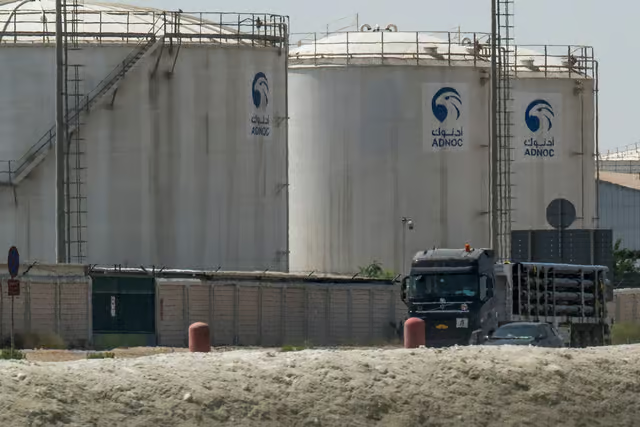
In a decision that’s already sending ripples through the oil world, the United Arab Emirates (UAE) has confirmed it will exit the oil-producing alliance known as OPEC.
The announcement, delivered through the state news agency WAM, sets the exit date for May 1, marking the end of more than 50 years of membership.
The move comes at a tense moment for global energy markets, already strained by conflict in the Middle East and disruptions in key shipping routes like the Strait of Hormuz.
Why the UAE Is Breaking Away
At the heart of the decision is a simple but long-building frustration: production limits.
The UAE has been pushing to increase its oil output capacity, but OPEC’s quota system restricts how much each member can produce.
Officials in Abu Dhabi say the country has reviewed its energy strategy and decided that operating independently better fits its long-term economic plans.
In its official statement, the UAE emphasized national interest, market responsiveness, and the need for flexibility in a volatile global environment.
Analysts have also pointed out that the country has invested heavily in expanding production infrastructure, with ambitions to pump significantly more oil than current quotas allow.
What OPEC Actually Is and Why It Matters
To understand why this matters, you need to know what OPEC is.
The Organization of the Petroleum Exporting Countries (OPEC) was formed in 1960 in Baghdad.
Its core purpose is to coordinate oil production among member countries so they can stabilize prices and manage global supply.
Founding members included Saudi Arabia, Iran, Iraq, Kuwait, and Venezuela.
Over time, more countries joined, including the UAE in 1967.




OPEC currently includes major producers such as Saudi Arabia, Iraq, Kuwait, Iran, Nigeria, and Venezuela, among others.
It also works closely with non-member allies in a broader grouping called OPEC+.
By controlling output levels, OPEC can influence global oil prices—something that affects everything from fuel costs to inflation worldwide.
What Triggered the Break
Behind the diplomatic language, there has been tension for years.
The UAE has repeatedly signaled discomfort with production caps, especially as it expands its capacity.
Reports suggest disagreements within OPEC—particularly with Saudi Arabia over quota levels and regional influence—have added pressure.
The timing is also important. The Middle East is currently dealing with instability linked to conflict in the region, which has disrupted oil flows through critical routes and pushed prices higher.
Some analysts believe the UAE sees this as an opportunity: with prices elevated, it can exit without immediate financial downside while preparing to increase output later.
Impact and Consequences
The UAE is not just any member—it is one of OPEC’s largest producers and a key “swing supplier” with the ability to adjust output when needed.
Its exit could lead to several major consequences:
- Weaker OPEC influence: Losing a major producer reduces the group’s ability to control global supply.
- More oil market volatility: Without coordinated production limits, prices may fluctuate more sharply.
- Higher potential output from UAE: Analysts estimate production could rise significantly once restrictions are removed.
- Pressure on other members: Other countries may reconsider their positions if they also feel constrained.
Some economists warn that if more countries follow the UAE, OPEC’s role in stabilizing oil markets could be seriously weakened.
What’s Next?
In the short term, not much changes immediately.
Oil production doesn’t suddenly spike overnight.
But over time, the UAE is expected to gradually increase output as infrastructure expansions come online and restrictions no longer apply.
The bigger question is how OPEC responds.
Will it adjust quotas, reform internally, or risk further departures?
Global energy markets will also be watching the Strait of Hormuz situation closely, since any improvement or escalation there will heavily influence oil prices regardless of OPEC decisions.
Summary
The UAE’s decision to leave OPEC marks one of the most significant shifts in global oil politics in decades.
Driven by frustration over production limits and a desire for flexibility, the move reflects deeper tensions inside the energy alliance.
While the immediate market impact may be limited due to ongoing regional instability, the long-term consequences could reshape how oil supply is managed worldwide.
Bulleted Takeaways
- UAE will exit OPEC effective May 1 after over 50 years of membership
- Decision driven by desire for greater production flexibility and national energy strategy
- OPEC was created in 1960 to regulate oil supply and stabilize prices globally
- UAE has long been frustrated by production quotas limiting its output growth
- The exit could weaken OPEC’s influence on global oil markets
- Oil prices are already volatile due to Middle East conflict and shipping disruptions
- Analysts expect UAE to gradually increase oil production after leaving
- Other OPEC members may reconsider their positions if tensions grow
- Long-term impact could mean more unpredictable global oil prices and supply shifts
- US authorities arrest Guatemalan drug kingpin Eugenio Molina-Lopez in San Diego and expose Los Huistas cocaine network
- Trump Praises Royal Alliance as He Hosts King Charles at White House in Washington DC
- Irish lawmaker Paul McAuliffe demands reform as An Garda Síochána holds €40 million cash stash in Ireland
- Nigerian group urges government to intervene as xenophobic attacks rise in South Africa
- Ibom Air exposes rising aviation fuel crisis in Nigeria as airlines struggle with soaring costs in Lagos and nationwide operations
- FLA spokesman Mohamed Elmaouloud Ramadane announces withdrawal agreement after renewed fighting in Kidal Mali
- Family Dispute Sparks Violent Reprisal Attacks That Rock Community in Rural Area of Plateau State
- Israel asserts expands security control with US coordination across Lebanon border region to neutralise emerging militant threats
- Troops Rescue Kidnapped Woman and Recover Eight Million Naira Ransom in Dramatic Forest Raid in Qua’an Pan Plateau State
- Reza Pahlavi tours Europe and faces shocking Berlin attack as German security fails during Iran opposition press event
- Iran pushes diplomatic proposal through Pakistani mediators as Tehran challenges US strategy over Strait of Hormuz negotiations in Middle East region
- Naftali Bennett and Yair Lapid rebuild political alliance shapes Israeli coalition race in Tel Aviv election strategy Israel

