
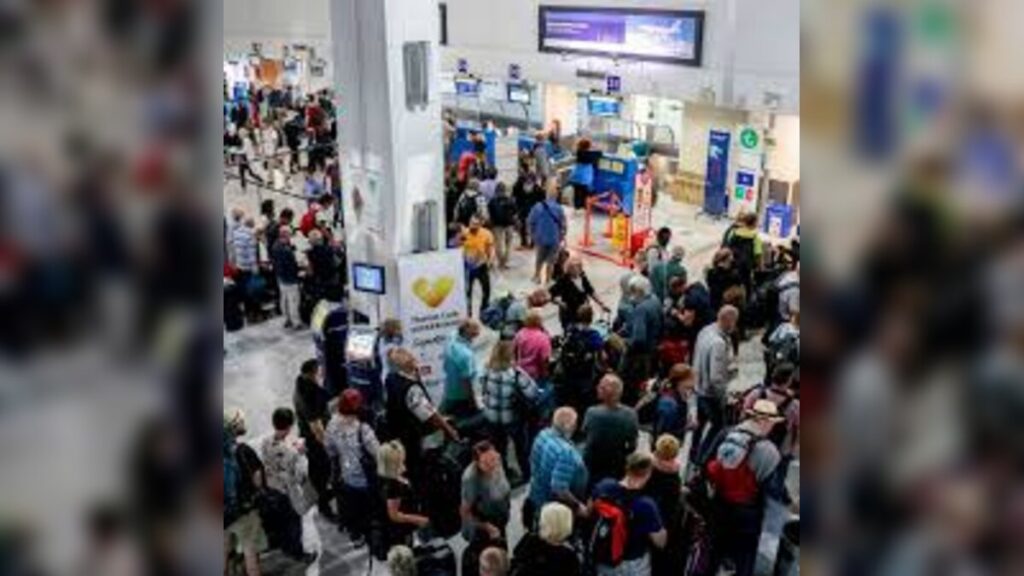
Holiday travel across Europe has taken a messy turn as Portugal and Italy confirmed they will not suspend the European Union’s new Entry-Exit System (EES), despite growing pressure from airlines, tourism operators, and frustrated passengers.
The decision comes at a time when airports are already struggling with long delays, overwhelmed terminals, and confused travellers.
The EES, designed to modernise border control for non-EU visitors, is now being blamed for turning some of Europe’s busiest airports into bottlenecks just as the peak holiday season builds momentum.
What the Entry-Exit System Is Doing at Borders
The new system requires all non-EU travellers to go through biometric registration, including facial scans and fingerprints, at dedicated kiosks when entering the Schengen zone.
In theory, it is meant to strengthen border security and track entries more efficiently.
In practice, however, it has slowed down processing times significantly, with reports of queues stretching for hours at major hubs across Spain, Italy, France, and beyond.
Airports such as Málaga and Alicante in Spain, as well as Milan Linate in Italy, have been repeatedly flagged for congestion, with some passengers reportedly missing flights entirely after waiting in long lines.
Airlines and Travel Companies Warn of a System Under Pressure
Airlines are increasingly vocal about the disruption.
Ryanair has described the rollout as poorly executed, arguing that governments introduced a “half-finished” digital system during one of the busiest travel periods of the year.
Travel firms are also concerned. Holiday industry voices have warned that countries risk damaging their own tourism economies if delays continue unchecked.
British tourists alone contribute billions of pounds annually to popular destinations like Greece, Spain, and Italy.
Some industry leaders have even suggested that governments may eventually be forced to suspend the system temporarily to prevent further disruption.
Greece’s Surprise Move Raises Pressure Across Europe
The situation escalated further after Greece chose to pause parts of the system, citing the need to protect smooth arrivals for tourists.
The move was widely interpreted as a way to protect its crucial summer tourism sector, particularly in destinations like Crete, Rhodes, and Corfu.
That decision immediately sparked speculation that other countries such as Spain, France, and Croatia could follow suit if delays worsen.
Analysts warned that if multiple nations suspend the system independently, it could undermine the EU-wide rollout entirely.




Portugal and Italy Stand Firm Despite Growing Backlash
Despite the pressure, the European Commission confirmed that Portugal and Italy will continue enforcing the system without suspension.
Officials argue that the EES is still in its early rollout phase and that disruptions are expected during the transition period.
However, critics say the lack of flexibility is worsening congestion.
Airports in Italy including Fiumicino, Malpensa, Venice, Naples, and Pisa have all reported serious delays, while French hubs like Marseille and Nantes are also experiencing bottlenecks.
In Portugal, concerns are growing that peak summer traffic could push systems beyond capacity.
Passengers Caught in the Middle of Airport Delays
For many travellers, the debate over policy has turned into a personal travel nightmare.
Families have reported standing in queues for hours with little assistance, while some passengers say they missed flights despite arriving early at airports.
One widely shared account described parents waiting in line for over three hours with children, with limited access to facilities and minimal airport intervention.
In some cases, missed flights have led to unexpected costs running into hundreds or even thousands of euros due to rebooking fees and hotel stays.
Why the EU Is Holding Its Ground
EU officials insist the system is necessary for long-term border security and efficiency.
The EES is part of a wider effort to digitise border control and track movement across the Schengen Area more accurately.
Authorities argue that short-term disruption is expected whenever a large-scale digital infrastructure is introduced across multiple countries simultaneously.
However, critics believe the rollout should have been phased more gradually or delayed until airport systems were fully prepared.
Impact and Consequences
The ongoing dispute is creating ripple effects across Europe’s travel industry.
Tourism-dependent economies are especially concerned, as delays risk damaging the region’s reputation during peak holiday months.
Airports are also under operational strain, with staff shortages and infrastructure limits making it difficult to manage sudden surges in passenger processing times.
If disruptions continue, airlines may adjust schedules, reduce flight frequencies, or shift routes away from heavily affected airports.
That could increase prices and limit travel options for passengers.
What’s Next?
Pressure is likely to intensify as summer travel demand increases.
Industry groups are expected to continue lobbying for temporary suspension of the system until technical issues are resolved.
The European Commission may also face renewed calls to allow more flexible implementation depending on airport capacity and seasonal demand.
In the meantime, travellers are being advised to arrive earlier than usual at airports and prepare for longer processing times at border control points across Europe.
Summary
Europe’s new Entry-Exit System is causing major disruption at airports, with long queues, missed flights, and rising frustration among travellers.
While Greece has temporarily eased its approach, Portugal and Italy have refused to suspend the system, keeping the EU-wide rollout in place.
Airlines and travel companies are warning that the system could severely impact tourism if delays continue, while passengers are already feeling the effects on the ground.
Bulleted Takeaways
- Portugal and Italy refuse to suspend the EU Entry-Exit System despite airport chaos
- The system requires biometric checks for all non-EU travellers
- Long queues have led to missed flights across Spain, Italy, and France
- Airlines like Ryanair call the system “half-baked” and poorly timed
- Greece has temporarily paused parts of the system to ease tourist arrivals
- Airports including Málaga, Alicante, Fiumicino, and Milan are heavily affected
- Some travellers report delays of up to three hours or more
- Tourism groups warn of billions in potential economic impact
- EU insists the system is essential for long-term border security
- Pressure is growing for a possible temporary suspension during peak season

