
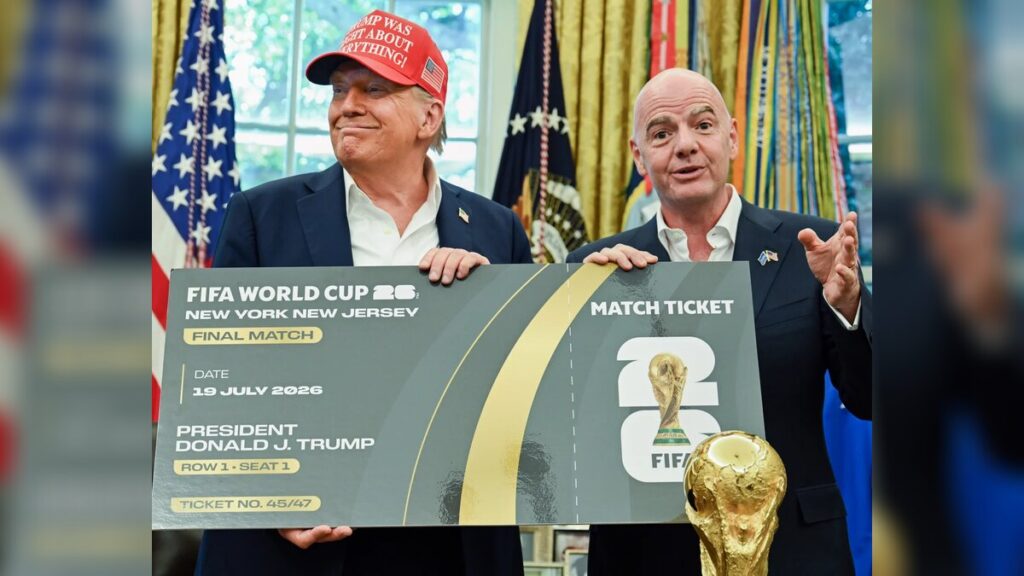
The debate around World Cup 2026 ticket prices has taken a political turn after comments from President Donald Trump, who said he would not personally pay the reported $1,000-plus cost for a match ticket.
Speaking in an interview published Thursday, Trump expressed surprise at how expensive entry to the tournament could be for fans in the United States.
He made it clear he would still like to attend, but the pricing structure gave him pause, especially as the event moves closer and public attention increases.
Concerns Over Access for Everyday Fans in the US
Trump’s main worry wasn’t just about price—it was about who gets left out.
He suggested that ordinary supporters, especially working-class fans from places like New York neighborhoods, could be priced out of attending matches.
He pointed to supporters who follow him politically and culturally, saying he would be disappointed if loyal fans could not afford to experience the tournament in person.
At the same time, he acknowledged the World Cup’s scale and commercial success, calling it a major global achievement for the United States.
The 2026 tournament will be jointly hosted by the United States, Canada, and Mexico, making it the first time three countries will co-host the event.
FIFA Under Fire for Rising Ticket Costs
The controversy is not limited to political commentary.
Football governing body FIFA has been widely criticized by lawmakers and fan organizations over what many describe as extreme pricing.
Supporters groups across Europe have called the pricing structure unfair, with one federation describing it as a “betrayal” of regular fans.
The biggest criticism focuses on how expensive resale and premium tickets have become compared to previous tournaments.
FIFA president Gianni Infantino has defended the pricing model, arguing that demand for the 2026 World Cup is unprecedented and that ticketing systems reflect market realities, including US laws that allow resale at significantly higher prices.
Record Demand and a Growing Commercial Event
According to FIFA leadership, interest in the 2026 World Cup is already breaking records, with hundreds of millions of ticket requests reported globally.
That figure dwarfs demand from previous tournaments in Russia 2018 and Qatar 2022.




The governing body has also said that a portion of tickets—particularly for group-stage matches—will be priced under $300, though those are expected to be limited compared to premium seating tiers.
Still, the gap between the cheapest and most expensive tickets has become a major talking point, especially with final match seats reportedly reaching around $11,000.
Comparisons With the Qatar 2022 World Cup
Fans and analysts have been quick to compare the upcoming tournament with the 2022 World Cup in Qatar, where even the most expensive final tickets were significantly lower than what is now being projected for 2026.
That difference has fueled concerns that the sport is becoming increasingly inaccessible to ordinary supporters, shifting toward a luxury entertainment model rather than a global public sporting event.
Political and Business Tensions Around the Tournament
Trump has also highlighted his historical role in bringing the World Cup to the United States during his presidency, framing the event as a major achievement for the country.
His relationship with FIFA leadership has been noted in media coverage, particularly his proximity to Gianni Infantino.
That connection has added another layer to the ongoing debate, as critics question how commercial decisions are being made ahead of the tournament.
The issue also ties into broader US discussions about entertainment pricing, resale laws, and affordability across major sporting events.
Impact and Consequences
The backlash over World Cup ticket prices could shape how FIFA handles future pricing strategies and public relations leading up to 2026.
If criticism continues to grow, pressure may mount to increase the number of affordable tickets or introduce stricter limits on resale pricing.
Politically, the issue also resonates with voters concerned about cost-of-living pressures.
Trump’s comments highlight how major sporting events can become part of wider debates about economic fairness and accessibility.
For FIFA, the reputational risk is significant.
While demand is extremely high, public perception matters—especially for an event marketed as a global celebration meant to include fans from all backgrounds.
What’s Next?
Attention will now shift to how FIFA responds publicly as ticket sales expand closer to the tournament.
Further announcements on pricing tiers, allocation systems, and resale regulations are expected.
Lawmakers and fan organizations are also likely to keep up pressure, especially in the United States where the tournament will be staged across multiple cities.
As 2026 approaches, the balance between commercial success and fan accessibility will remain one of the biggest unresolved questions surrounding the World Cup.
Summary
President Donald Trump has criticized the high cost of 2026 World Cup tickets, saying he would not personally pay over $1,000 to attend a match.
His comments add to growing global concern over FIFA’s pricing strategy.
While FIFA defends the model due to record demand and market conditions, fan groups argue that prices are pushing ordinary supporters out of the game.
With the tournament set to be hosted across the US, Canada, and Mexico, the debate over affordability is intensifying.
Bulleted Takeaways
- Trump says he would not pay over $1,000 for World Cup tickets
- The 2026 World Cup will be hosted in the United States, Canada, and Mexico
- FIFA faces criticism over rising ticket prices
- FIFA reports record global demand for the tournament
- Some final tickets are projected to cost around $11,000
- Fans and lawmakers call pricing unfair and exclusionary
- FIFA President Gianni Infantino defends pricing based on demand and US resale laws
- 2022 Qatar World Cup is being used as a lower-cost comparison point
- Debate highlights tension between commercial growth and fan accessibility
- Public pressure may influence final pricing and ticket distribution policies ahead of 2026

