
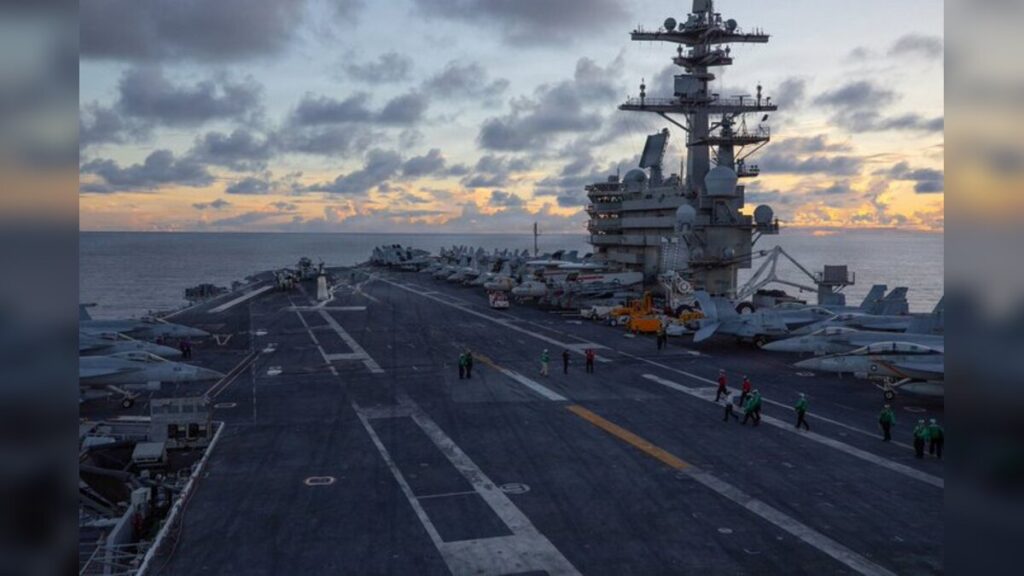
U.S. Central Command says American forces are continuing to enforce a naval blockade against Iran, with 52 commercial vessels now directed to either turn around or return to port.
The latest update points to a large U.S. military presence in and around the Arabian Sea and the Strait of Hormuz, where warships, helicopters, fighter jets, and personnel are being used to enforce the blockade while protecting commercial shipping.
USS George H.W. Bush Anchors Major U.S. Naval Presence
CENTCOM said the aircraft carrier USS George H.W. Bush is part of the large group of U.S. forces supporting the blockade.
The carrier is one of the most visible symbols of American military power in the region, giving U.S. commanders a major platform for air operations, surveillance, deterrence, and rapid response.
Its presence suggests the blockade is not a short-term patrol effort, but a major military operation backed by significant resources.
Sea Hawk Helicopters Support Blockade Enforcement
The U.S. also highlighted the role of MH-60 Sea Hawk helicopters, including one shown taking off from the amphibious assault ship USS Tripoli in the Arabian Sea.
According to CENTCOM, Sea Hawks are playing an essential role in enforcing the naval blockade.
These helicopters can support maritime surveillance, patrols, ship monitoring, rapid movement, and other operations needed to track and respond to vessels in a crowded sea environment.
F-16s Patrol Near the Strait of Hormuz
CENTCOM also said a U.S. Air Force F-16 fighter jet was patrolling near the Strait of Hormuz.

The command described a heavy concentration of U.S. capability and firepower around the strait, saying it is meant to create a defensive umbrella for U.S. forces and commercial shipping.
That means the U.S. is not only blocking vessels linked to Iran, but also preparing to defend ships moving through one of the world’s most important maritime corridors.
Blockade and Shipping Protection Are Happening Together
The operation has two overlapping goals. First, U.S. forces are enforcing the blockade by stopping commercial vessels from entering or leaving Iran.
Second, they are protecting commercial shipping in and around the Strait of Hormuz.
That balance is central to Washington’s message. The U.S. is applying pressure on Iran while saying it is also defending the wider flow of commerce through the region.
Impact and Consequences
The immediate impact is on maritime traffic linked to Iran. With 52 vessels already redirected, shipping companies may face delays, rerouting costs, insurance concerns, and uncertainty over whether their cargo or destination will trigger U.S. enforcement action.
For Iran, the blockade increases pressure on port access and commercial movement. If more vessels are turned back, the effect could spread to trade, logistics, and oil-related shipping.
The wider consequence is regional risk. A large U.S. naval and air presence may deter threats to commercial shipping, but it also increases the chance of confrontation if Iranian forces, small boats, drones, or other assets challenge the blockade.
What’s next?
The number of redirected vessels could continue to rise if more ships attempt to enter or leave Iranian ports.
U.S. forces are likely to maintain heavy patrols near the Strait of Hormuz and across the Arabian Sea, using aircraft carriers, amphibious ships, helicopters, destroyers, and fighter jets to monitor traffic and respond to threats.
The key question now is whether Iran avoids direct confrontation or tries to test the blockade. Any clash near the Strait of Hormuz could quickly draw international attention because of the waterway’s importance to global commerce.
Summary
U.S. Central Command says American forces are fully enforcing a naval blockade against Iran, with 52 commercial vessels redirected so far.
The operation includes major assets such as the USS George H.W. Bush, USS Tripoli, MH-60 Sea Hawk helicopters, and U.S. Air Force F-16 fighter jets near the Strait of Hormuz.
CENTCOM says the mission is designed to enforce the blockade while also protecting U.S. forces and defending commercial shipping.
Bulleted Takeaways:
- U.S. forces say 52 commercial vessels have been directed to turn around or return to port.
- The vessels were redirected to comply with the U.S. naval blockade against Iran.
- USS George H.W. Bush is part of the large U.S. military force enforcing the blockade.
- USS Tripoli is supporting operations in the Arabian Sea.
- MH-60 Sea Hawk helicopters are being used in blockade enforcement.
- A U.S. Air Force F-16 patrolled near the Strait of Hormuz.
- CENTCOM says U.S. forces have significant firepower concentrated around the strait.
- The mission is also meant to protect U.S. forces and commercial shipping.
- The blockade could disrupt shipping linked to Iranian ports.
- Continued enforcement may raise tensions if Iran challenges U.S. operations.
