
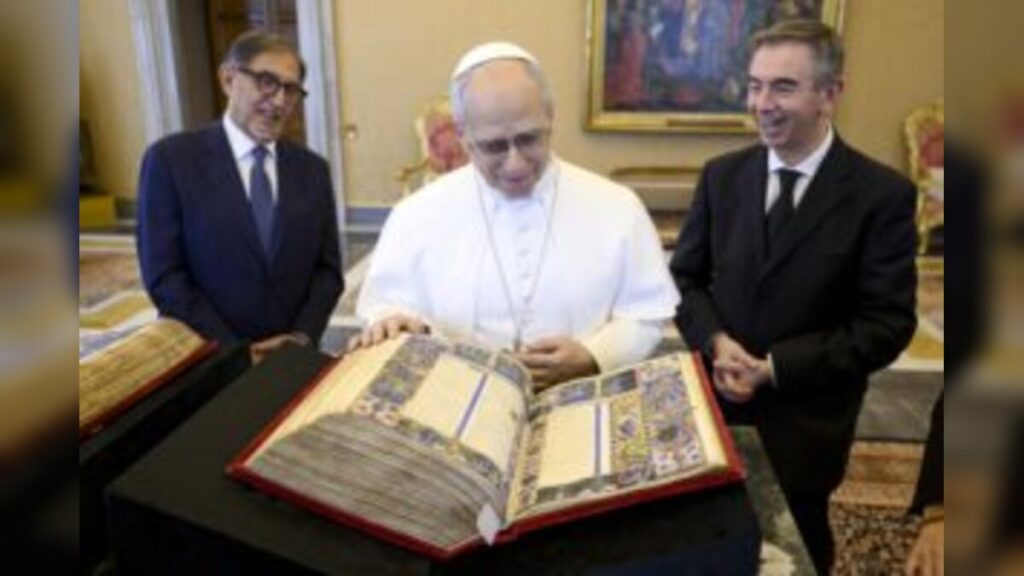
At a time when phones, screens, and constant notifications dominate daily life, Pope Leo XIV used a Vatican gathering on May 7 to remind the world not to forget something far more traditional — the printed book.
Speaking to staff of the Vatican Publishing House, which is marking its 100th anniversary, the Pope delivered a reflection that felt both nostalgic and surprisingly urgent.
His message was simple but firm: reading books still matters deeply, even in an age obsessed with speed and digital consumption.
A Centenary Moment for the Vatican Publishing House
The audience took place with employees of the Libreria Editrice Vaticana, the Vatican’s official publishing house founded in 1926.
The institution has spent a century producing theological works, papal writings, and religious scholarship for global Catholic readership.
Pope Leo used the milestone not just to celebrate the organisation’s history but to reflect on what books represent in a rapidly changing cultural landscape.
For him, the printed page still carries a kind of weight that digital formats cannot fully replace.
“Reading Nourishes the Mind,” the Pope Says
In his address, Pope Leo strongly defended physical books, describing them as tools that encourage deeper thinking and reflection.
He warned against the growing tendency toward superficial understanding in a fast-scrolling digital world.
Reading, he said, is not just about information — it is about formation.
He explained that books help shape a “conscious and well-formed critical sense,” which protects readers from ideological extremes and oversimplified thinking.
In his view, the habit of reading builds mental discipline that screens often weaken.
Books as Encounters, Not Just Objects
One of the most striking parts of his speech focused on the idea that books connect people across time.
Holding a book, he said, is like entering into conversation with the author, but also with every reader who has engaged with the same text before and after you.
He linked this idea to the “culture of encounter,” a phrase often associated with his predecessor, Pope Francis.
According to Pope Leo, books are not silent objects but bridges — linking minds, generations, and perspectives.




That perspective, he suggested, is increasingly important in a divided world where dialogue is often replaced by quick reactions online.
Faith, Scripture, and the Role of Spiritual Reading
The Pope also connected reading with Christian life more directly.
He said books can serve as a pathway to faith, especially when they include spiritual reflections or biographies of saints.
He referenced familiar religious imagery: the Virgin Mary depicted reading Scripture during the Annunciation, St. Anthony of Padua holding the Gospel, and St. Augustine shown studying deeply while reflecting on truth and love.
These examples, he said, highlight how reading has long been tied to spiritual growth within Christianity.
A Warning About Closed Minds in a Digital Age
Without directly attacking technology, Pope Leo made clear that modern media habits can encourage shallow thinking.
Endless scrolling, he implied, risks replacing reflection with reaction.
Books, by contrast, slow the mind down.
He encouraged Catholics — and readers more broadly — to treat books as an “antidote to closed-mindedness,” helping people avoid rigid thinking and simplistic views of complex realities.
Honouring a Legacy of Catholic Publishing
The speech also paid tribute to St. Paul VI, who in 1976 visited the Vatican Publishing House and urged its staff to look toward the future with creativity and dedication.
Pope Leo echoed that sentiment, thanking the publishing employees for their work and encouraging them to continue their mission with passion.
He ended his remarks with a blessing for them and their families.
Impact and Consequences
The Pope’s remarks add to a growing global conversation about the place of physical books in a digital-first society.
While e-books, audiobooks, and online platforms continue to expand access to knowledge, concerns remain about declining attention spans and reduced deep reading habits.
Within Catholic communities, his comments reinforce the importance of Scripture study and spiritual reading as daily practices rather than occasional activities.
More broadly, his speech may influence educational and cultural debates about how societies can balance technology with reflective learning.
What’s Next?
The Vatican Publishing House is expected to continue its centenary celebrations with renewed attention on its mission in a digital era.
There may also be increased efforts to digitise Vatican publications while still promoting printed editions.
Observers will be watching whether Pope Leo’s emphasis on reading leads to new Catholic initiatives encouraging book-based learning, especially among younger audiences.
The broader conversation about digital distraction versus deep reading is also likely to continue across schools, churches, and cultural institutions worldwide.
Summary
Pope Leo XIV used a Vatican audience to deliver a strong message about the importance of reading printed books in a digital world.
He described books as tools for reflection, critical thinking, and spiritual growth, while warning against the risks of shallow, fast-paced digital consumption.
His remarks also highlighted books as a form of human connection and a bridge between generations, reinforcing their value not only in education but also in faith.
Bulleted Takeaways
- Pope Leo XIV spoke at the Vatican Publishing House’s 100th anniversary event
- He defended printed books as essential for deep thinking and reflection
- Reading was described as a safeguard against ideological rigidity and shallow thinking
- Books were called “bridges” that connect readers, authors, and generations
- He linked reading to Christian tradition and spiritual growth
- Biblical and saint imagery was used to highlight the importance of reading Scripture
- The Pope warned against digital culture encouraging closed or simplistic thinking
- He thanked Vatican publishing staff and encouraged future dedication
- The speech aligns with broader debates about digital media vs. deep reading
- The Vatican may expand efforts to promote both print and digital religious texts

