
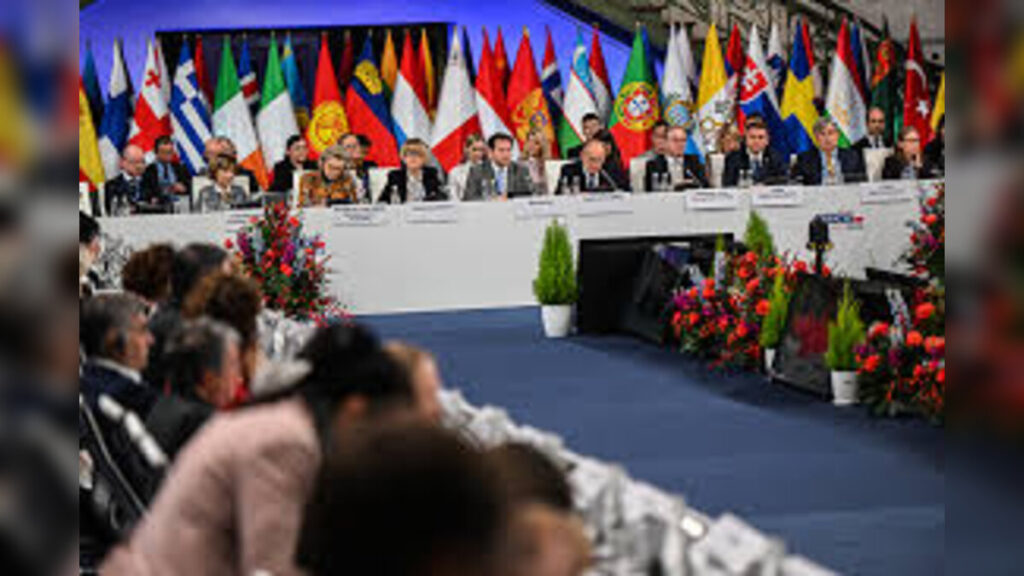
At a tense session of the Organisation for Security and Co-operation in Europe, the United Kingdom delivered a sharply worded statement accusing Russia of undermining the foundations of Europe’s post-Second World War peace order.
The intervention came as European nations prepare to mark VE Day, a moment meant to commemorate the end of the Second World War—but also, as the UK stressed, a reminder of why the continent built a system of rules designed to prevent such devastation from happening again.
In London’s view, that system is now under its most serious strain in decades.
Russia Accused of Breaking the Post-War Security Framework
The UK statement centred on one core claim: Russia’s war in Ukraine represents a direct assault on the post-1945 international security structure.
That structure—built around principles like sovereignty, territorial integrity, and peaceful dispute resolution—was designed to ensure that borders in Europe could never again be changed by force.
But according to the UK, Russia’s actions have done exactly that.
The war in Ukraine is described not just as a regional conflict, but as a fundamental challenge to the rules that have shaped European stability since the end of the Second World War.
The UK also argued that Moscow’s actions have weakened trust inside international institutions, including the OSCE itself.
VE Day Reminder Becomes Political Warning
As Europe prepares to commemorate Victory in Europe Day, the UK used the historical moment to draw a direct line between past and present.
Eighty-one years ago, Europe rebuilt itself from the ruins of war by agreeing that peace must be anchored in law, not military force.
That agreement eventually helped shape institutions like the OSCE, which was created to promote dialogue and prevent conflict escalation.
The UK’s message was that these principles are now being tested in real time.
The statement warned that remembrance should not be symbolic alone—it should act as a reminder of what happens when collective security breaks down.



Ukraine Praised as Calls for Ceasefire Continue
The UK also used the platform to highlight Ukraine’s position in the conflict, describing it as a country repeatedly seeking peace through diplomatic means.
It referenced Ukrainian President Volodymyr Zelenskyy’s call for a full ceasefire and urged Russia to respond by halting its military operations as a first step toward negotiations.
However, the UK contrasted these efforts with continued Russian strikes, including attacks that reportedly caused civilian casualties in recent days.
The statement also condemned threats made toward Kyiv and diplomatic missions, describing them as incompatible with basic international norms.
A Wider Struggle Over International Rules
Beyond the immediate war, the UK framed the situation as part of a broader struggle over the global rules-based order.
The OSCE, created during the Cold War and expanded after it, was built on the idea that cooperation and transparency could reduce the risk of large-scale conflict in Europe.
But the UK argued that Russia’s behaviour has eroded that foundation, making meaningful dialogue more difficult unless commitments are respected in good faith.
The message was blunt: participation in international institutions comes with obligations, not just membership.
Impact and Consequences
The UK’s statement reinforces growing diplomatic isolation between Russia and many Western-aligned OSCE members.
It also signals continued political unity among several European states in framing the Ukraine war as a systemic threat rather than a regional dispute.
For the OSCE itself, the conflict continues to test its relevance as a platform for dialogue when one of its major participating states is accused of violating core principles.
The broader consequence is a deepening divide in European security architecture, with trust between key actors significantly reduced.
What’s next?
Diplomatic pressure on Russia is expected to continue through forums like the OSCE and the United Nations system.
Calls for ceasefires or negotiated pauses in fighting are likely to remain central to Western positions, especially during symbolic periods such as VE Day commemorations.
However, meaningful progress will depend on whether both sides can find even limited common ground for negotiation, which currently appears distant.
The OSCE is also expected to remain a key venue for political messaging, even as its ability to enforce agreements remains limited.
Summary
The United Kingdom used a speech at the OSCE to accuse Russia of undermining Europe’s post-Second World War security order through its war in Ukraine.
The statement linked the conflict to broader violations of international principles such as sovereignty and territorial integrity, while urging Russia to agree to a ceasefire.
It also framed VE Day as a reminder of why Europe built a rules-based system that is now under strain.
Bulleted Takeaways
- UK condemned Russia’s war in Ukraine at an OSCE meeting
- Statement linked the conflict to the breakdown of post-WWII European security rules
- Principles such as sovereignty and territorial integrity were highlighted as being violated
- VE Day was used as a reminder of Europe’s post-war commitment to peace
- Ukraine was praised for calling repeatedly for a ceasefire
- UK condemned Russian strikes and threats against Kyiv and diplomatic missions
- OSCE described as a key but challenged platform for dialogue
- Broader message focused on defending a rules-based international order

