
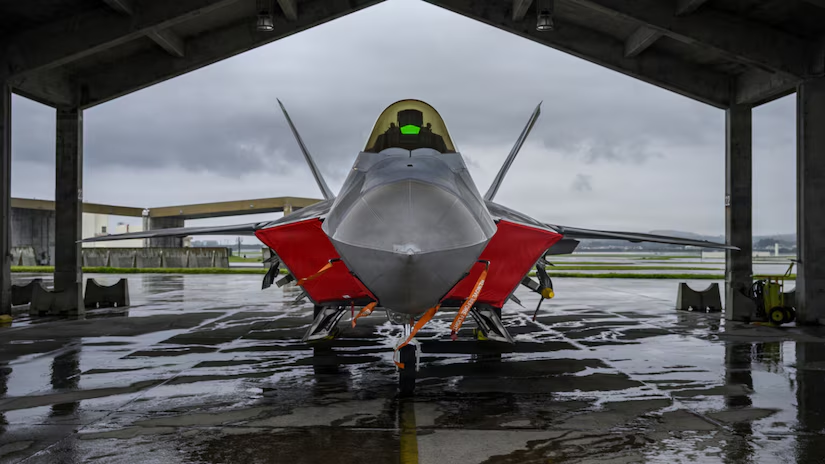
U.S. Air Force F-22 Raptors have arrived at Kadena Air Base in Japan, marking the latest fighter rotation meant to strengthen American airpower across the Indo-Pacific.
The aircraft are assigned to the 90th Fighter Squadron from Joint Base Elmendorf-Richardson, Alaska, and the 27th Fighter Squadron from Joint Base Langley-Eustis, Virginia.
Their deployment adds another layer of advanced fighter capability to one of the most strategically important U.S. air bases in the region.
Kadena Remains a Key Hub for Regional Air Operations
Kadena Air Base, often called the “Keystone of the Pacific,” plays a central role in U.S. air operations in the Indo-Pacific. While deployed there, the F-22s will operate alongside a wider mix of aircraft already tied to the Air Force’s 18th Wing.
That includes heavy aircraft, reconnaissance platforms, and both fourth- and fifth-generation fighters. Together, the rotation is designed to keep a steady and credible U.S. fighter presence in the region.
Why the F-22 Matters
The F-22 Raptor is the Air Force’s premier fifth-generation air superiority fighter. It combines stealth, advanced sensors, speed, maneuverability, and long-range detection capability.
Its role is to dominate contested airspace.
The aircraft can detect and track threats at extended ranges while remaining difficult for adversaries to detect. That makes it especially valuable in a region where air superiority, deterrence, and rapid response are major priorities.
Crews Will Train With U.S., Joint, and Allied Partners
During the deployment, F-22 pilots and maintainers will work directly with Kadena’s operations and maintenance groups.
They will also integrate with joint and allied partners to sharpen tactics, improve interoperability, and maintain readiness for real-world contingencies.



The goal is not simply to park advanced jets in Japan, but to ensure crews and support teams can operate together under pressure.
Deployment Reinforces U.S.-Japan Security Commitment
The fighter rotation also sends a broader diplomatic and military message. By placing advanced aircraft at Kadena, the United States is reinforcing its commitment to defend Japan under the U.S.-Japan security alliance.
The deployment also supports Washington’s wider goal of maintaining what it describes as a free and open Indo-Pacific, especially as regional tensions and military competition remain high.
Noise Concerns Remain Part of the Deployment
The Air Force said the 18th Wing will continue to follow applicable bilateral agreements with the Japanese government, including procedures related to noise abatement.
Visiting aircrews are briefed on local noise-control rules, while mission planners are expected to consider ways to limit the impact of flight operations on surrounding communities.
Fighter Rotations Help Bridge Toward Future Modernization
The F-22 deployment is part of a broader War Department priority to modernize airpower in the Indo-Pacific.
Rotating fighters through Kadena helps maintain today’s operational presence while preparing the base for future capabilities, including the planned arrival of the F-15EX Eagle II. That transition is part of the long-term effort to keep U.S. airpower strong and adaptable in the region.
Impact and Consequences
The arrival of F-22s strengthens U.S. deterrence in the Indo-Pacific by placing highly advanced air superiority fighters closer to potential flashpoints. Their presence gives commanders more options for training, rapid response, and joint operations with allies.
For Japan, the deployment reinforces the U.S. defense commitment but may also bring local concerns around noise and base activity. That is why the Air Force is emphasizing noise-abatement procedures and coordination with Japanese authorities.
For the wider region, the rotation signals that the U.S. intends to keep a persistent and capable airpower presence in the Indo-Pacific, even as it prepares for future modernization.
What’s next?
The F-22 crews and maintainers will continue integrating with the 18th Wing and partner forces during the deployment.
Training will likely focus on readiness, tactics, interoperability, and maintenance operations in a forward-deployed environment. Over time, Kadena will also continue preparing for future aircraft transitions, including the eventual arrival of the F-15EX Eagle II.
Summary
F-22 Raptors from Alaska and Virginia have arrived at Kadena Air Base in Japan as part of a new fighter rotation supporting Indo-Pacific operations.
The aircraft will work with the 18th Wing, joint forces, and allied partners to strengthen readiness and maintain a credible U.S. fighter presence.
The deployment supports the U.S.-Japan alliance, reinforces regional deterrence, and helps bridge current operations with future airpower modernization.
Bulleted Takeaways:
- U.S. Air Force F-22 Raptors have arrived at Kadena Air Base, Japan.
- The jets are assigned to the 90th Fighter Squadron and 27th Fighter Squadron.
- The rotation supports U.S. operations across the Indo-Pacific.
- Kadena Air Base is known as the “Keystone of the Pacific.”
- The F-22s will operate alongside aircraft assigned to the 18th Wing.
- The F-22 is a fifth-generation air superiority fighter.
- Its strengths include stealth, advanced sensors, maneuverability, and long-range detection.
- Aircrews and maintainers will train with U.S., joint, and allied partners.
- The deployment supports the U.S.-Japan security alliance.
- The Air Force says it will follow noise-abatement procedures under agreements with Japan.
- Fighter rotations help maintain a continuous U.S. airpower presence in the region.
- Kadena is also preparing for the future arrival of the F-15EX Eagle II.
