
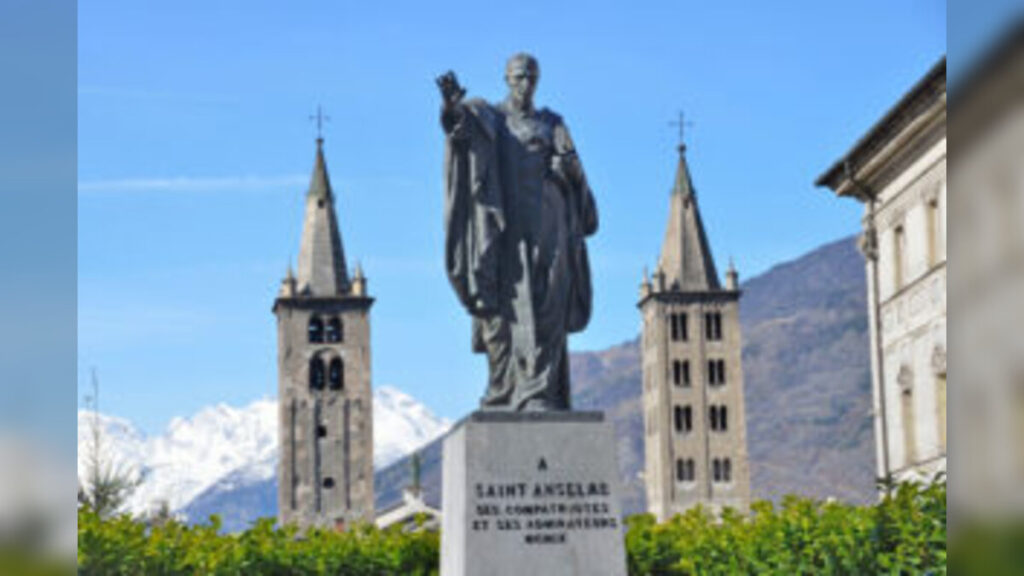
Every year on April 21, the Catholic Church pauses to remember St. Anselm—a thinker whose ideas still echo through centuries of Christian theology.
He wasn’t just a monk tucked away in prayer; he was a bold intellectual who tried to explain faith using reason, a rare combination in his time.
A Mind Shaped Early in Life
Anselm’s story begins around 1033 in Aosta, in what is now northern Italy.
His upbringing was a study in contrasts.
His mother was deeply religious and nurturing, while his father was often harsh and dismissive of spiritual pursuits.
It was his mother who ensured he received a strong education with the Benedictines, where he quickly stood out—especially in Latin, the academic language of the time.
As a teenager, Anselm reportedly had a vivid dream in which he encountered God.
That moment left a lasting mark, sparking a desire to become a monk.
But his father had other plans, pushing him toward a more worldly path.
The tension took its toll—Anselm fell ill, lost his mother, and eventually walked away from home altogether.
Years of Wandering and a Turning Point
For about three years, Anselm drifted across parts of France and Italy, searching for purpose.
That search ended in Normandy, where he met Lanfranc of Pavia.
Under Lanfranc’s guidance, Anselm found both direction and encouragement.
He joined the Benedictine order, was ordained a priest at 27, and quickly rose through the ranks.
By 1063, he became prior of the monastery at Bec, and later its abbot.
Under his leadership, Bec transformed into a hub of learning that attracted students from across Europe.
Faith Meets Reason
Anselm’s legacy rests heavily on his intellectual work.
Around 1077, he wrote Monologion, an ambitious attempt to prove God’s existence using reason alone.




Later works, including Proslogion, would refine these ideas further, introducing what is now known as the ontological argument.
His approach was summed up in a simple yet powerful phrase: faith seeking understanding.
Rather than seeing belief and logic as opposites, Anselm believed they belonged together.
He also developed influential ideas about Christ’s atonement—explaining why Jesus’ sacrifice was necessary for humanity’s salvation.
These ideas would later shape both Catholic and Protestant theology in lasting ways.
A Reluctant Leader in a Time of Conflict
Anselm’s life wasn’t confined to quiet study.
When his mentor Lanfranc became Archbishop of Canterbury, Anselm was drawn into the political and religious tensions of England.
After Lanfranc’s death, the English throne—under William II of England—delayed appointing a successor.
Eventually, Anselm was chosen, though he accepted reluctantly, knowing it would put him in direct conflict with royal authority.
He wasn’t wrong. Anselm clashed repeatedly with the crown over who had control over Church matters.
His firm stance on the Church’s independence led to exile for several years in the early 1100s. Still, he didn’t back down.
In 1106, he returned to England after reaching a compromise, having successfully defended key principles of ecclesiastical freedom.
Final Years and Lasting Recognition
Even in his later years, Anselm remained active—writing, teaching, and working to reform the Church.
When he died in 1109, his influence was already spreading.
More than six centuries later, Pope Clement XI formally recognized his importance by declaring him a Doctor of the Church in 1720—a title reserved for those whose teachings have profoundly shaped Christian doctrine.
Impact and Consequences
Anselm’s work reshaped how theology was approached in the Western Church.
By insisting that faith could be explored through reason, he helped lay the groundwork for scholasticism—a method that would dominate medieval universities.
His ideas on atonement became foundational, influencing thinkers like Thomas Aquinas and even reformers such as Martin Luther.
Politically, his resistance to royal interference strengthened the idea that the Church should govern its own affairs—a concept that would echo in later church-state conflicts across Europe.
What’s Next?
While Anselm lived nearly a thousand years ago, his questions remain strikingly modern.
Can faith and logic coexist? Can belief be explained, or only experienced?
Today, scholars still debate and refine his arguments.
His writings continue to be studied in seminaries and universities, proving that his voice hasn’t faded—it’s just part of a much longer conversation.
Summary
St. Anselm was more than a medieval monk—he was a bridge-builder between belief and intellect.
From a troubled youth to a respected archbishop, his life was marked by both deep reflection and real-world conflict.
His ideas didn’t just influence his own era; they helped shape centuries of theological thought.
Bulleted Takeaways
- St. Anselm is honored each year on April 21 for his contributions to theology
- He was a Benedictine monk who became Archbishop of Canterbury
- His writings sought to explain God’s existence using reason
- He developed key teachings on Christ’s atonement still used today
- Anselm defended the Church’s independence from royal control
- He experienced exile due to conflicts with English rulers
- His motto “faith seeking understanding” defines his approach
- Declared a Doctor of the Church in 1720 by Pope Clement XI
- His influence spans both Catholic and Protestant traditions

