
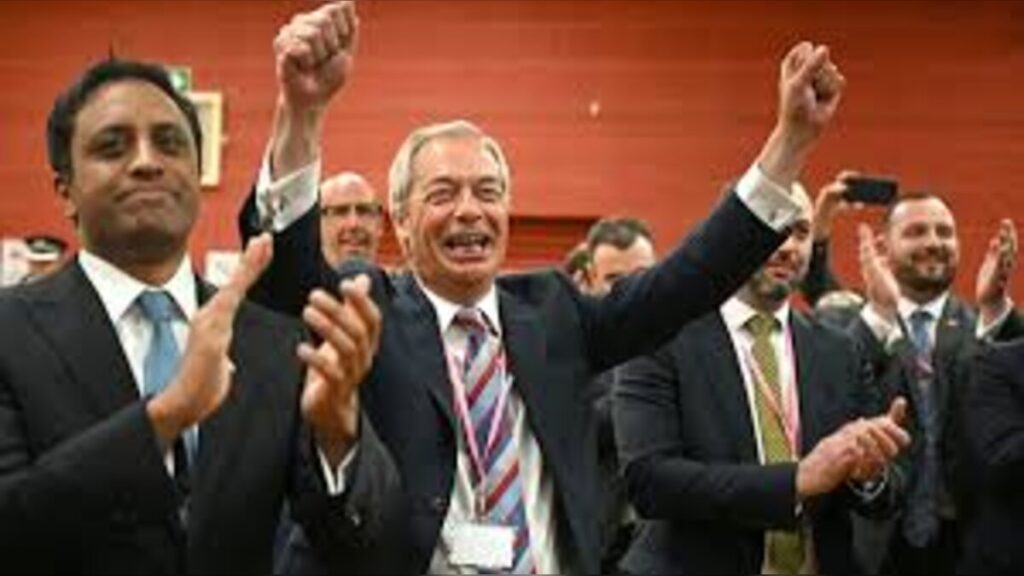
The latest round of local elections has delivered a bruising political moment for the Labour Party, with Nigel Farage’s Reform UK making dramatic gains across areas once considered safely Labour territory.
What began as a difficult night for Sir Keir Starmer quickly turned into a full-scale political warning sign for the party leadership.
Across England, particularly in former industrial strongholds known as the “Red Wall,” Labour candidates were swept aside as Reform UK surged forward.
The scale of the losses has triggered open panic within Labour ranks and renewed questions about whether Starmer can realistically survive as party leader until the next general election.
Reform UK Breaks Through in Labour Heartlands
Perhaps the most symbolic result came in Hartlepool, where Labour lost every available seat to Reform UK.
The result was especially painful because Hartlepool has long represented Labour’s traditional working-class base.
Losing the council entirely underlines how deeply voter loyalties are shifting.
The backlash did not stop there. In Tameside, an area closely associated with Deputy Prime Minister Angela Rayner, Labour managed to hold onto just a single seat while Reform swept through the borough.
In nearby Wigan, linked politically to senior Labour figure Lisa Nandy, Labour also lost every contested seat to Farage’s party.
These are not isolated areas. They are places that continued backing Labour even during the 2019 general election, when Boris Johnson’s Conservatives shattered Labour’s electoral map with their Brexit-driven campaign.
For Reform UK to now succeed where even the Conservatives previously struggled shows how volatile British politics has become.
Nigel Farage’s Party Moves Beyond Protest Politics
For years, Reform UK was dismissed by critics as a protest movement built mainly around Brexit frustration.
These elections suggest the party may now be evolving into something much larger.
Farage’s support still appears strongest in regions that voted heavily for Brexit, but the latest results show the party expanding beyond those boundaries.
Reform is expected to make breakthroughs in London councils while also improving its standing in Scotland and Wales.
That wider geographical spread matters politically.
It supports Farage’s argument that Reform UK is no longer simply a fringe movement but a national political force capable of seriously threatening both Labour and the Conservatives in a future general election.
Labour’s Problems Are Coming From Both Sides
One of the most damaging realities for Labour is that it is not losing support to only one rival.
The party is being squeezed from both directions politically.
On the Right, Reform UK is attracting working-class voters frustrated with immigration, economic pressures, and what many perceive as Labour’s disconnect from traditional communities.
On the Left, the Green Party has steadily chipped away at Labour’s urban progressive base.
Although the Greens have only recorded modest seat gains so far, their growing vote share is damaging Labour in tightly contested areas.
In many cities and metropolitan districts, Labour now faces an increasingly fractured electorate where voters dissatisfied with the party can defect in multiple directions.
That creates a serious strategic problem heading into future elections.




Conservatives Also Face a Difficult Night
While Labour suffered the biggest psychological blow, the Conservatives were hardly celebrating nationwide.
Kemi Badenoch’s party achieved some success in Westminster, reclaiming control of a flagship council, but elsewhere the picture looked grim.
In several southern and eastern regions, Reform UK appears to be draining large numbers of Conservative voters.
Essex, a county strongly associated with Conservative politics and home to several senior Tory figures, is now at risk of falling into Reform’s hands.
That possibility would have seemed almost unimaginable just a few years ago.
The election results therefore point to a broader collapse of Britain’s traditional two-party dominance, with both Labour and the Conservatives struggling to maintain voter loyalty.
Growing Pressure on Keir Starmer
Although Sir Keir Starmer publicly accepted responsibility for Labour’s disappointing performance, many inside the party appear unconvinced he can recover politically.
Reports emerging from Labour circles suggest some local leaders actively avoided having Starmer campaign in their constituencies because they feared his presence would hurt candidates.
Some MPs are reportedly describing him as politically toxic among voters.
That sentiment is especially dangerous because local election defeats alone rarely remove prime ministers or party leaders.
British political history is filled with leaders who survived difficult midterm elections.
What makes this moment different is the growing belief inside Labour that the problem is not temporary policy frustration but Starmer himself.
Increasingly, MPs fear he lacks the ability to reconnect with working-class voters or inspire enthusiasm among Labour supporters.
Why the “Red Wall” Matters So Much
The so-called Red Wall includes dozens of working-class communities across northern England and the Midlands that traditionally voted Labour for generations.
These areas became politically volatile after the Brexit referendum in 2016, when cultural identity, immigration concerns, and economic frustrations reshaped voting patterns.
Boris Johnson successfully captured many of these seats in 2019 by promising to “Get Brexit Done.”
Labour hoped those voters would eventually return once the Conservatives lost popularity.
Instead, Reform UK now appears to be inheriting much of that anti-establishment energy.
If Labour cannot rebuild trust in these communities, its path to winning a strong parliamentary majority becomes dramatically harder.
Impact and Consequences
The consequences of these elections could reshape British politics over the next few years.
First, Labour now faces a potential internal civil war over leadership.
Even if Starmer survives in the short term, pressure for a replacement is likely to intensify.
Second, Reform UK’s rise changes the electoral landscape for both major parties.
The Conservatives risk losing right-wing voters permanently, while Labour risks becoming trapped between progressive urban voters and culturally conservative working-class communities.
Third, the results may encourage tactical voting and coalition-style politics at local levels, especially as Britain’s traditional political loyalties continue weakening.
Finally, investors, businesses, and international observers may begin reassessing the stability of Britain’s political future if the next general election becomes a fragmented multi-party contest.
What’s Next?
In the immediate aftermath, Labour is expected to begin internal discussions about strategy, messaging, and leadership direction.
Some MPs will likely push for a more left-wing agenda, arguing the party has become too cautious under Starmer.
Others may call for a leadership transition before the next general election, believing a fresh face could prevent further electoral decline.
Meanwhile, Nigel Farage and Reform UK will attempt to build momentum from these results by presenting themselves as the authentic opposition to the political establishment.
The Conservatives also face difficult decisions.
Kemi Badenoch must find a way to stop Reform from peeling away traditional Tory voters while also rebuilding trust after years of political instability.
As Britain moves closer to the next general election, the country may be entering its most unpredictable political era in decades.
Summary
Labour’s poor showing in the local elections has exposed deep cracks inside the party and intensified doubts about Keir Starmer’s future leadership.
Reform UK emerged as the biggest winner of the night, making major gains in former Labour strongholds and positioning itself as a serious national force.
The elections also highlighted the growing collapse of Britain’s traditional two-party political structure, with both Labour and the Conservatives losing support from multiple directions.
While Starmer has accepted responsibility publicly, many inside Labour now believe he may not remain leader long enough to fight the next general election.
Bulleted Takeaways
- Reform UK made major gains across Labour’s traditional “Red Wall” areas.
- Labour lost every seat in Hartlepool to Reform UK.
- Tameside and Wigan also saw heavy Labour losses.
- Nigel Farage is increasingly positioning Reform UK as a national political force.
- Labour is losing support to both Reform UK and the Green Party.
- Conservatives also suffered losses as Reform attracted right-wing voters.
- Internal pressure on Keir Starmer is growing rapidly.
- Many Labour MPs reportedly believe Starmer cannot recover politically.
- Britain’s traditional two-party system appears increasingly fractured.
- The next general election could become one of the most unpredictable in modern UK history.

