
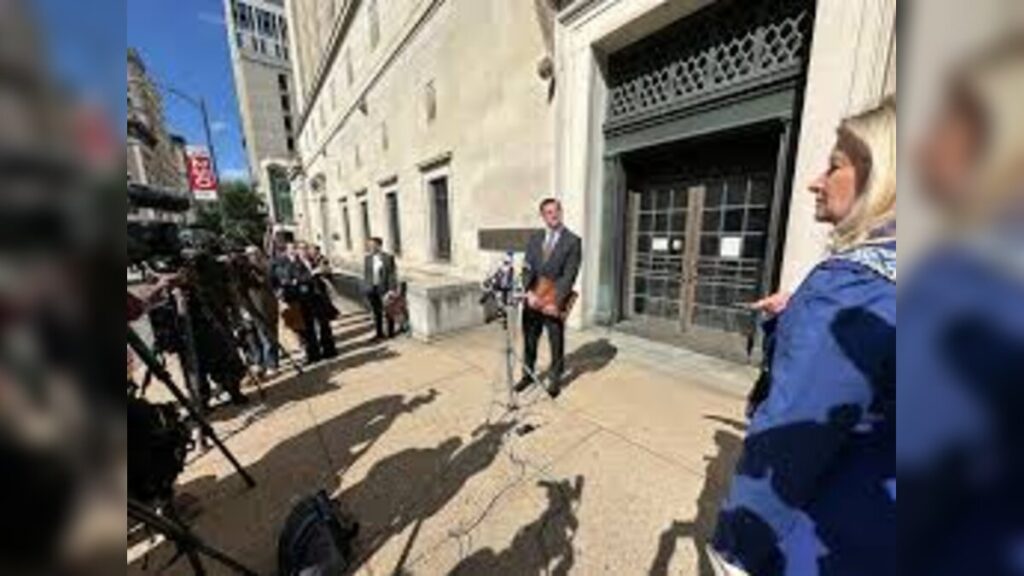
The political fight over how Virginia draws its congressional districts has taken a sharp turn after the Supreme Court of Virginia invalidated the results of a closely watched redistricting referendum.
The vote, which had narrowly passed just weeks earlier, is now wiped off the books, resetting a battle that was already heating up ahead of national elections.
What makes this moment stand out is not just the ruling itself, but how much was riding on that referendum.
It wasn’t a routine ballot issue—it was expected to reshape the balance of power in Washington from a relatively competitive split into a heavily one-sided map favoring Democrats.
How the Redistricting Plan Became a Political Flashpoint
At the center of the controversy was a proposal that could have shifted Virginia’s congressional representation from a 6–5 Democratic edge to something closer to a 10–1 advantage, according to projections tied to the new map.
That idea immediately triggered resistance from Republicans, who argued the process was rushed and legally flawed.
Democrats, on the other hand, defended it as a necessary response to aggressive redistricting efforts in other states controlled by the GOP.
The referendum itself was expensive and heavily contested.
The state spent about $5.2 million organizing the special vote, while political groups on both sides poured close to $100 million into advertising, organizing, and legal challenges.
The Constitutional Argument That Changed Everything
The legal dispute didn’t just focus on politics—it went deep into constitutional interpretation.
Virginia law requires amendments to pass through two sessions of the General Assembly, with timing tied to elections.
Republicans argued lawmakers pushed the amendment through at the wrong stage, especially after early voting had already begun.
Democrats insisted the term “election” refers strictly to Election Day in November, not the entire voting period.
That argument didn’t seem to fully convince the justices.
During oral hearings, several members of the court appeared doubtful about the broader interpretation, especially given the timing concerns raised by opponents.




In the end, the court sided with the argument that the process violated constitutional requirements, effectively voiding the referendum results entirely.
A Rare but Not Unprecedented Judicial Move
Overturning a voter-approved measure is not something courts do often, but it has happened before in Virginia history.
In 1958, the state’s highest court struck down a local referendum in Arlington after ruling it was unconstitutional, following a similar earlier approval by voters.
That historical context has added weight to the current decision, with legal analysts pointing out that courts typically step in only when procedural or constitutional violations are clear.
National Stakes Beyond Virginia
This isn’t just a state-level dispute. Redistricting has become one of the most powerful political tools in U.S. elections, especially in tightly divided regions.
Virginia has often been seen as a battleground where even small shifts in district boundaries can have national consequences.
That’s why both parties invested heavily in this case, viewing it as a preview of broader fights heading into the next midterm cycle.
The legal system has also seen similar tensions before.
In 2024, Virginia election-related disputes reached the U.S. Supreme Court when then-Attorney General Jason Miyares secured a last-minute ruling allowing a voter purge program to proceed just before Election Day.
That case showed how quickly election law battles can escalate beyond state borders.
Impact and Consequences
The immediate effect of the ruling is clear: the proposed congressional map is off the table, at least for now.
That preserves Virginia’s current political balance, which is more competitive than what the referendum would have created.
Politically, this is a setback for Democrats who were hoping to gain a stronger advantage in the U.S.
House through redistricting. For Republicans, it represents a legal victory that blocks what they saw as an aggressive partisan move.
Beyond party politics, the decision raises bigger questions about voter referendums and how far courts can go in overturning them.
It also reinforces how powerful procedural rules can be in determining electoral outcomes—even more than voter sentiment itself.
What’s Next?
The legal story may not be finished yet. There is already speculation that the dispute could be escalated to federal courts, including the U.S. Supreme Court, especially if new constitutional arguments are introduced.
On the state level, lawmakers may have to revisit the redistricting process entirely if they still want to pursue changes.
That would likely involve starting from scratch and ensuring full compliance with procedural requirements.
Meanwhile, political parties are expected to shift focus back to preparing for upcoming elections, where district boundaries—old or new—will still play a decisive role in campaign strategy.
Summary
The Supreme Court of Virginia has overturned a voter-approved redistricting referendum that would have significantly reshaped Virginia’s congressional map.
The decision halts a plan that could have shifted political power in the state and potentially influenced national House control.
The ruling rests on constitutional concerns about how and when the amendment process was carried out, making it one of the most significant election-related court decisions in recent Virginia history.
Bulleted Takeaways
- Virginia Supreme Court invalidated a narrow redistricting referendum approved by voters
- Proposed map could have shifted Virginia’s congressional split from 6–5 to 10–1
- State and outside groups spent over $100 million influencing the vote
- Court ruled the process violated constitutional amendment procedures
- Decision preserves current congressional map for now
- Case adds to growing national legal battles over redistricting and election rules
- Potential for escalation to federal courts remains open
- Outcome has major implications for upcoming U.S. House elections

