
Mali woke up to another grim chapter in its long-running insecurity crisis after Defence Minister Sadio Camara was killed in a deadly attack on his home in Kita, a town outside Bamako.
The strike, which officials say involved a car bomb, also claimed the lives of his second wife and two grandchildren.
The incident has shaken the already fragile junta-led government, coming at a time when the country is battling renewed offensives from jihadist groups and separatist rebels across multiple regions.
Coordinated assaults stretch army across Bamako and northern Mali
What made the situation worse was not just one attack, but a wave of coordinated strikes across several parts of the country.
Fighters linked to the Azawad Liberation Front (FLA) and the jihadist group JNIM reportedly launched simultaneous assaults targeting military positions.
By Sunday, fighting was still ongoing in areas including Kita, Kidal, Gao, and Sévaré.
These are not isolated flashpoints—they stretch across Mali’s vast northern and central belt, forcing the army into a scattered and reactive defence.
Security sources described the timing and coordination as deliberate, suggesting the goal was not full territorial control but disruption and psychological pressure on the state.
Kidal becomes symbolic battleground once again
One of the most sensitive flashpoints remains Kidal, a northern stronghold with deep historical significance for Tuareg separatists.
Reports suggest rebel fighters have now gained control of parts of the city after Malian forces and Russian-backed units reportedly agreed to withdraw from a military camp there.
Residents described seeing military convoys leaving positions, while armed groups began moving into streets shortly after.
Kidal has changed hands multiple times over the years.
It was retaken by Mali’s army with Russian Wagner support in 2023, ending more than a decade of rebel dominance—but control has remained unstable ever since.
Bamako on edge as fear spreads beyond the battlefield
Even in the capital’s outskirts, anxiety is rising.
Military checkpoints have increased, roads near key installations are blocked with barriers, tyres, and makeshift security measures.




In Senou, near Bamako’s airport, residents described a night filled with explosions and fear that still lingers.
Some say the sound of blasts continues to echo mentally long after the violence stops, reflecting how deeply the conflict is affecting civilians far from the frontlines.
Government insists it is in control despite rising pressure
Despite the intensity of the attacks, Mali’s government insists the situation is under control in all affected areas.
Officials reported casualties among both civilians and soldiers, along with limited material damage.
However, the scale and spread of the attacks have raised questions about how stable that control really is.
International reactions have been swift. The United Nations Secretary-General Antonio Guterres condemned the violence and called for stronger coordinated global support to address extremist threats in the Sahel.
The European Union also labelled the incidents as terrorist attacks and condemned them.
Russia’s growing role and shifting alliances in Mali’s conflict
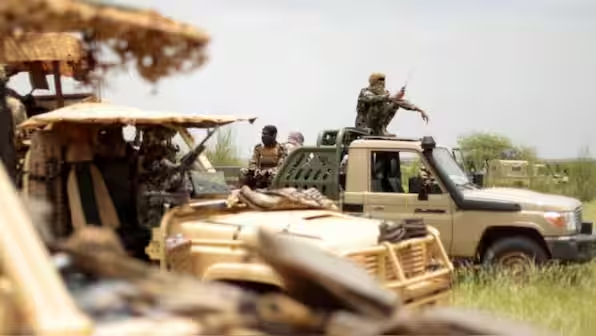
Mali’s military response continues to rely heavily on foreign support, particularly from Russia’s Africa Corps, which replaced the Wagner Group after its restructuring.
Russian personnel now operate alongside Malian forces in counter-insurgency efforts.
This shift comes after Mali, along with neighbours Niger and Burkina Faso, distanced itself from France and several Western allies in favour of new security partnerships with Russia.
The country’s vast mineral wealth, including gold reserves, adds another layer of geopolitical interest to the conflict.
Impact and Consequences
The killing of the defence minister is more than a symbolic loss—it directly affects military leadership at a time of escalating multi-front conflict.
It also signals that even high-level officials are no longer beyond reach, increasing fear within government ranks.
The simultaneous attacks across multiple regions suggest a growing coordination among armed groups, putting serious strain on Mali’s already stretched military forces.
For civilians, the consequences are immediate: displacement risk, disrupted movement, and rising insecurity in both rural and urban areas.
Internationally, the instability raises concerns about further spillover across the Sahel region, which is already one of the world’s most fragile security zones.
What’s next?
In the short term, Mali’s military is expected to intensify counter-offensives, especially around strategic cities like Kidal and Gao.
Diplomatic pressure will likely increase as global partners push for coordinated counter-terrorism strategies in the Sahel.
There may also be renewed negotiations or tactical repositioning in contested northern areas, especially if holding territory proves too difficult for any single side.
Longer term, the country faces a continuing struggle between military control, rebel influence, and jihadist expansion unless a broader political solution is found.
Summary
Mali is facing one of its most serious security crises in recent years following the death of Defence Minister Sadio Camara in a car bomb attack in Kita.
Coordinated assaults by jihadist and separatist groups have stretched the military across multiple regions, including Bamako’s outskirts and key northern cities like Kidal and Gao.
While the government insists it remains in control, fear, instability, and international concern continue to rise.
Bulleted Takeaways
- Mali’s Defence Minister Sadio Camara killed in car bomb attack in Kita
- His wife and two grandchildren also died in the explosion
- Coordinated attacks hit multiple cities including Kidal, Gao, and Sévaré
- Jihadist JNIM and Tuareg-linked FLA involved in simultaneous offensives
- Fighting continues near Bamako and northern strongholds
- Rebels reportedly gaining ground in Kidal after military withdrawal
- UN and EU condemn attacks and call for stronger international response
- Russia’s Africa Corps now supports Mali’s military after Wagner exit
- Government claims situation is under control despite widespread violence
- Crisis raises fears of deeper instability across the Sahel region

