
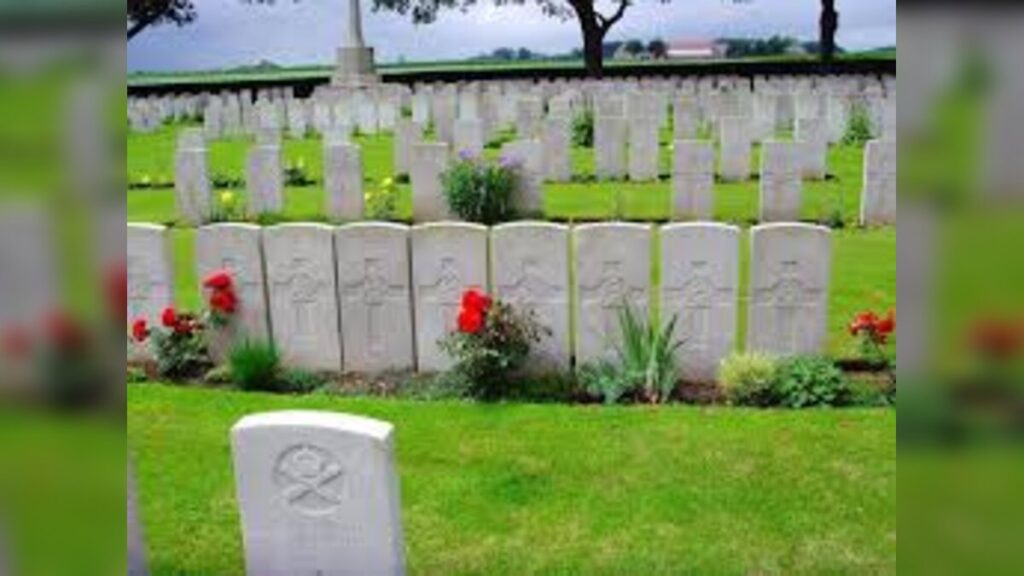
For more than a century, two graves in Belgium stood silently marked only as “unknown officers” from the First World War.
But in a powerful historical breakthrough, Captain Gordon Cuthbert and Lieutenant Leslie Harvey have finally been identified—restoring their names to their resting places nearly 111 years after they were killed near Ypres.
The discovery has brought emotional closure to families, historians, and military teams who have spent years piecing together fragments of wartime records.
How Two Unnamed Soldiers Were Reclaimed by History
The breakthrough came through detailed investigation by the UK Ministry of Defence’s Joint Casualty and Compassionate Centre (JCCC), often called the “War Detectives.”
Their work, alongside independent researchers and archival digging, connected battlefield records, burial notes, and military insignia evidence.
What had once been two unnamed officers buried in Commonwealth War Graves Commission cemeteries are now confirmed as:
- Captain Gordon Cuthbert of Sunbury, Middlesex
- Lieutenant Leslie Harvey of Windsor
Both men served in the 1/8 Battalion, Duke of Cambridge’s Own Middlesex Regiment, and both were killed on the same day—25 April 1915—during fierce fighting near Ypres.
The Final Moments on the Battlefields of Ypres
The First World War battlefields around Ypres in Belgium were among the most brutal on the Western Front.
In April 1915, German forces launched intense assaults involving poison gas and heavy infantry attacks.
Captain Cuthbert was reportedly killed while leading a storming party to retake a trench.
Lieutenant Harvey died during a bayonet charge in the Zonnebeke area.
At the time, chaos made proper burial and record-keeping nearly impossible.
As a result, both men were initially listed as missing and later commemorated on the Menin Gate Memorial alongside thousands of others whose bodies were never identified.
How the “Unknown” Status Finally Changed
After the war, unidentified remains recovered near the Ypres-Roulers railway line were buried as unknown officers.



Uniform fragments and insignia confirmed rank and regiment, but personal identity remained a mystery for decades.
Recent research changed that.
A combination of:
- Military archive re-examination
- Cemetery record cross-checking
- Independent historical research contributions
helped confirm that these remains belonged to Cuthbert and Harvey.
This allowed the Commonwealth War Graves Commission to replace the generic headstones with properly named ones.
Emotional Rededication Ceremonies in Belgium
On 29 April 2026, formal rededication services were held at two Commonwealth War Graves Commission sites:
- Tyne Cot Cemetery for Captain Cuthbert
- Sanctuary Wood Cemetery for Lieutenant Harvey
Military personnel from the Princess of Wales’s Royal Regiment attended alongside chaplains and ceremonial guards.
The Last Post was played as standards were lowered in honour of the fallen officers.
Officials described the moment as deeply symbolic, especially as it came almost exactly 111 years after their deaths.
Voices Behind the Identification
JCCC caseworker Alexia Clark praised the independent researcher whose efforts helped unlock the case, noting that without their persistence, the identities might have remained unknown.
CWGC commemorations officer Polly Brewster also highlighted the significance of restoring names to graves after more than a century, saying it ensures the men are remembered with dignity and permanence.
Other Known Facts About the Two Officers
Both men had notable military backgrounds before the war:
- Gordon Cuthbert joined the London Rifle Brigade in 1894 and later became a captain in the Middlesex Regiment’s Twickenham Company
- Leslie Harvey served in the Inns of Court Officer Training Corps and received his commission shortly after the war began in 1914
Both were career-oriented officers who quickly answered the call to serve when war broke out.
Impact and Consequences
The identification of the two officers carries wider significance beyond historical correction.
It:
- Restores identity and dignity to previously unnamed war dead
- Strengthens ongoing efforts by military historians to resolve missing-in-action cases
- Highlights the importance of archival preservation and battlefield archaeology
- Reaffirms commitment by the Commonwealth War Graves Commission to maintain and correct historical records
It also reminds modern audiences how many wartime stories remain incomplete even a century later.
What’s Next?
The JCCC and CWGC continue to review other unidentified graves from World War One and World War Two.
More identifications are expected as:
- Digital archive analysis expands
- Private researchers contribute findings
- DNA and forensic techniques improve
There is also growing interest in encouraging descendants of WW1 soldiers to come forward with family records that may assist ongoing investigations.
Summary
After 111 years, Captain Gordon Cuthbert and Lieutenant Leslie Harvey have finally been named at their graves in Belgium.
Their identities were confirmed through detailed historical investigation, allowing their headstones to be replaced with their names.
The discovery closes a long-standing gap in WW1 remembrance and reinforces the ongoing mission to identify unknown war dead.
Bulleted Takeaways
- Two WW1 officers were identified after 111 years as Captain Gordon Cuthbert and Lieutenant Leslie Harvey
- Both served in the Middlesex Regiment and died on 25 April 1915 near Ypres
- They were originally buried as unknown officers in Belgium
- Identification was made by the UK’s Joint Casualty and Compassionate Centre
- Independent researchers played a key role in solving the case
- New headstones were unveiled at Tyne Cot and Sanctuary Wood cemeteries
- Ceremonies included military honours and Last Post tributes
- The Commonwealth War Graves Commission will maintain their graves permanently
- The case highlights ongoing efforts to identify unknown soldiers from world wars

