
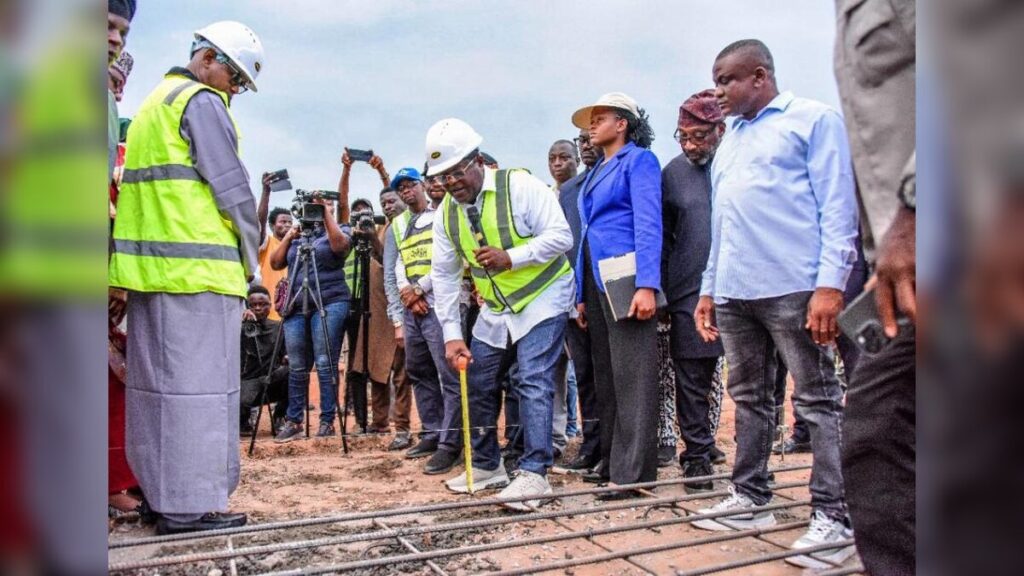
The dream of a seamless coastal highway linking five West African nations is still alive, but it’s clearly entering a more complicated phase.
At a high-level meeting in Abuja, the Federal Government reaffirmed its commitment to the 1,028-kilometre Lagos–Abidjan Corridor Highway Project, while also raising serious concerns about design alignment, funding clarity, and how responsibilities are shared across participating countries.
The discussion, led by Works Minister David Umahi, brought together representatives from the ECOWAS Commission and the African Development Bank.
What emerged was a familiar tension in African megaprojects: big ambition meeting uneven implementation realities.
Nigeria Draws a Line on Engineering Standards
Nigeria didn’t just reaffirm commitment — it also pushed back.
Umahi made it clear that while the country supports the project politically, it is not willing to simply adopt a one-size-fits-all design.
He argued that the engineering blueprint provided under ECOWAS guidance contains gaps that don’t reflect real-world conditions along the corridor.
In practical terms, Nigeria’s section of the highway — roughly 79.5 kilometres — will not follow the originally proposed format.
Instead, the government is opting for reinforced concrete construction and a three-lane carriageway in each direction, a more durable and capacity-heavy design.
That decision alone signals a shift: Nigeria is treating its segment not just as a link in a regional chain, but as a standalone infrastructure asset built to higher national standards.
A Five-Country Vision With Uneven Ground Reality
The highway is designed to connect Côte d’Ivoire, Ghana, Togo, Benin, and Nigeria, forming a continuous transport spine along the West African coast.
But as officials admitted in Abuja, the corridor is not evenly distributed.
Some countries carry longer stretches, others shorter — and that imbalance is now a political sticking point that can’t be resolved at technical level alone.
Umahi was blunt about it: only Heads of State can settle the dispute over fair distribution and alignment of responsibilities.
That kind of statement reflects how quickly technical projects become diplomatic negotiations in regional infrastructure work.
Funding Questions Hanging Over the Project
Beyond engineering disagreements, money remains the other major hurdle.
The African Development Bank, represented at the meeting by Salawou Mike Moukaila, reiterated strong interest in financing the corridor.
But interest is not the same as agreement on structure.



The key issue is sequencing: who funds what, when procurement begins, and how risk is shared among countries and financiers.
Nigeria’s position is cautious — no procurement should begin until design standards and funding models are fully agreed at political level.
That kind of delay is not unusual in ECOWAS-led infrastructure projects, where alignment between countries often takes longer than construction itself.
Nigeria Expands Its Own Highway Network in Parallel
While regional negotiations continue, Nigeria is pushing ahead with domestic infrastructure expansion that will eventually connect into the corridor.
Projects linked to the broader network include the Sokoto–Badagry Superhighway and the Lagos–Calabar Coastal Highway.
According to updates shared at the meeting, sections of these highways are already under construction, with some nearing completion.
One Lagos section is expected to be commissioned soon, while other stretches toward Ogun State and beyond are progressing in phases.
This parallel development strategy suggests Nigeria is not waiting for full regional alignment before advancing its own transport infrastructure.
Regional Integration Still the Big Prize
Despite the disagreements, no one in the room questioned the long-term value of the project.
The Lagos–Abidjan corridor is widely seen as a cornerstone of West African economic integration.
It is expected to reduce transport costs, improve trade flows, and strengthen connectivity between major ports and commercial hubs.
ECOWAS officials emphasized that consultations have already been completed with several member states, while the African Development Bank is actively designing financing frameworks and attracting co-funders.
The message was clear: the vision is intact, even if the execution path is still being debated.
Impact and Consequences
This renewed scrutiny has both positive and risky implications.
On one hand, Nigeria’s insistence on higher standards could raise the overall quality of the entire corridor if other countries follow suit.
On the other hand, disagreements over design and funding could slow down procurement timelines significantly.
There is also a broader political implication: regional infrastructure projects depend heavily on trust between governments.
Any perception of imbalance — whether in cost, length, or benefit — can delay progress for years.
For investors and development banks, uncertainty around timelines may also affect financing momentum, even if interest remains strong.
What’s Next?
The next phase now depends on political coordination rather than technical planning.
Heads of State across the five countries will likely need to meet to resolve design harmonisation and funding distribution.
Until that happens, full-scale construction is unlikely to proceed beyond national segments.
Meanwhile, Nigeria will continue refining its internal design and advancing related highway projects independently.
ECOWAS and development partners are expected to keep pushing consultations to prevent momentum loss.
Summary
The Lagos–Abidjan Corridor Highway remains one of West Africa’s most ambitious infrastructure plans.
Nigeria has reaffirmed its support, but also raised major concerns about design standards, funding structure, and fairness among participating countries.
While technical teams continue discussions, political leadership will ultimately determine how — and when — the project moves forward.
Bulleted Takeaways
- Nigeria supports the Lagos–Abidjan Corridor but wants design and funding renegotiated
- Works Minister David Umahi insists on higher construction standards for Nigeria’s section
- The project connects five countries across West Africa, but corridor length is unevenly distributed
- ECOWAS and African Development Bank remain committed but face coordination challenges
- Funding structure and procurement timing remain unresolved major issues
- Nigeria is advancing related domestic highway projects in parallel
- Final decisions likely depend on Heads of State-level negotiations
- Project success could significantly boost regional trade and integration if disagreements are resolved

