
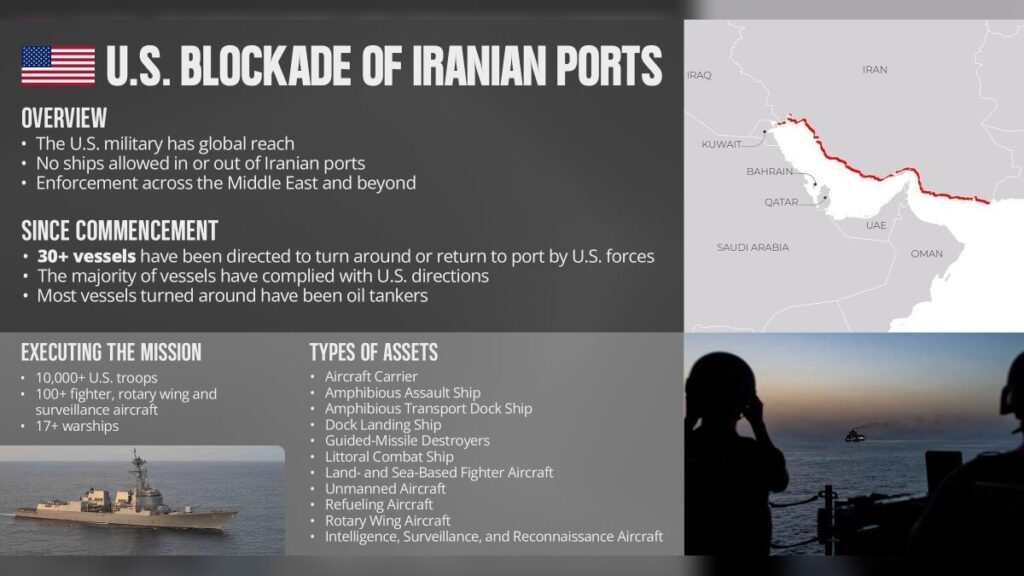
U.S. forces have redirected 31 vessels, ordering them to either turn around at sea or head back to port as part of the American blockade targeting Iran.
The operation appears to be focused on restricting movement in and out of Iranian ports, with oil tankers making up most of the ships affected so far.
Blockade Framed as a Broad Military Operation
The blockade is being presented as more than a narrow naval patrol. It is described as a wide-reaching military effort backed by U.S. power across the region and beyond.
The goal, according to the details in the graphic, is to stop maritime traffic connected to Iranian ports and enforce those restrictions across key Middle East waterways.
Most Ships Reportedly Complied
Since the blockade began, the majority of vessels contacted by U.S. forces are said to have followed instructions.
Out of the 31 ships redirected, most reportedly complied without major confrontation.
The vessels most commonly forced to change course were oil tankers, highlighting the pressure being placed on commercial energy movement linked to Iran.
Heavy U.S. Military Presence Behind the Mission
The image describes a large-scale force supporting the operation. It says the mission involves more than 10,000 U.S. troops, over 100 aircraft, and at least 17 warships.
That level of deployment suggests the blockade is being enforced with a strong mix of naval, air, and surveillance capability rather than with a limited maritime presence.
Types of Assets Involved
A wide range of military equipment is listed as part of the operation.
These include an aircraft carrier, amphibious assault ships, amphibious transport dock ships, dock landing ships, guided-missile destroyers, littoral combat ships, land- and sea-based fighter aircraft, unmanned aircraft, refueling aircraft, rotary-wing aircraft, and intelligence, surveillance, and reconnaissance platforms.



Taken together, those assets point to a mission designed for constant monitoring and rapid response.
Strategic Focus on the Gulf Region
The map in the image places attention on the waters near Iran’s southern coast and the wider Gulf area, including the route near the Strait of Hormuz.
That location is one of the world’s most sensitive shipping corridors, especially for oil transport. Any disruption there carries weight far beyond the region because of its importance to global energy trade.
Impact and Consequences
The immediate impact of the blockade is on commercial shipping, especially tankers linked to Iranian port activity.
Redirecting vessels can delay cargo movement, raise operating costs, and create uncertainty for shipping companies and energy markets.
The longer such restrictions remain in place, the more likely they are to affect trade flows, insurance costs, and regional tensions.
There is also a broader geopolitical effect.
A blockade of this scale signals that the U.S. is prepared to use significant military resources to control maritime access around Iran.
That raises the risk of further confrontation, even if most ships continue to comply without incident.
What’s next?
The next phase will likely depend on whether vessels keep obeying U.S. directives and whether Iran or shipping operators try to challenge the restrictions.
If compliance remains high, the blockade may continue as a pressure campaign aimed at limiting Iran’s maritime and oil-related activity. If resistance grows, the situation could become more tense, especially in already sensitive Gulf waters.
Much will also depend on how long the U.S. chooses to maintain such a large military posture in the area.
Sustained enforcement would point to a longer-term strategy rather than a short-term show of force.
Summary
The reported redirection of 31 vessels shows that the U.S. blockade against Iran is already having visible effects at sea.
Most of the ships ordered back were oil tankers, and most appear to have complied.
Backed by thousands of troops, dozens of warships, and a large air component, the operation is being framed as a major enforcement effort centered on blocking access to Iranian ports and controlling movement in nearby strategic waters.
Bulleted Takeaways:
- U.S. forces have directed 31 vessels to turn around or return to port.
- The action is part of a blockade aimed at stopping ships from entering or leaving Iranian ports.
- Most of the redirected vessels were reportedly oil tankers.
- The majority of ships contacted by U.S. forces are said to have complied.
- The operation is described as involving more than 10,000 troops, 100-plus aircraft, and at least 17 warships.
- Military assets listed include carriers, destroyers, amphibious ships, surveillance aircraft, drones, and refueling aircraft.
- The blockade is centered on strategically important Gulf waters near Iran.
- The move could disrupt shipping, increase regional tensions, and put added pressure on Iran’s maritime trade.
