
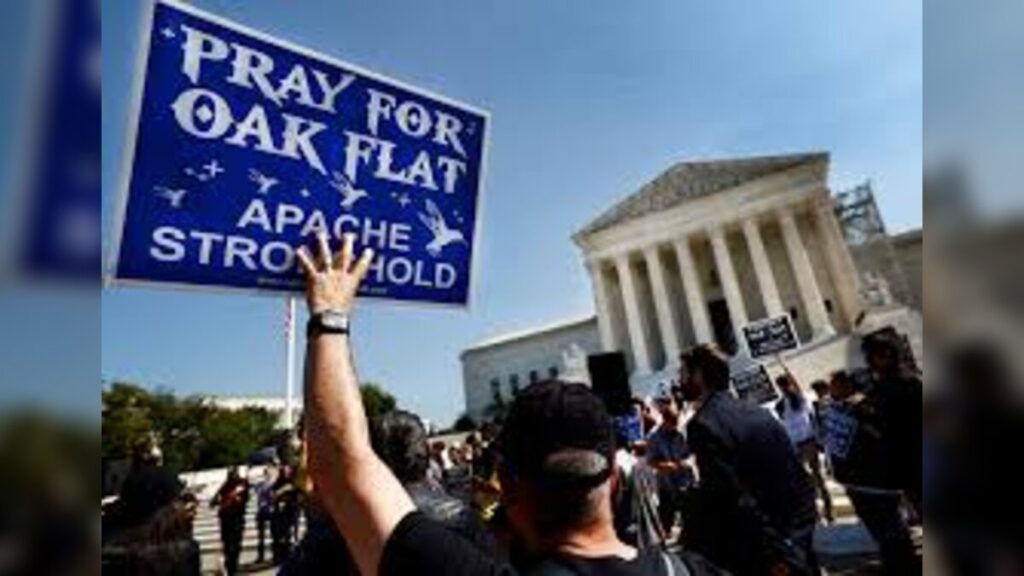
A long-running legal battle over a sacred Native American site has resurfaced in the United States, with a new court filing attempting to stop the transfer of land to a major mining company.
The land at the center of the dispute is Oak Flat, a site considered deeply spiritual by the Western Apache people.
The group leading the legal fight, known as Apache Stronghold, has been challenging the planned transfer for years, arguing that it threatens both their religious freedom and cultural heritage.
A Fight Over Oak Flat That Refuses to End
The controversy revolves around Oak Flat, a site located in Arizona that holds ceremonial and spiritual significance for Apache communities.
The land is scheduled to be transferred to Resolution Copper, which plans to carry out mining operations in the area.
Despite repeated legal defeats, Apache Stronghold continues to argue that the land transfer violates U.S. religious freedom protections.
Their position is that destroying or altering the site would permanently interfere with sacred practices tied to the land.
The group has already taken the case through multiple levels of the U.S. court system, including an unsuccessful appeal to the U.S. Supreme Court, which declined to hear the case in October 2025.
New Legal Push and Strong Accusations
On April 22, Apache Stronghold returned to federal district court with an amended lawsuit.
The filing, supported by the religious liberty law firm Becket, accuses the federal government of rushing the land transfer process.
According to senior attorney Luke Goodrich, the transfer was accelerated in a way that avoided meaningful judicial oversight.
The lawsuit claims this approach was not only improper but unconstitutional.
The group is asking the court to reverse the transfer entirely and block mining activity at Oak Flat, arguing that religious freedom protections under U.S. law are being ignored.
Legal Arguments and Treaty Claims
The lawsuit is built around several legal claims.




One of the central arguments is that the land transfer violates the U.S. Religious Freedom Restoration Act, a law designed to protect individuals and groups from government actions that substantially burden religious practice.
In addition, the case references constitutional protections under the First Amendment, which safeguards religious liberty in the United States.
A lesser-known but important part of the argument is the 1852 Treaty of Santa Fe, which Apache representatives say guarantees certain protections between the U.S. government and Apache nations.
Religious and Institutional Support Grows
The case has drawn support beyond Indigenous advocacy circles.
In 2024, the United States Conference of Catholic Bishops joined an amicus brief supporting Apache Stronghold’s position, describing earlier court rulings as a misunderstanding of religious freedom protections.
Similarly, the Knights of Columbus also filed legal support, arguing that limiting religious protections in this case would contradict the intent of federal law.
This unusual coalition highlights how the case has evolved beyond a land dispute into a broader debate about religious rights in the United States.
Mining Plans and Economic Pressure
On the other side of the dispute, Resolution Copper has pushed forward with plans to begin exploratory drilling at Oak Flat.
According to court filings from March 2025, early-stage work was scheduled to begin shortly after regulatory approvals.
The project is seen as economically significant, with estimates suggesting it could become one of the largest copper mining operations in North America.
However, critics argue that economic gains should not come at the expense of destroying a sacred Indigenous site.
Impact and Consequences
This case has far-reaching implications beyond Oak Flat itself.
If the land transfer proceeds, it could set a precedent for how sacred Indigenous sites are treated under U.S. law, especially when they overlap with commercial development interests.
A ruling against Apache Stronghold, on the other hand, could narrow interpretations of religious freedom protections, particularly for land-based spiritual practices that do not fit into conventional legal frameworks.
There are also broader cultural consequences. Indigenous groups across the United States are watching closely, as similar disputes over sacred land continue to surface in other regions.
What’s Next?
The immediate next step is the district court’s review of the amended lawsuit.
Depending on how the court responds, the case could move through appeals again, potentially reaching higher federal courts.
Meanwhile, Resolution Copper’s long-term mining plans remain in motion, though further legal delays could impact project timelines.
If negotiations or legal rulings do not resolve the dispute, the conflict may continue for years, reflecting a broader tension between economic development and cultural preservation.
Summary
The legal battle over Oak Flat has returned to court as Apache Stronghold seeks to block the transfer of sacred land to Resolution Copper.
The group argues that the move violates religious freedom laws and treaty protections.
With support from major religious organizations and ongoing mining interests, the case continues to highlight a deep conflict between cultural preservation and economic development in the United States.
Bulleted Takeaways
- Apache Stronghold is challenging the land transfer of Oak Flat
- The land is set to be transferred to Resolution Copper for mining development
- The group previously lost appeals, including a U.S. Supreme Court rejection in 2025
- A new amended lawsuit was filed in April 2026 with support from Becket
- Claims include violations of the Religious Freedom Restoration Act, First Amendment, and the 1852 Treaty of Santa Fe
- The United States Conference of Catholic Bishops and Knights of Columbus support Apache Stronghold
- Resolution Copper planned exploratory drilling at Oak Flat as early as March 2025
- The case could influence future U.S. law on sacred Indigenous lands and development projects

