
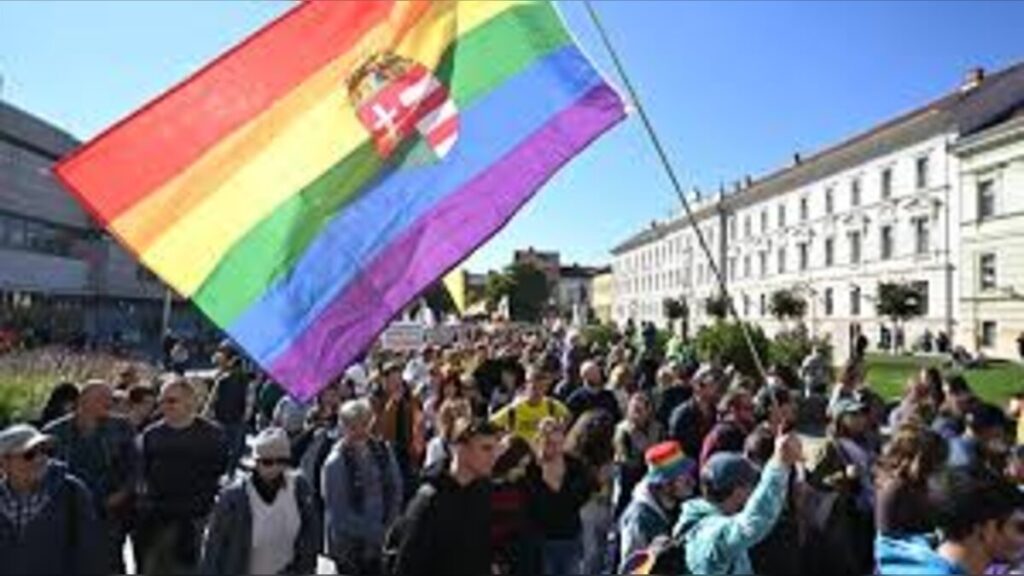
A major legal showdown in Europe just reached a turning point after the Court of Justice of the European Union (CJEU) ruled that Hungary’s 2021 legislation on LGBTQ-related content breaches the EU’s core values.
The decision didn’t just settle a dispute—it set a legal precedent that could reshape how member states balance national policy with union-wide rights protections.
The ruling focused on a controversial law passed under Hungary’s long-time leader Viktor Orbán, which combined child protection measures with restrictions on LGBTQ-related content in education and media accessible to minors.
What the Court Actually Said
At the centre of the judgment is Article 2 of the Treaty on European Union, which outlines the foundational values shared across all member states.
For the first time, the EU’s top court found that a member state had violated these values directly.
Judges described parts of the Hungarian law as a “coordinated series of discriminatory measures,” arguing that it unfairly targeted non-cisgender and non-heterosexual individuals.
The ruling emphasized that such provisions undermine equality, human dignity, and the rights of minorities—principles that sit at the heart of EU law.
The Law That Sparked the Case
The 2021 legislation was originally framed as a child protection measure, strengthening penalties against child abuse and restricting access to certain sexual content for minors.
However, critics argued that it went much further, limiting how LGBTQ and gender-related topics could be discussed in schools and public materials accessible to young people.
The European Commission escalated the issue to court, accusing Hungary of failing to meet its obligations under EU treaties.
That legal action ultimately led to this landmark judgment.
A Clash Between National Sovereignty and EU Values
Beyond the legal language, the ruling exposes a deeper political tension: how much control individual countries should have over education, culture, and moral regulation versus the EU’s authority to enforce shared rights standards.
Legal scholars have pointed out that this case highlights a long-running debate inside the union—especially when it comes to sensitive issues like sexuality, parenting, and education policy.




Some argue that Brussels is expanding its reach too far, while others see the court’s intervention as necessary to protect fundamental rights.
Political Reactions and Backlash
Unsurprisingly, the ruling triggered sharp political reactions.
Orbán responded defiantly, accusing the EU of ideological interference and framing Hungary’s stance as a defence of children and national sovereignty.
His remarks reflected a broader narrative he has consistently used in disputes with Brussels.
At the same time, many Western governments and rights groups welcomed the decision, while conservative commentators and outlets such as the Hungarian Conservative criticized it as judicial overreach.
The divide reflects a wider cultural and political split across Europe, where questions of identity, rights, and tradition are increasingly politicized.
Timing and Electoral Underpinnings
The ruling also comes in a politically sensitive moment following Hungary’s recent elections, where a new governing direction is expected under the party Tisza, led by Péter Magyar.
Analysts have been split on what this shift might mean for Hungary’s future stance on LGBTQ-related policies.
Some observers suggest the transition could soften tensions with the EU, while others believe the new leadership may continue aspects of Orbán’s conservative social agenda, particularly around family and education policies.
Impact and Consequences
This decision marks a significant expansion of how EU law can be used to enforce fundamental rights across member states.
It signals that national laws framed under “child protection” will still be scrutinized if they are found to discriminate or restrict minority rights.
Politically, it increases pressure on Hungary’s leadership to adjust or defend its legislation in ongoing legal and diplomatic battles with Brussels.
It may also influence other EU countries watching closely how far they can push cultural or social legislation without triggering similar legal consequences.
At a broader level, the ruling intensifies the ideological divide within the EU, especially between governments prioritizing traditional values and those emphasizing expanded equality protections.
What’s Next?
Hungary now faces increased legal and political scrutiny from EU institutions.
The ruling could lead to enforcement actions, financial penalties, or continued negotiations over compliance.
On the political side, the new Hungarian leadership will likely have to decide whether to amend the law, defend it in a revised form, or risk further conflict with EU institutions.
Meanwhile, similar cultural legislation in other member states may also come under review as the precedent spreads.
Summary
The CJEU ruling against Hungary’s 2021 law is more than a legal judgment—it is a defining moment in the ongoing struggle over values inside the European Union.
It confirms that EU fundamental rights can override national legislation when discrimination is found, setting the stage for future legal and political clashes.
Bulleted Takeaways
- EU Court ruled Hungary’s 2021 law breaches core EU values
- Case is the first involving Article 2 of the EU Treaty on fundamental values
- Law combined child protection rules with restrictions on LGBTQ content
- Court found discriminatory impact on non-cisgender and non-heterosexual individuals
- European Commission initiated legal action against Hungary
- Viktor Orbán defended the law as child protection and cultural sovereignty
- Political and media reactions split sharply across ideological lines
- Ruling intensifies EU–Hungary tensions over rights vs national authority
- Hungary’s new political leadership may influence future legal direction
- Decision sets a precedent for future EU-wide human rights enforcement challenges

