
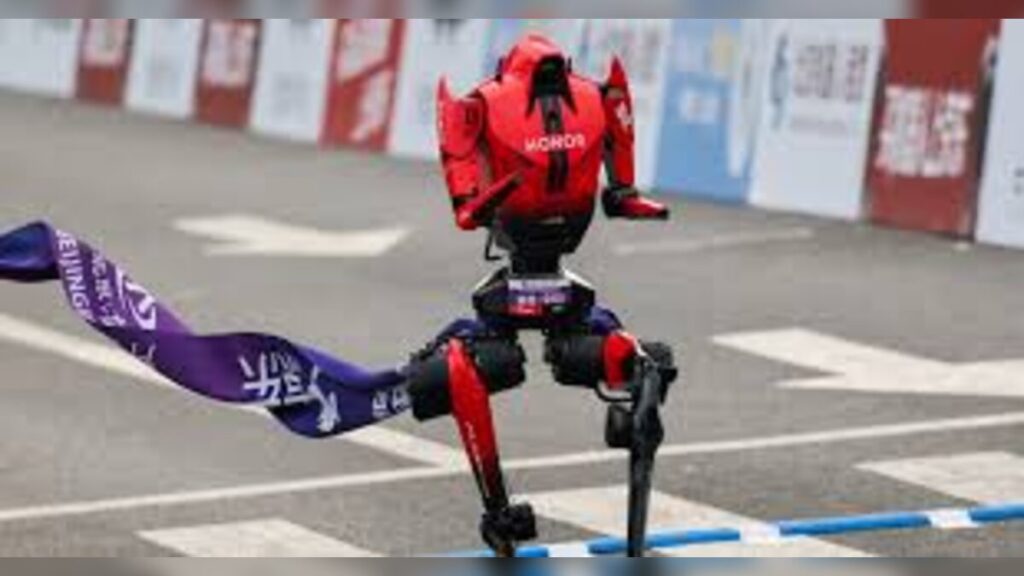
It started with something that looked almost like a normal race mishap, the kind you scroll past online without thinking twice.
But the clip from a roadside in Beijing quickly became something else entirely—half sports footage, half robotics experiment gone wrong.
A humanoid robot, wearing what looked like a red bandana, misjudged a raised cable cover on the road during a trial run ahead of the Beijing Half Marathon.
The stumble looked dramatic on camera, and for a moment it seemed like the machine had completely fallen apart.
The internet did what it always does: replayed it, zoomed in, and turned it into a talking point far bigger than the moment itself.
From a Clumsy Fall to a Record-Breaking Machine
What makes the story even more unusual is what came next.
Just days after that chaotic trial scene, a humanoid robot named Lightning showed up at the same event and completed the half marathon course in a staggering 50 minutes and 26 seconds.
The machine was developed by Honor, a company better known for smartphones than endurance robotics.
To put that in perspective, that time is faster than many elite human athletes and significantly ahead of earlier robot attempts in similar races.
The contrast between the stumble and the record run made the whole event feel like two different timelines of technology colliding in the same weekend.
Why Beijing Is Becoming a Robot Testing Ground
China has been steadily turning public sporting events into live testing environments for robotics.
The half marathon is part of a wider push that includes exhibitions like the World Humanoid Robot Games, where humanoid machines compete in tasks ranging from sprinting to basic coordination challenges.
In earlier editions, many robots struggled with balance, coordination, and even simple navigation.
Some collided with humans, others toppled mid-race, and a few barely finished at all.




But each year the progress is visible—and fast.
More Than Entertainment: A Tech Race in Disguise
Behind the spectacle is a serious global competition.
Countries like the United States, Japan, and China are investing heavily in humanoid robotics, not just for entertainment but for logistics, healthcare, manufacturing, and even defence applications.
Sport has become a convenient “showroom”—a way to test balance, speed, reaction time, and decision-making in unpredictable environments.
Experts in robotics have noted that what looks like entertainment is often industrial testing in disguise, with companies using races and matches to refine movement systems under pressure.
The Question Nobody Can Fully Answer Yet
The most debated idea is whether robots will ever become a real part of competitive sport—not just as tools or assistants, but as actual athletes.
Some observers believe it’s inevitable that robotic competitions will grow into something closer to leagues, especially as public curiosity increases.
Others think the appeal is more about novelty than long-term entertainment.
Still, interest is rising. Surveys in recent years have shown a surprising number of younger sports fans open to watching robotic leagues, particularly in combat sports and football-style simulations.
Impact and Consequences
The rapid progress shown in events like the Beijing half marathon has several ripple effects.
First, it pushes robotics companies to accelerate development, especially in balance control and autonomous movement.
Second, it raises ethical and social questions about what “sport” means if human limits are no longer the benchmark.
There is also an economic angle. Public demonstrations attract investment, and investment fuels faster development.
That cycle could eventually lead to commercial robotic sports leagues or hybrid events featuring both humans and machines.
At the same time, there is concern that spectacle could outpace safety standards, especially if robots are pushed into unpredictable real-world environments too quickly.
What’s Next?
The next phase is already scheduled, with China planning further humanoid robot competitions and expanded events following the momentum of the World Humanoid Robot Games.
Elsewhere, smaller robotics demonstrations are beginning to appear in cities like Boston and Tokyo, often linked to universities and private labs.
The bigger question is whether these experiments remain niche showcases—or evolve into structured global competitions with audiences, sponsors, and rankings.
Summary
A viral robotics mishap in Beijing quickly turned into a broader story about how fast humanoid machines are evolving.
Within days of a dramatic fall during a race trial, a robot named Lightning completed a half marathon in record time, highlighting just how quickly the technology is advancing.
The event reflects a growing global push to use sport as a testing ground for robotics innovation.
Bulleted Takeaways
- A humanoid robot had a dramatic fall during a trial run ahead of the Beijing Half Marathon
- The incident went viral, sparking global attention to robotics in sport
- Lightning, developed by Honor, completed the race in 50:26
- The time is faster than earlier robot marathon attempts and many human benchmarks
- China is expanding robotics showcases through events like the World Humanoid Robot Games
- Robotics is increasingly used as a testing ground for real-world industrial applications
- Global interest is growing in potential robot sports leagues, especially among younger audiences
- The technology race between major countries is accelerating investment and innovation
- Future developments may blur the line between entertainment, engineering, and sport

