
Forty years after the world changed at a quiet nuclear facility in northern Ukraine, the legacy of Chernobyl disaster is still very much alive.
The anniversary, marked this Sunday, is not just a historical reflection—it lands in a moment when the same site is again caught in geopolitical tension due to the ongoing war in Ukraine.
What was once the worst civilian nuclear accident in history has become something more unsettling: a warning that never stopped being relevant.
The Night Everything Went Wrong
On April 26, 1986, at exactly 01:23, a routine safety test at reactor number four spiraled into catastrophe.
Operators made procedural errors during an experiment, but deeper issues were already embedded in the system’s design.
The explosion ripped through the core of the reactor, exposing burning nuclear fuel and releasing a massive cloud of radioactive material into the atmosphere for more than ten days.
Emergency crews and helicopter pilots were later sent in to dump sand, lead, and other materials over the burning reactor in an attempt to smother the radiation.
Many of them would later become part of what the world now refers to as the “liquidators.”
A Contaminated Sky That Crossed Borders
In the days following the explosion, radiation spread silently across borders.
Ukraine, Belarus, and Russia were the hardest hit, but radioactive particles did not stop there—they drifted across Europe before being detected.
Sweden was the first country outside the Soviet Union to raise the alarm after monitoring stations picked up unusually high radiation levels.
The Soviet government initially delayed public acknowledgment, adding confusion and fear to the unfolding crisis.
Estimates of the human toll remain widely debated.
While official figures are lower, some international environmental groups have suggested the long-term death toll could be far higher due to radiation-related illnesses.
Inside the Exclusion Zone That Still Exists Today
After the disaster, a massive exclusion zone was created around the plant.
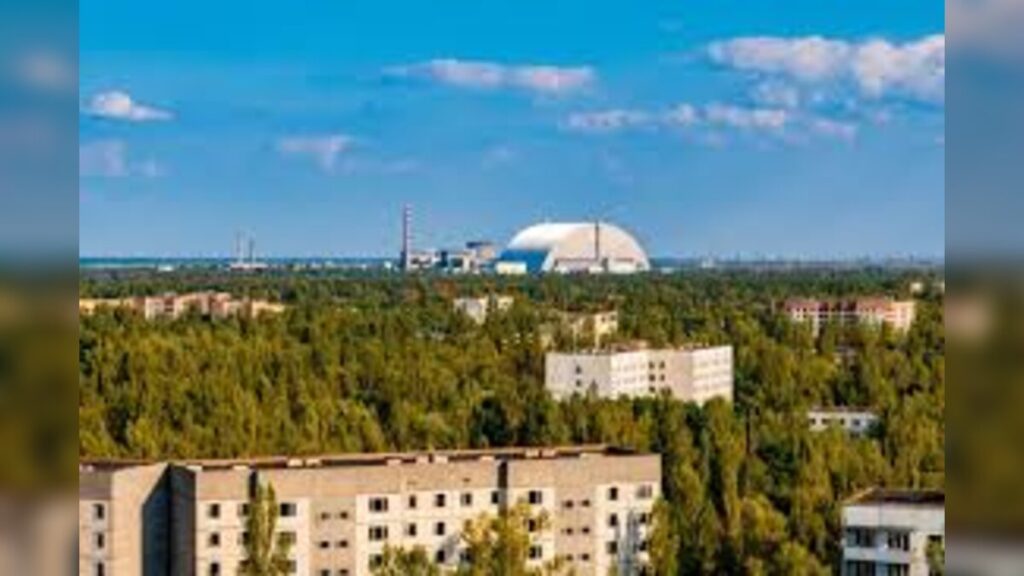
Entire towns were evacuated, including the nearby city of Pripyat, once home to nearly 50,000 people.




Today, the area remains largely uninhabited.
Forests have overtaken streets, buildings are collapsing, and wildlife has returned in unexpected ways.
Despite the contamination, nature has reclaimed much of the land, turning it into an eerie but thriving ecosystem.
According to assessments by international nuclear authorities, some areas may remain unsafe for human habitation for tens of thousands of years.
From Soviet Disaster to Modern Security Risk
The damaged reactor was initially sealed with a massive concrete-and-steel shelter, often referred to as the sarcophagus.
Years later, a more advanced containment system—the New Safe Confinement—was built to encase the structure more securely.
That system, however, has faced new challenges in recent years.
During the ongoing conflict in Ukraine, Russian forces briefly occupied the plant during the early stages of the 2022 invasion before withdrawing weeks later.
Reports have since raised concerns about damage to protective structures, including impacts from military activity that could weaken containment integrity.
New War, Old Fears
More recently, experts have warned that renewed military activity in the region could destabilize safety systems.
Damage to protective shells and restricted access for repairs have raised concerns among nuclear safety agencies.
The risk is no longer just historical—it is tied to present-day conflict.
Even small structural failures in containment systems could have serious consequences, given the radioactive materials still present.
Impact and Consequences
The Chernobyl disaster reshaped global attitudes toward nuclear power, triggering widespread fear and slowing nuclear development across parts of Europe for years.
It also led to major reforms in reactor safety standards and international nuclear oversight.
Socially, it displaced hundreds of thousands of people and left entire regions uninhabitable.
Economically, it placed long-term burdens on Ukraine and neighbouring states, while environmentally it created one of the largest contaminated zones on Earth.
Today, the site also serves as a reminder that nuclear risks do not end with shutdown—they require long-term management across generations.
What’s Next?
Ongoing monitoring and repair efforts remain critical, especially for the New Safe Confinement structure.
Experts say restoration work could take several years, particularly if further damage has occurred.
International agencies are expected to maintain oversight, while Ukraine continues to balance wartime pressures with nuclear safety obligations.
The exclusion zone will remain restricted, though controlled scientific and environmental research may continue depending on security conditions.
Summary
Forty years after the Chernobyl disaster, the site remains both a historical scar and a present-day concern.
What began as a reactor failure in the Soviet era has evolved into a long-term environmental, political, and security issue that still demands global attention.
Bulleted Takeaways
- Chernobyl disaster occurred on April 26, 1986 at reactor 4 in Soviet Ukraine
- Explosion caused massive radiation release across Europe
- Initial cause linked to design flaws and human error during a safety test
- Thousands involved in cleanup exposed to high radiation levels
- Entire region around plant remains largely uninhabitable exclusion zone
- Nearby city Pripyat was fully evacuated and remains abandoned
- New containment structure built in 2016–2017 to cover damaged reactor
- Recent conflict in Ukraine has renewed concerns over site safety
- Russian forces briefly occupied the plant during 2022 invasion
- Chernobyl continues to influence global nuclear safety policies and public perception

