
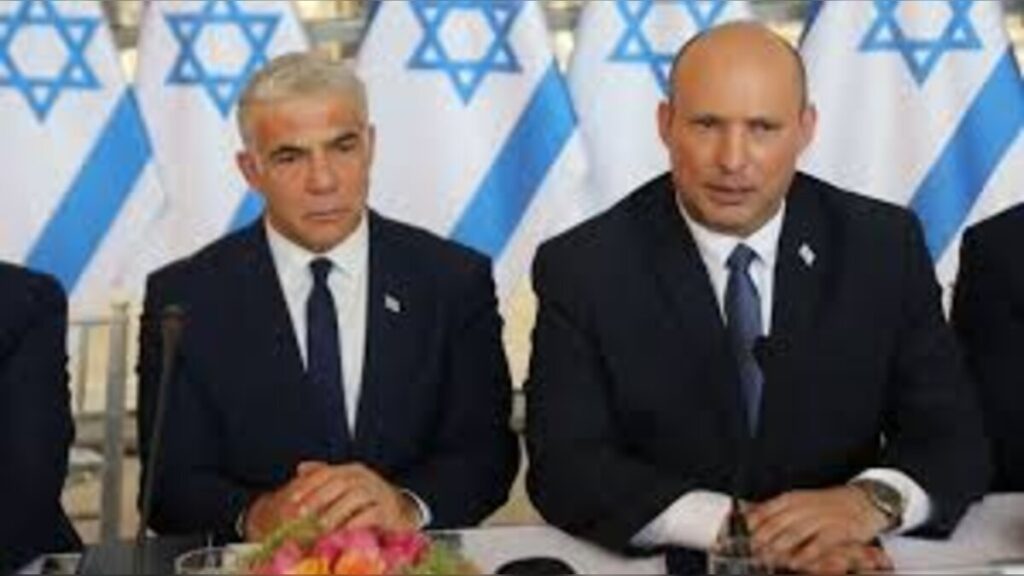
Israeli politics is gearing up for another major shake-up as former Prime Minister Naftali Bennett and opposition leader Yair Lapid prepare to step back into the spotlight together.
The two are set to appear at a joint press conference on Sunday evening in Tel Aviv, where they will officially outline plans for a new political alliance ahead of upcoming national elections.
According to statements from Bennett’s office, the move will merge Lapid’s Yesh Atid party with Bennett’s new political platform, temporarily branded “Bennett 2026.”
The joint list will reportedly be led by Bennett himself.
Old Partners, New Strategy
This isn’t the first time the two leaders have shared power.
Both Bennett and Lapid previously rotated the role of prime minister during Israel’s unusual coalition arrangement in 2021–2022, a government that brought together ideologically diverse parties to end a prolonged political deadlock.
That experiment was short-lived but significant, proving that political opposites in Israel’s fragmented system can still cooperate when necessary.
Now, the new alliance suggests a return to that pragmatic approach—this time with elections in sight and a more direct bid for voter consolidation.
Reactions From Across the Political Spectrum
The announcement immediately triggered strong responses from across Israel’s political landscape.
Finance Minister Bezalel Smotrich was quick to criticise the move, framing it as part of a broader political realignment he opposes.
In a social media post, he referenced the 2021 coalition that included support from the United Arab List, led by Mansour Abbas, suggesting that the new partnership follows a similar pattern of alliances he strongly rejects.
His comments reflect ongoing tensions within Israel’s right-wing bloc, which has frequently accused centrist and left-leaning parties of forming unstable coalitions.




Why This Alliance Matters Now
Israel’s political system is built on coalition governments, often requiring parties to negotiate across deep ideological divides.
That reality has led to frequent elections and shifting alliances.
The Bennett–Lapid partnership is widely seen as an attempt to re-establish a centrist bloc capable of challenging both the current government and fragmented opposition parties.
Historically, such alliances tend to emerge when political deadlock makes single-party governance impossible.
Israel has held multiple elections in recent years, reflecting this instability.
Familiar Faces in a New Political Game
Both leaders remain well-known figures in Israeli politics.
Bennett, a former tech entrepreneur turned politician, built his reputation on security-focused policies and right-leaning economic views before leading a diverse coalition government.
Lapid, a former journalist and finance minister, has positioned himself as a centrist voice advocating governance reform, diplomatic engagement, and economic moderation.
Their partnership suggests a calculated attempt to blend credibility from both the right and centre of Israeli politics.
Impact and Consequences
The immediate impact is a potential reshaping of Israel’s electoral map.
A united Bennett–Lapid list could consolidate centrist and moderate votes, reducing fragmentation among smaller parties.
It also raises pressure on rival blocs, particularly the current governing coalition and right-wing parties, which may now face a stronger unified challenger.
At the same time, critics argue such alliances can be unstable, pointing to the previous coalition government’s collapse as evidence that ideological differences may resurface under pressure.
What’s next?
The upcoming press conference is expected to clarify leadership structure, campaign strategy, and policy direction for the joint list.
Attention will also turn to how other opposition parties respond—whether they align, compete, or attempt counter-alliances.
With elections approaching, political negotiations in Israel are likely to intensify rapidly, and further realignments cannot be ruled out.
Summary
Naftali Bennett and Yair Lapid are preparing to launch a joint political alliance ahead of Israel’s next elections, merging their political platforms into a single list led by Bennett.
The move has triggered criticism from right-wing figures and signals a potential reshaping of the country’s centrist political space.
Bulleted Takeaways
- Naftali Bennett and Yair Lapid to announce joint political party in Tel Aviv
- Lapid’s Yesh Atid and Bennett 2026 will form a unified electoral list
- Bennett expected to lead the new alliance
- Both previously served as rotating prime ministers in 2021–2022 coalition
- Bezalel Smotrich criticised the move, referencing past coalition agreements
- Alliance aims to strengthen centrist bloc ahead of upcoming Israeli elections
- Israeli politics remains highly fragmented with frequent coalition shifts
- Press conference expected to outline strategy and leadership roles
- Political impact could reshape electoral balance in Israel’s parliament

