
Kogi State is stepping up its efforts to turn its long-term agricultural ambitions into something more concrete, as it deepens international partnerships around its Special Agro-Industrial Processing Zone (SAPZ) programme.
The idea is simple on paper but big in scope—move from farming as survival to farming as industry.
According to the State Commissioner for Information, Kingsley Fanwo, the SAPZ project is designed as a full ecosystem rather than just an agricultural scheme.
It is expected to boost food production, support large-scale processing, attract investors, and create jobs across multiple value chains.
In his words, the programme is meant to reposition Kogi as a serious agro-industrial player, not just a producing state.
From Concept Papers to Industrial Groundwork
At the heart of the latest engagement is the plan to establish a modern agricultural science and technology industrial park in Kogi.
This is not just another policy idea—it is meant to be the operational base where raw farm produce gets processed, packaged, and prepared for both local and international markets.
The SAPZ framework also includes logistics systems, cold storage infrastructure, technology transfer hubs, and power solutions.
These are all aimed at solving one of Nigeria’s biggest agricultural challenges: post-harvest losses and weak value chains.
Anyone familiar with Nigeria’s farming sector knows the problem is not just production—it is what happens after harvest.
That is where this project is trying to intervene.
Ajaokuta and Other Hubs at the Centre of the Plan
The SAPZ structure in Kogi is spread across several strategic locations.]
The Ajaokuta Agro-Industrial Hub sits at the centre, supported by Agricultural Transformation Centres in Anyigba, Alape, and Osara.
There is also the Zariagi Agro-Air Hub, which is expected to improve export logistics.
Each zone is designed to connect directly with farmer clusters and expand into large-scale production covering up to 150,000 hectares per zone.
That scale alone signals how ambitious the programme is.
Key crops and livestock under focus include rice, maize, cassava, sesame, cashew, oil palm, poultry, and greenhouse farming.




Partnership with Chinese Firms Signals Shift in Strategy
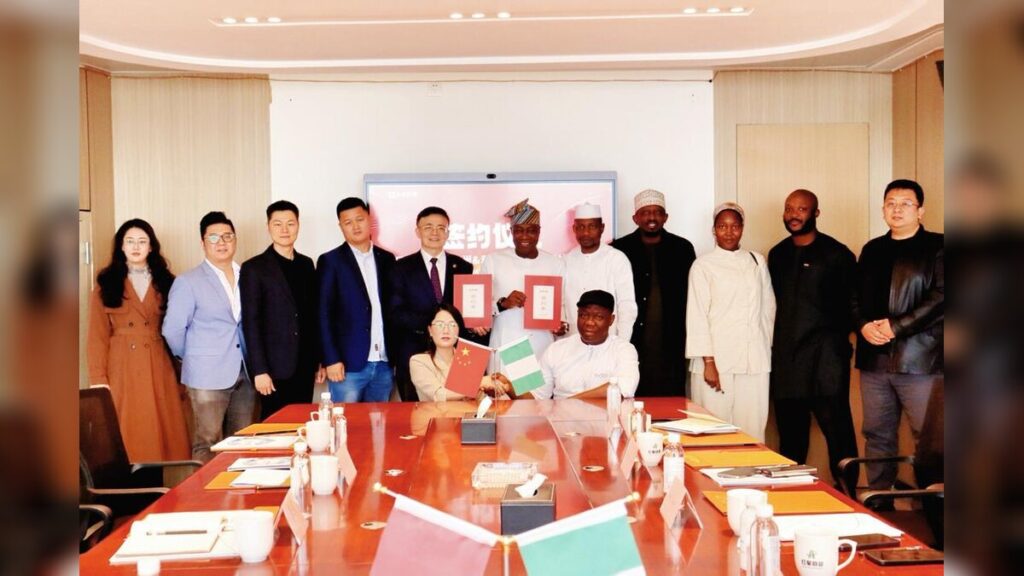
One of the most significant developments is Kogi’s cooperation agreement with Hezheng Holdings Group and Hezheng Digital Technology (Hezheng Innovation Valley).
This partnership is being positioned as a bridge between planning and actual implementation.
The goal is not just funding—it is also technical expertise, industrial park management models, and digital agricultural systems.
Delegates from Kogi State visited several Hezheng facilities, including investment centres, agricultural exhibition halls, and incubation bases.
The idea was to study how industrial parks operate in practice, especially in integrating technology with agriculture.
Government Delegation and Technical Engagement
The state delegation was led by Alhaji Yakubu Okala, who represented the governor.
He was joined by senior officials including the Commissioner for Agriculture, the Chief Economic Adviser, and technical consultants.
Their discussions with the Chinese partners focused on practical areas such as processing infrastructure, investment mobilisation, equipment deployment, and park management systems.
There was also emphasis on creating a structured China–Kogi cooperation model that can survive beyond political cycles.
From Policy to Groundbreaking Expectations
Both sides reportedly agreed on the roadmap moving forward.
In the coming months, technical workstreams are expected to kick off, alongside preparations for groundbreaking activities.
Plans also include setting up coordination offices in China, Abuja, and Kogi State itself to streamline implementation.
For a programme that has been in planning stages for years, this marks a shift toward visible execution.
Impact and Consequences
If implemented as planned, the SAPZ initiative could significantly reshape Kogi’s agricultural economy.
It may reduce post-harvest losses, improve farmer incomes, and attract private sector investment into rural communities.
There is also the potential for job creation across farming, processing, logistics, and export services.
However, like many large-scale projects in Nigeria, success will depend heavily on execution, funding continuity, and infrastructure stability.
There is also the broader national impact—Nigeria continues to push for agricultural diversification away from oil dependency, and Kogi’s model could become a reference point if successful.
What’s Next?
The next phase will involve technical planning, investor coordination, and infrastructure groundwork.
Stakeholders are expected to move into implementation mode, with focus on industrial park development and early-stage construction activities.
Attention will also shift to funding structures and how private investors will be integrated into the system without slowing down execution.
The real test will be whether the project moves quickly from agreements and tours to actual functioning facilities.
Summary
Kogi State is intensifying its agro-industrial transformation efforts through the SAPZ programme, supported by new international partnerships.
The plan focuses on building industrial hubs, improving agricultural processing, and attracting global investment.
With agreements now in place and implementation discussions underway, the project is entering a critical transition phase from planning to execution.
Bulleted Takeaways
- Kogi State is expanding international partnerships for its SAPZ agro-industrial programme
- The project aims to boost farming, processing, jobs, and investment
- A modern agricultural science and technology industrial park is central to the plan
- Key hubs include Ajaokuta, Anyigba, Alape, Osara, and Zariagi
- Priority crops include rice, cassava, maize, sesame, cashew, and oil palm
- Kogi signed cooperation agreements with Chinese firms Hezheng Holdings and Hezheng Digital Technology
- Delegation included top government officials and technical advisers
- Discussions focused on infrastructure, technology transfer, and industrial park management
- Coordination offices will be set up in China, Abuja, and Kogi State
- Project moves from planning phase toward implementation and construction readiness

