
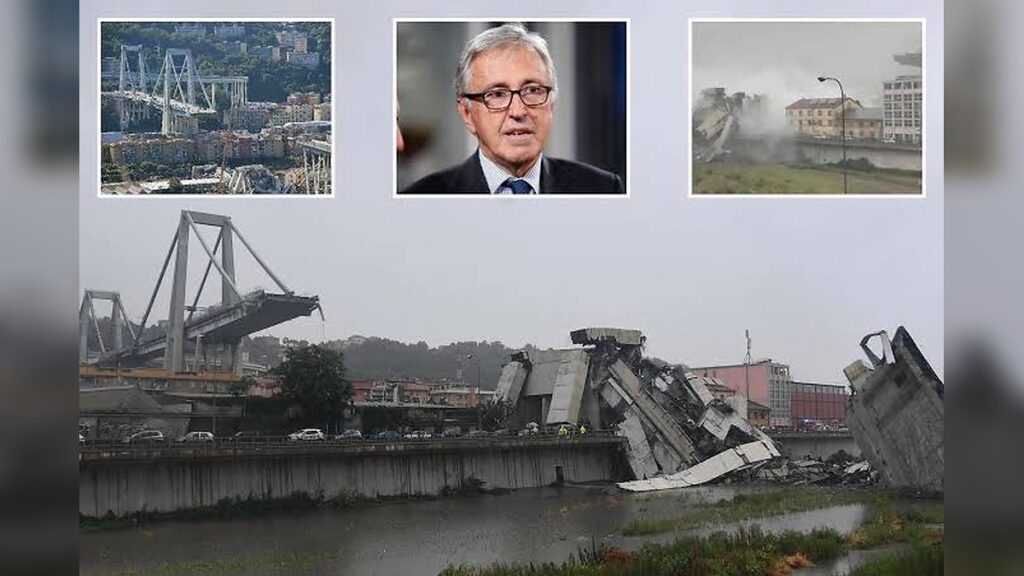
An Italian court has convicted 32 people over the catastrophic collapse of Genoa’s Morandi Bridge, delivering one of the country’s most significant rulings in an infrastructure disaster case.
Among those sentenced was former Autostrade per l’Italia (ASPI) chief executive Giovanni Castellucci, who received a 12-year prison term after being found guilty of vehicular homicide and negligence.
The verdict concludes the first stage of a lengthy legal process stemming from the August 14, 2018 tragedy, when a section of the Morandi Bridge collapsed during heavy rain, sending vehicles plunging to the ground below and killing 43 people.
Investigation Blamed Years of Neglected Maintenance
Prosecutors argued that the disaster was preventable, pointing to decades of inadequate maintenance on the bridge.
Investigators concluded that the structure’s pillar number nine had gone more than five decades without reinforcement work after the bridge opened in 1967.
While repair work had previously been carried out on pillars 10 and 11, maintenance planned for pillar nine had not been completed before it gave way during morning traffic.
The bridge formed part of the A10 motorway, a vital transport corridor linking northern Italy with France.
Court Convicts Executives, Engineers and Public Officials
Most of those found guilty were former executives and technical staff from motorway operator ASPI, which manages nearly half of Italy’s motorway network, as well as engineers from maintenance contractor Spea and officials linked to the country’s infrastructure ministry.
Alongside Castellucci, former Spea chief Antonino Galata was convicted. ASPI maintenance executive Michele Mitelli was sentenced to 11 years in prison, while the company’s former deputy executive Paolo Berti received a sentence of five years and six months.
Families Welcome Verdict but Legal Fight Continues
Relatives of the victims filled the courtroom as the judgment was delivered, with many describing the ruling as an important moment in their long pursuit of accountability.
Michele Matti Altadonna, whose brother died in the collapse, said the decision confirmed that those responsible had finally been identified.



He also vowed that his family would continue pursuing justice through every level of Italy’s judicial system, particularly for his late brother’s four children.
Italian law allows defendants to appeal, and several legal teams, including Castellucci’s, immediately announced plans to challenge the convictions. Judges are expected to publish the detailed reasoning behind the verdict within six months.
Defence Maintains Bridge Failed Because of Hidden Design Flaw
Throughout the trial, defence lawyers argued that the collapse resulted from an undiscovered construction defect rather than failures in maintenance.
They claimed corrosion inside the bridge’s cables represented a hidden structural weakness that could not have been detected through ordinary inspections.
Castellucci’s legal team criticized the ruling, arguing that the court improperly assigned criminal responsibility based on his leadership position.
His lawyers insisted the former CEO had relied on engineering experts and had taken all necessary steps to ensure the bridge’s safety.
Prosecutors Say Disaster Could Have Been Prevented
Lawyers representing victims maintained that years of neglected maintenance directly contributed to the collapse.
Attorney Raffaele Caruso said the bridge did not fail by chance, arguing that investigators consistently demonstrated the disaster could have been avoided had appropriate safety measures been implemented in time.
The prosecution’s findings described a prolonged pattern of omissions that ultimately left one of Italy’s most important transport structures vulnerable to failure.
Government Calls Verdict a Milestone for Accountability
Italy’s Deputy Transport Secretary Edoardo Rixi described the court’s decision as a significant step toward establishing truth and justice.
In a public statement, he said the bridge collapse was not an unavoidable accident but the consequence of serious mistakes and failures by those responsible for maintaining public safety.
His remarks echoed widespread public outrage that followed the disaster, which prompted intense scrutiny of Italy’s ageing infrastructure and oversight practices.
Company Ownership Changed Following Public Backlash
Following the bridge collapse, Autostrade and its engineering subsidiary Spea reached an out-of-court agreement with prosecutors, paying €29 million (about $30 million) to the Italian state.
The tragedy also reshaped ownership of the motorway operator.
At the time of the collapse, ASPI was controlled by the Atlantia group, backed by the influential Benetton family.
Amid mounting political pressure and public criticism, the family later relinquished its controlling stake, allowing the Italian state to assume ownership.
