
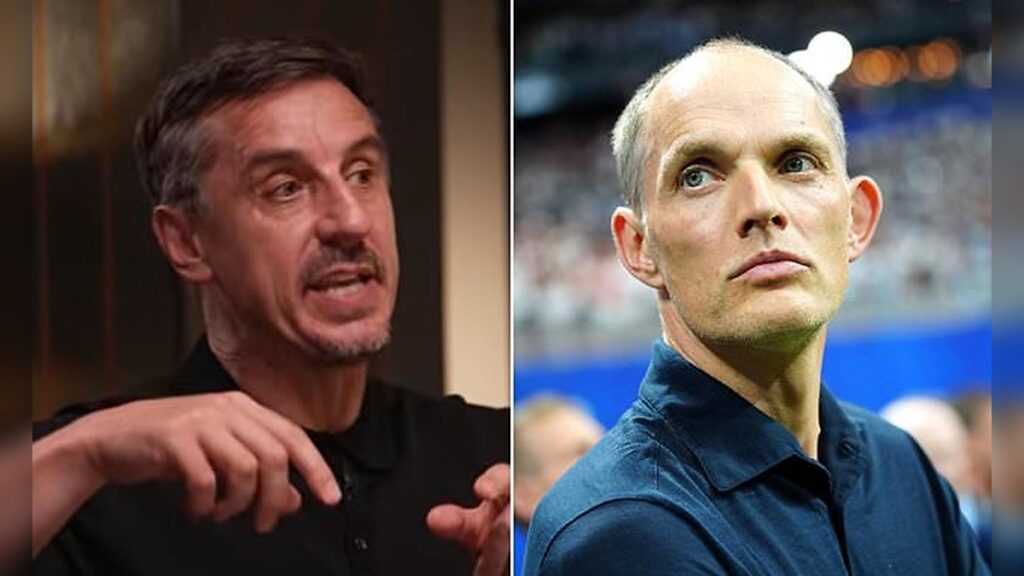
England’s dramatic World Cup semi-final defeat to Argentina has sparked renewed scrutiny of Thomas Tuchel’s tactical decisions, with former England defender Gary Neville questioning both the manager’s in-game approach and his assessment of the national team’s footballing identity.
Neville believes Tuchel’s suggestion that England lack the natural ability to dominate possession is contradicted by the very players the German coach chose to leave out of his squad or keep on the bench throughout the tournament.
Tuchel Defends Tactical Decisions and Possession Comments
Following England’s painful collapse after taking the lead, Tuchel stood by both his substitutions and his broader view of the team’s limitations in controlling matches through possession.
The England boss argued that once Argentina increased the intensity of their attacking runs and midfield pressure, no tactical structure alone would have been enough to prevent the momentum from shifting.
He maintained that regaining control required sustained possession, adding that such an approach is more deeply embedded in the football cultures of Spain, Argentina and Brazil than it is in England’s.
His comments quickly became one of the biggest talking points after England’s elimination.
Neville Says Squad Selection Contradicts Manager’s Argument
Speaking on Sky Bet’s Stick to Football podcast alongside Ian Wright, Roy Keane and Peter Crouch, Neville strongly disagreed with Tuchel’s assessment.
According to Neville, England possess enough technically gifted footballers to retain possession under pressure, but many of those players were overlooked.
He highlighted Kobbie Mainoo, who did not feature at all during the tournament despite his composure in tight spaces.
Neville also pointed to Phil Foden’s omission from the World Cup squad, describing him as one of England’s finest technical footballers.
He expanded the list to include Cole Palmer, Adam Wharton, Morgan Gibbs-White and Trent Alexander-Arnold, arguing that several players capable of dictating possession were unavailable because of selection decisions rather than a lack of national footballing identity.




He suggested that describing possession football as being outside England’s “DNA” ignored the quality already available to the squad.
Defensive Changes Become Focus of Criticism
Tuchel has also faced criticism for the substitutions he made after Anthony Gordon gave England the lead.
Rather than introducing fresh midfield control, the manager replaced attacking and midfield options with defenders, including Ezri Konsa, Nico O’Reilly and Dan Burn.
The changes reshaped England into a defensive 5-4-1 system as Argentina continued to push forward.
Neville argued that these decisions unintentionally encouraged England to retreat deeper, sending a message to the players that their priority had become protecting the lead instead of maintaining control through possession.
He suggested that introducing technical players capable of keeping the ball may have relieved some of the sustained Argentine pressure.
Statistics Highlight England’s Loss of Control
The match statistics reflected England’s struggles once they moved ahead.
From Gordon’s goal in the 55th minute until Lautaro Martínez scored Argentina’s decisive goal in the 92nd minute, England controlled just 12 percent of possession while Argentina dominated with 88 percent.
England also managed only five shots throughout the contest, their lowest total in a World Cup match in six decades, underlining how little attacking threat they carried after taking the lead.
Pundits Offer Different Perspectives
Peter Crouch agreed that England often depended on moments of individual brilliance rather than consistently controlling matches.
He contrasted England’s performances with Spain’s possession-based style, suggesting the Three Lions rarely looked fully in command despite boasting match-winning players such as Jude Bellingham and Harry Kane.
Roy Keane, however, offered a more balanced assessment.
While acknowledging that Tuchel’s defensive substitutions appeared negative and would naturally attract criticism, he argued that elite teams like Argentina often find a way to win regardless of tactical adjustments.
Keane suggested that had England adopted a more attacking approach and conceded space, the manager would likely have faced criticism for not protecting the lead.
Attention Turns to Final Fixtures
England must now quickly regroup as they prepare for Saturday’s bronze medal play-off against France.
Meanwhile, Argentina will attempt to lift the World Cup trophy when they meet Spain in Sunday’s final at MetLife Stadium in New Jersey, while debate over England’s tactical approach and squad selection is expected to continue well beyond the tournament’s conclusion.
