
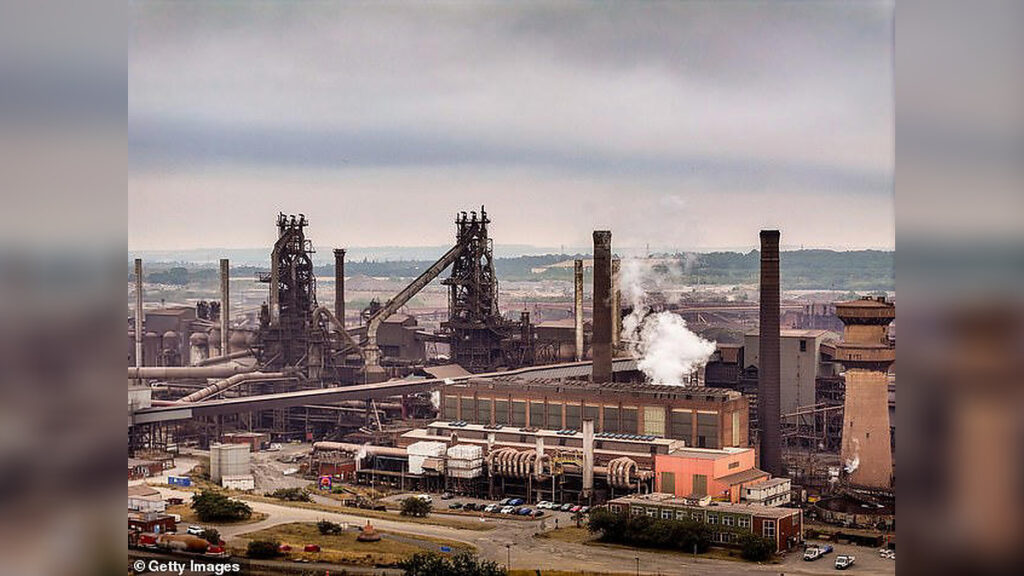
The UK government has formally taken British Steel into public ownership after legislation approving the move received Royal Assent, marking the return of one of Britain’s most strategically important industrial assets to state control for the first time since its privatisation in 1988.
Ministers said the decision was made to preserve domestic steel production, secure thousands of jobs and protect industries that depend on British-made steel.
The move also aims to strengthen supply chains supporting major infrastructure projects, defence and other sectors considered critical to national security.
Scunthorpe Blast Furnaces Become State-Owned
The nationalisation places the company‘s Scunthorpe steelworks, home to the UK’s last two operational blast furnaces, under government ownership.
The facility produces approximately 3.2 million tonnes of steel annually, representing around two-thirds of Britain’s current steelmaking capacity.
The Scunthorpe plant remains the country’s only site capable of producing virgin steel, making it a strategic asset for construction, transport infrastructure, railway maintenance and defence manufacturing.
Government officials argued that allowing the plant to shut down would have left the UK heavily dependent on overseas suppliers for a material regarded as essential to national resilience.
Ministers Promise Long-Term Recovery Plan
Business Secretary Peter Kyle said the government’s priority is to stabilise operations while laying the foundation for a commercially viable and environmentally sustainable future.
According to the government, a new leadership team will be appointed to oversee the company’s recovery, with a focus on improving financial performance while transitioning toward lower-carbon steel production.
Kyle said bringing the company into public ownership was necessary to preserve Britain’s steelmaking capability, describing it as a decision taken in the national interest.
He added that future investment decisions, including whether to replace the ageing blast furnaces with alternative technology capable of producing virgin steel, would be made jointly by the government and the business.
Compensation Decision for Jingye Still Pending
Although British Steel has now been nationalised, questions remain over whether its former Chinese owner, Jingye, will receive financial compensation.




The Department for Business and Trade confirmed that an independent assessor will determine whether compensation is appropriate.
Draft regulations outlining the process are expected to be introduced in the autumn, with the final decision based on an independent valuation of the company.
Conservatives Warn Against Unlimited Public Spending
The nationalisation has drawn criticism from the Conservative Party, which warned ministers against committing unlimited taxpayer funding to the struggling steelmaker.
Shadow Business Secretary Andrew Griffith argued that state ownership alone would not resolve the industry’s deeper challenges, pointing instead to high energy prices and government policies that he said continue to undermine British manufacturers.
He questioned how much additional public funding would be required after the Scunthorpe operation reportedly continued losing around £1 million each day since the government intervened last April to prevent production from being halted.
Griffith also insisted that Jingye should not receive compensation and argued that the company should instead remain responsible for future decommissioning costs when the ageing blast furnaces are eventually retired.
Steel Strategy Aims to Revive Domestic Production
The nationalisation comes alongside the government’s wider industrial strategy for the steel sector.
Earlier this year, the Department for Business and Trade unveiled plans to invest £2.5 billion in the UK steel industry before the next general election, with additional commitments to increase procurement from domestic producers.
Officials have set a target for half of all steel used across the UK to be manufactured within the country, a move intended to strengthen domestic production and reduce reliance on imports.
However, industry leaders continue to argue that persistently high electricity prices and environmental levies remain significant obstacles to restoring the competitiveness of British steelmakers.
Industry and Union Leaders Welcome State Intervention
Trade unions and industry representatives broadly supported the government’s decision, describing it as a necessary step to protect jobs and secure the future of British steelmaking.
Community General Secretary Roy Rickhuss said the legislation would help safeguard thousands of workers while providing greater stability for an industry that has experienced years of uncertainty.
British Steel Interim Chief Executive Allan Bell described the nationalisation as a landmark moment for the company, its employees, customers, suppliers and the wider communities connected to its operations.
UK Steel Director General Gareth Stace also backed the move, saying public ownership provides an opportunity for the next government to establish a long-term strategy that restores commercial sustainability, encourages investment in modern low-carbon production and creates the conditions needed for the industry to remain competitive.
What’s Next for British Steel?
The government’s immediate priorities include appointing a new executive leadership team, maintaining uninterrupted production at Scunthorpe and determining the company’s long-term investment strategy.
Officials must also complete the independent assessment of any compensation owed to Jingye while advancing plans to modernise Britain’s remaining steelmaking capacity.
Summary
The UK government has officially nationalised British Steel, placing the strategically important Scunthorpe steelworks under state ownership to preserve domestic steel production, protect thousands of jobs and strengthen national security.
While ministers have pledged investment and a long-term transition to commercially sustainable, low-carbon steelmaking, the Conservatives have criticised the move, warning against excessive taxpayer spending and opposing any compensation for former owner Jingye.
Industry leaders and trade unions have largely welcomed the decision, viewing it as a crucial step toward securing the future of Britain’s steel sector.
