
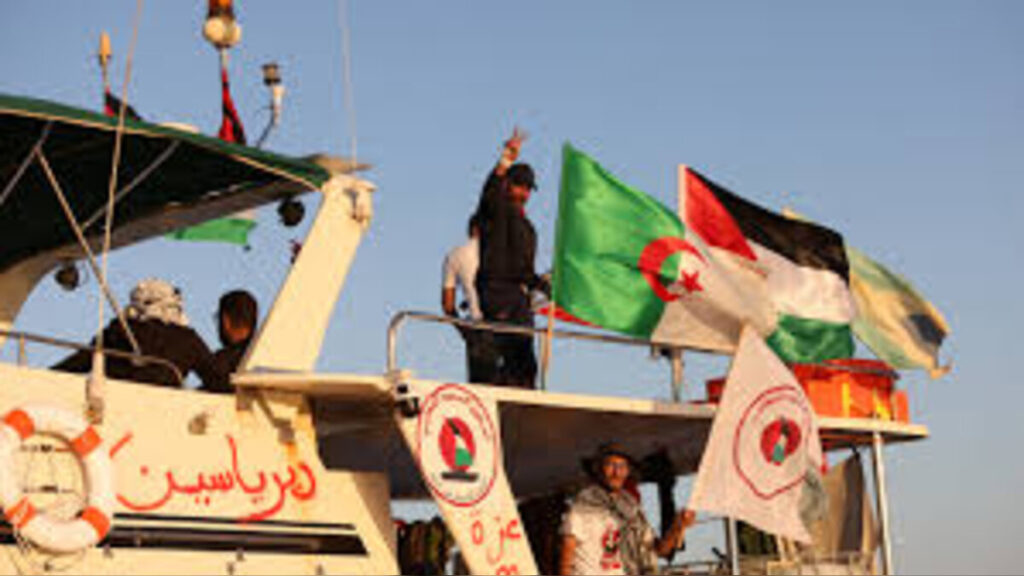
A high-stakes maritime standoff unfolded on Wednesday night after the Global Sumud Flotilla said Israeli warships moved in to intercept a large convoy of vessels heading toward Gaza.
The group, which claims to be carrying humanitarian intent, said more than 50 boats were part of the mission when contact escalated at sea.
The situation quickly turned chaotic, with communications disrupted and distress signals reportedly sent out as the fleet attempted to continue its course.
Flotilla Describes Military Encounters at Sea
According to statements shared by the Global Sumud Flotilla, several military-style speedboats approached their vessels and identified themselves as Israeli forces.
The group alleged that lasers were pointed at boats and that individuals aboard were instructed to move to the front of the vessels and kneel with hands raised.
They also claimed that radio communications were jammed during the encounter, forcing an SOS alert to be issued.
These claims have not been independently verified, but they have intensified already high tensions surrounding maritime activity bound for Gaza.
Satellite Tracking Shows Fleet Movement Disruption
Maritime tracking data added another layer to the developing situation.
According to reports from MarineTraffic, the vessel Greenpeace Arctic Sunrise, which was expected to be part of the flotilla, was located west of Crete at the time of reporting.
That detail has raised questions about how coordinated the fleet remains as it moves through contested waters in the Mediterranean region.
Israel Cites Security and Counterterror Laws
On the same day, Israeli Defence Minister Israel Katz referenced legal provisions under the country’s counterterrorism framework, suggesting that vessels linked to what it considers unlawful activity could be subject to seizure.
He also argued that the flotilla violates United Nations Resolution 2803, which outlines that humanitarian assistance to Gaza should pass through officially recognized channels.




From Israel’s perspective, the flotilla is not a neutral aid mission but a politically charged maritime challenge to its naval restrictions around Gaza.
Israel’s Foreign Ministry Calls Mission a “Provocation”
The Israeli Foreign Ministry took a firmer public stance on social media platform X, describing the flotilla as a “provocation” allegedly influenced by Hamas.
Officials claimed the mission was designed to undermine diplomatic efforts, including peace initiatives associated with U.S. President Donald Trump.
They also dismissed the humanitarian framing, calling the vessels part of a publicity-driven campaign rather than a genuine aid operation.
These remarks reflect Israel’s long-standing position that maritime attempts to breach the blockade are politically motivated rather than humanitarian in nature.
A Fleet With Political and Humanitarian Claims
The flotilla reportedly began its journey from Italy, where around 56 vessels set sail earlier in the week.
Organizers say their goal is to challenge the blockade on Gaza and push for a permanent humanitarian corridor for aid delivery.
The mission has been described by supporters as a form of civil maritime activism, designed to increase international pressure on governments and institutions involved in enforcing restrictions on Gaza.
A Long-Running Maritime Flashpoint
Maritime confrontations linked to Gaza are not new.
Similar flotilla attempts in past years have led to interceptions, diplomatic disputes, and international criticism.
One of the most widely known incidents involved the 2010 Mavi Marmara ship, which resulted in fatalities and a major diplomatic crisis.
That history continues to shape how both sides interpret current events—one framing it as humanitarian resistance, the other as security provocation.
Impact and Consequences
The immediate impact of this incident is a further escalation in already tense regional dynamics.
If confirmed interceptions continue, it could trigger diplomatic responses from countries whose citizens are aboard the vessels.
It also places renewed attention on the legal and political debate over Gaza’s maritime access, blockade enforcement, and the role of international humanitarian missions at sea.
For humanitarian organizers, disruptions like these complicate efforts to deliver aid and may deter future maritime missions.
For Israel, it reinforces its security posture around maritime borders and blockade enforcement.
What’s Next?
The situation remains fluid, and further updates are expected as the flotilla continues its journey—or possibly halts due to interception risks.
International observers may call for clarification or independent verification of events at sea, especially regarding claims of military engagement and communications jamming

