
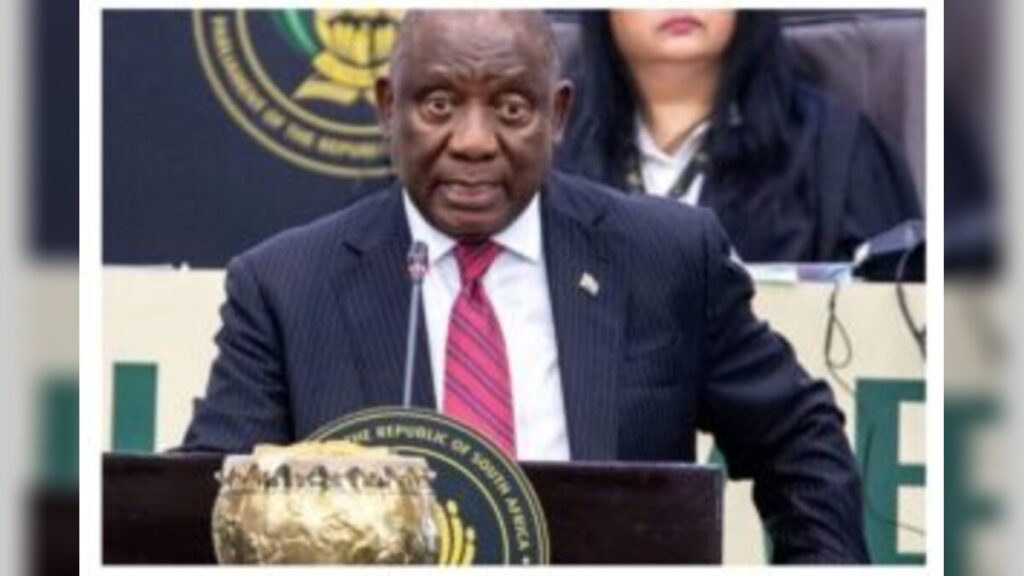
South Africa’s political temperature rose again after the opposition party Economic Freedom Fighters strongly criticised President Cyril Ramaphosa for refusing to resign over the long-running Phala Phala matter.
The response came shortly after Ramaphosa addressed the nation, making it clear that he intends to remain in office while continuing his legal challenge linked to the Section 89 Independent Panel findings.
His position immediately reignited debate across the political landscape.
At the centre of it all is the ongoing controversy known as the Phala Phala scandal, which has followed the president since allegations surfaced involving foreign currency allegedly stolen from his Limpopo farm in 2020.
Ramaphosa Stands Firm on His Decision
In his national statement, Ramaphosa repeated his long-held position that he has not committed any crime and has not stolen public funds.
He argued that stepping down at this stage would undermine constitutional processes that are still underway.
He also confirmed that he will continue with a judicial review of the Section 89 panel report, insisting that due process must be allowed to run its course before any political consequences are considered.
For Ramaphosa, the argument is simple: accountability must be decided in court, not through political pressure.
EFF Accuses President of Delaying Accountability
The EFF did not hold back in its reaction, describing the president’s decision as a strategy to delay justice and protect his political position.
According to the party, Ramaphosa is using legal mechanisms not to clear his name quickly, but to extend his stay in office while the matter drags on.
The EFF argued that this behaviour weakens public trust in democratic institutions and sends the wrong message about leadership accountability.
Party representatives said the president’s refusal to step aside reflects what they call “political self-preservation” rather than respect for the constitution.
Calls for Immediate Resignation Grow Louder
EFF spokesperson Sinawo Thambo sharpened the party’s message, saying Ramaphosa should have resigned long ago if he truly respected the country’s democratic principles.
The party insists that a leader facing such serious allegations should not continue to govern while legal questions remain unresolved.




They also confirmed that they will formally oppose Ramaphosa’s court application and push for the matter to be heard urgently, arguing that delays only deepen uncertainty in the country’s governance.
The EFF further claimed that even previous court discussions have acknowledged the seriousness of the Phala Phala matter, making prolonged legal processes unacceptable in their view.
A Political Battle That Keeps Escalating
The disagreement between the presidency and opposition parties has turned into one of South Africa’s most persistent political standoffs in recent years.
Supporters of Ramaphosa argue that stepping down before legal clarity would set a dangerous precedent, while critics insist that staying in office undermines accountability standards.
The issue continues to divide public opinion, with some viewing the president’s stance as lawful caution and others seeing it as political shielding.
Meanwhile, the Phala Phala case remains a symbol of broader tensions around transparency, wealth declaration rules, and presidential conduct in South Africa’s democratic system.
Impact and Consequences
The continued standoff has several ripple effects on South African politics and governance.
Public trust in leadership is increasingly under pressure, especially as the case remains unresolved years after the initial allegations surfaced.
Each new legal or political development reopens national debate and keeps uncertainty alive.
For the EFF and other opposition groups, the issue strengthens their narrative around government accountability and institutional reform.
It also provides ongoing political momentum ahead of future elections.
However, for the presidency, prolonged controversy risks distracting from policy priorities and economic challenges, as attention repeatedly shifts back to legal disputes.
The broader concern is that unresolved high-level cases like this can deepen political polarisation and slow down public confidence in democratic institutions.
What’s Next?
The immediate focus now shifts to the courts, where Ramaphosa’s judicial review is expected to continue.
The timing of hearings and the pace of legal proceedings will play a major role in how quickly the matter progresses.
The EFF has signalled it will actively participate in opposing the application, which could lead to a more complex and drawn-out legal process.
Politically, pressure is likely to intensify as opposition parties continue to demand clarity and accountability, while the presidency maintains its stance on due process.
The outcome of the review may also influence how similar cases involving high-level political accountability are handled in the future.
Summary
The EFF has sharply criticised President Cyril Ramaphosa for refusing to resign amid the ongoing Phala Phala controversy, arguing that he is prioritising political survival over accountability.
Ramaphosa maintains that he has done nothing wrong and insists that the matter must be resolved through legal channels rather than political pressure.
The disagreement highlights deep divisions in South Africa’s political landscape and keeps the Phala Phala issue at the centre of national debate.
Bulleted Takeaways
- The Economic Freedom Fighters condemned Ramaphosa’s decision to remain in office
- President Cyril Ramaphosa insists he will not resign while legal processes continue
- The dispute relates to the Phala Phala scandal
- Ramaphosa is pursuing a judicial review of the Section 89 report
- The EFF accuses him of delaying accountability and protecting his position
- Opposition parties say he should step aside until the matter is resolved
- The case continues to divide public and political opinion in South Africa
- Court proceedings are expected to shape the next phase of the controversy
- The issue continues to affect trust in governance and political stability
- The EFF has pledged to oppose the president’s legal challenge in court

