
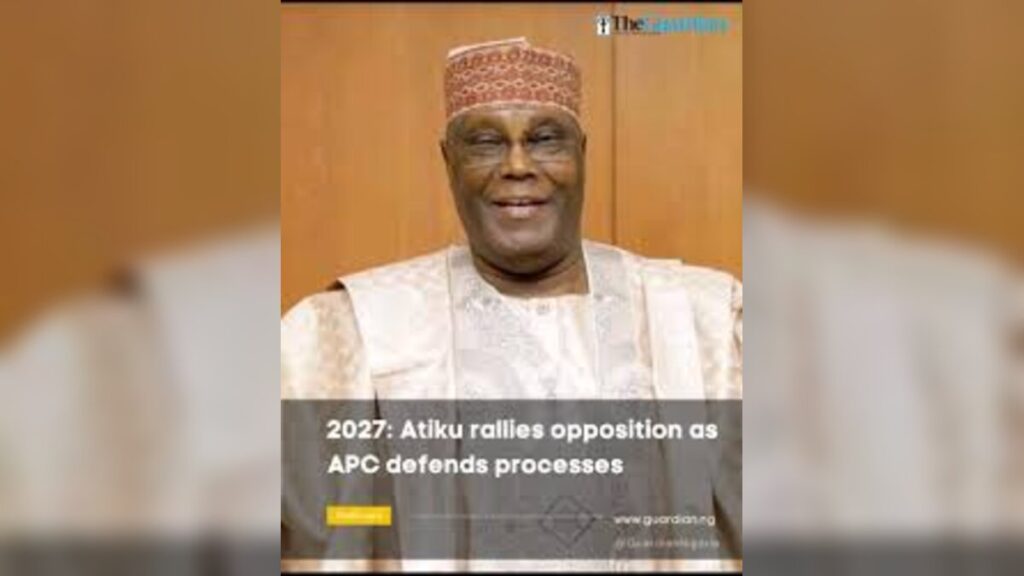
Nigeria’s political scene is already getting noisy ahead of 2027, with opposition alliances beginning to strain under disagreements about zoning, leadership ambition, and who should fly which regional flag.
What looks like a united front on paper is increasingly turning into a contest of competing interests.
At the same time, security warnings from abroad and fresh claims linked to an alleged coup plot are adding another layer of tension to an already crowded national conversation.
Atiku’s Push for Northern Candidacy Divides Opposition Bloc
Former Vice President Atiku Abubakar’s reported preference for a northern presidential candidate has reopened old wounds in Nigeria’s long-running zoning debate.
Within the opposition coalition, some stakeholders argue that since President Bola Tinubu from the South is currently in office, power should logically rotate back southwards in 2027 to maintain political balance.
Supporters of figures like Peter Obi and Rabiu Kwankwaso are among those strongly pushing that view.
Others, however, see Atiku’s position as a strategic move to keep the north influential in the coalition’s power structure.
The disagreement is not just about personalities—it reflects deeper regional calculations that often shape Nigerian elections.
Kwankwaso and the “Obi Alliance” Argument
Former Kano State Governor Rabiu Kwankwaso has added his voice to the conversation, explaining why many northern political actors are reportedly comfortable aligning with Peter Obi within the opposition structure.
His argument is simple: unity first, zoning later.
According to him, several northern stakeholders see Obi as a strong and “capable” partner who could help consolidate opposition strength against the ruling party.
In this reading, electoral strategy matters more than immediate regional bargaining.
Still, critics within the coalition warn that sidelining zoning expectations could create fractures that may be difficult to repair before the election season fully kicks off.
Nigeria’s Economic Direction and Fresh World Bank Talks
Away from politics, attention is also on Nigeria’s economic outlook as the federal government reportedly engages the World Bank on a proposed $1.25 billion facility.



If approved, the package would rank among the country’s largest recent multilateral loans.
The funding is expected to support ongoing economic reforms under the current administration, particularly in areas like fiscal stability, infrastructure, and social investment.
This comes at a time when Nigeria continues to balance subsidy reforms, inflation pressures, and foreign exchange challenges—issues that have defined much of the economic debate in recent years.
US Raises Alarm Over ISIS Movement into West Africa
Security concerns across the Sahel region and Nigeria’s north have intensified after warnings from the United States that ISIS-linked groups are shifting operational focus toward West Africa and the Lake Chad Basin.
Lake Chad Basin has long been a hotspot for insurgency activity, with groups linked to ISIS and Boko Haram operating in fragmented but persistent cells across borders.
The warning raises fresh concerns for Nigeria, where military operations against insurgents have stretched for years with mixed results.
Analysts often note that when pressure increases in one region, extremist groups tend to relocate and adapt rather than disappear.
Cleric’s Claim Adds Twist to Alleged Coup Plot Case
In a separate development still unfolding in court discussions, an Islamic cleric involved in an alleged coup-related investigation claimed that some suspects approached him seeking spiritual assistance before their arrests.
According to his account, one of the individuals allegedly requested prayers and spiritual protection for his “superior,” believed to be connected to the plot.
While the claims remain part of ongoing legal proceedings and have not been independently verified, they have added a controversial and dramatic layer to an already sensitive national security matter.
Impact and Consequences
The growing rift within the opposition coalition could weaken its ability to present a unified challenge in 2027.
If disagreements over zoning persist, the alliance risks fragmenting into regional blocs rather than functioning as a coordinated political force.
On the security front, the ISIS relocation warning signals a potential shift in threat patterns, especially for Nigeria’s northeast.
Any increase in cross-border insurgency activity could stretch military resources further and complicate stabilization efforts.
Economically, new borrowing discussions with the World Bank highlight Nigeria’s continued reliance on external financing, which may bring short-term relief but also long-term repayment pressure.
What’s Next?
The coming months will likely determine whether the opposition can resolve its internal zoning disputes or drift further apart.
Much will depend on behind-the-scenes negotiations between key figures and regional power brokers.
On security, regional cooperation across the Sahel and Lake Chad countries will become even more critical as intelligence agencies track militant movements.
For the economy, attention will turn to whether the proposed World Bank facility is approved and how effectively it translates into visible improvements for citizens.
Summary
Nigeria is entering another politically charged season early, with opposition realignments, economic negotiations, and security warnings all unfolding at once.
While 2027 may still be far off, the groundwork for that election is already being aggressively laid.
Bulleted Takeaways
- Opposition coalition divided over zoning and 2027 presidential ambition
- Atiku’s northern candidacy push faces resistance from southern-aligned blocs
- Kwankwaso says northern stakeholders see Peter Obi as a strong alliance partner
- Federal Government in talks for $1.25bn World Bank loan
- US warns ISIS-linked groups are shifting toward West Africa and Lake Chad Basin
- Cleric claims suspects in alleged coup case sought spiritual protection
- Political unity, security threats, and economic pressure are shaping Nigeria’s early 2027 narrative

