
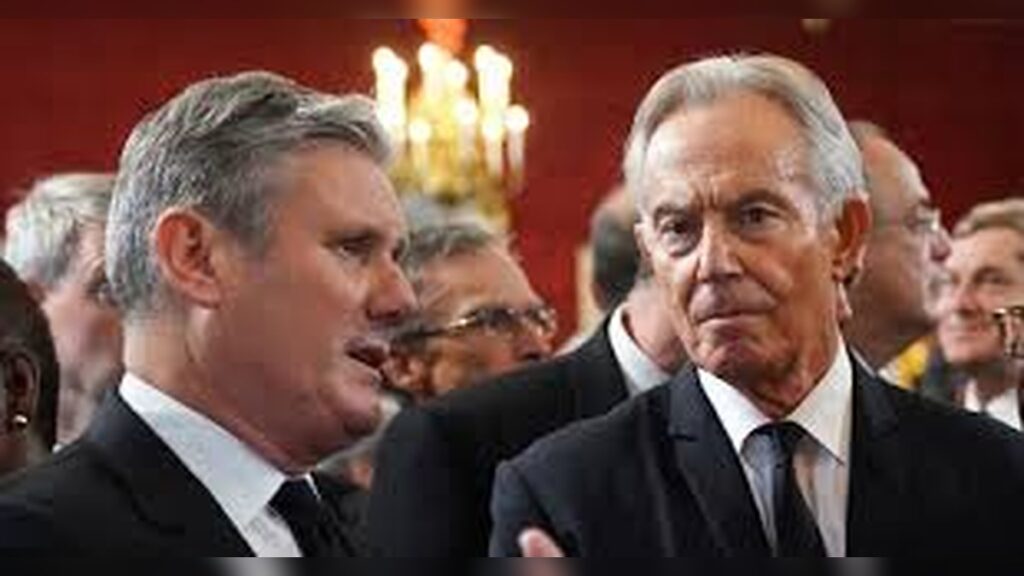
Pressure is building inside the UK Government as senior ministers reportedly push Keir Starmer to reconsider the direction of his Net Zero strategy.
What was once presented as a clear, unified green transition is now being pulled into an increasingly public debate about energy prices, economic growth, and North Sea production.
The flashpoint has been comments from Tony Blair, who has stepped back into the climate debate with unusually sharp criticism of current policy thinking.
His intervention has added fuel to an already tense discussion inside Labour circles, where disagreements over energy strategy are beginning to surface.
Tony Blair’s intervention reignites a long-running energy debate
Tony Blair, former prime minister, has argued that parts of the current Net Zero approach are “illogical,” particularly the idea of limiting domestic fossil fuel production while the UK still relies heavily on imported energy.
In a lengthy essay, he warned that Labour risks drifting into what he described as a political “comfort zone” without a realistic economic roadmap.
His central argument is that the UK should prioritise affordable energy and growth rather than focusing too narrowly on rapid decarbonisation targets.
Blair also criticised the idea of restricting North Sea oil and gas exploration, questioning why Britain would reduce domestic production while other countries continue to develop their own reserves.
For him, the issue is not climate ambition itself, but what he sees as a lack of practical sequencing.
Tensions inside government over North Sea policy
Behind the scenes, there are growing reports of disagreement within Cabinet ranks over the Energy Secretary Ed Miliband’s stance on North Sea oil and gas.
Some ministers are said to be uncomfortable with the position that new exploration would not significantly reduce household energy bills.
Critics within government argue that this framing ignores broader economic effects such as trade balance, currency stability, and long-term energy security.
One Whitehall source suggested that even if direct bill reductions are limited, domestic production could still strengthen the wider economy.
Another insider described the current messaging as “technically defensible but politically damaging,” reflecting concern that voters are not convinced by the government’s explanations.




Energy bills remain the central political battleground
At the heart of the debate is a simple political reality: energy costs are still a major concern for the public.
Recent polling shows that a large majority of people prioritise keeping energy bills stable over fully removing fossil fuels from electricity generation.
That gap between public concern and long-term climate planning is now shaping internal arguments inside Labour.
Supporters of a slower transition argue that voters are focused on immediate affordability rather than long-term emissions targets.
Others insist that abandoning or weakening Net Zero commitments would damage credibility and delay necessary investment in clean infrastructure.
A wider Labour leadership pressure cooker
The energy dispute is unfolding alongside broader political tensions within Labour following recent electoral setbacks.
Reports suggest that frustration has been growing among senior figures about the party’s direction and internal decision-making.
Some insiders claim that disagreements over energy policy are part of a wider struggle about leadership authority and economic strategy.
In that context, Blair’s intervention has landed at a sensitive moment, intensifying questions about whether Labour’s current approach is politically sustainable.
Impact and Consequences
If the internal pressure continues to build, it could force a recalibration of how the government communicates its Net Zero agenda.
Even if core targets remain unchanged, the language and framing around North Sea production and energy pricing may shift.
Economically, the debate highlights a tension between short-term cost pressures and long-term investment in renewable infrastructure.
Politically, it risks creating visible divisions at a time when the government is trying to present a unified strategy on growth and energy security.
There is also a reputational risk. If voters perceive that policy is inconsistent or disconnected from household realities, confidence in the broader economic plan could weaken.
What’s next?
For now, the government is standing by its current approach, insisting that new North Sea exploration would not meaningfully reduce energy bills.
Officials continue to argue that the transition strategy is designed to balance energy security, climate commitments, and affordability.
However, the intensity of the debate suggests that adjustments in messaging—or even policy emphasis—may be unavoidable.
Much will depend on whether economic conditions improve and whether energy prices stabilise in the coming months.
Inside Labour, the bigger question is whether this dispute signals a temporary disagreement or the start of a deeper ideological split over how fast the UK should move away from fossil fuels.
Summary
The Net Zero debate inside government has shifted from policy discussion to political pressure point.
Tony Blair’s criticism has amplified existing concerns among ministers about energy pricing, North Sea policy, and public perception.
While the government remains committed to its current framework, internal disagreement suggests the issue is far from settled.
Bulleted Takeaways
- Cabinet ministers are reportedly pressuring Keir Starmer over Net Zero strategy
- Tony Blair has criticised current green targets as “illogical”
- Dispute centres on North Sea oil and gas exploration policy
- Some insiders question the government’s claim that new drilling won’t cut bills
- Public polling shows energy prices are a higher priority than full decarbonisation
- Labour is facing wider internal political tension after recent setbacks
- Government insists its energy strategy balances climate goals with affordability
- Debate may force changes in messaging or policy emphasis going forward

