
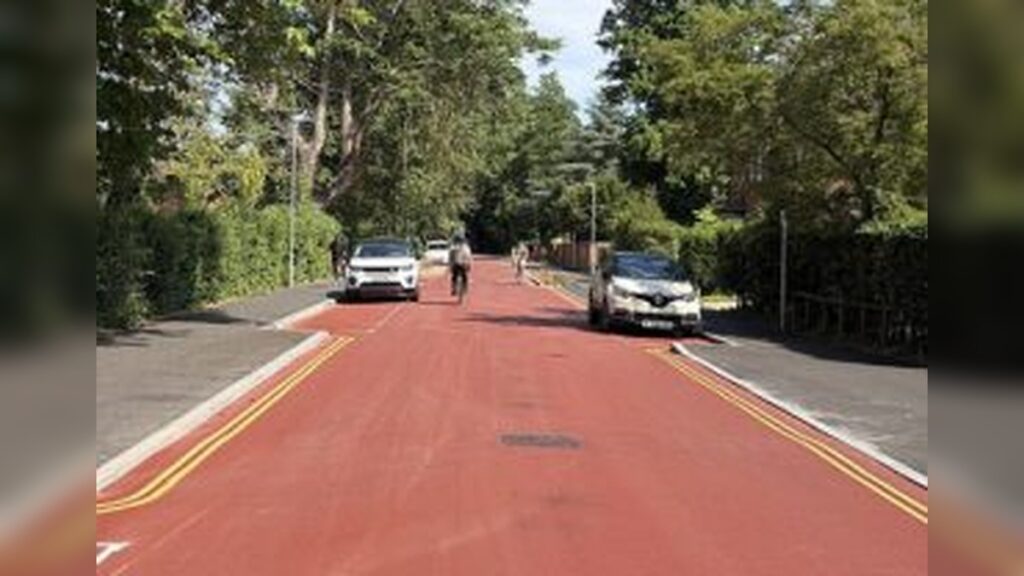
A newly redesigned road in Cambridge is at the centre of a growing argument about how cities should balance the needs of cyclists, pedestrians and drivers.
Officials behind the project say the revamped “cycle street” on Adams Road is designed to make travel safer and more comfortable for people walking and cycling.
Critics, however, believe the expensive makeover solves a problem that barely existed in the first place.
The controversial project reportedly cost £2.4 million and is being promoted as the first road of its kind in England based on a Dutch-style approach that prioritises bicycles and pedestrians over motor vehicles.
What Changed on Adams Road?
Adams Road, located in one of Cambridge’s wealthiest neighbourhoods, has long been known as a busy cycling route.
Authorities say around 3,000 cyclists travel through the road daily, making it one of the city’s most heavily used bike corridors.
To transform the road, planners removed much of the on-road parking, widened footpaths, redesigned junctions, added raised crossings and introduced a bright red road surface intended to slow drivers and encourage safer behaviour.
Supporters insist these changes will reduce risks for cyclists, especially incidents involving suddenly opened car doors or collisions with vehicles.
Local officials have argued that the previous layout created blind spots and near-misses that often went unreported.
Critics Question the Need for the Scheme
Despite the ambitious claims surrounding the project, official data released following requests for statistics painted a different picture.
According to the figures, only two reported cyclist collisions occurred on Adams Road over a seven-year period.
Just one of those incidents was classified as serious.
That revelation has fuelled criticism from residents and motorists who argue that millions of pounds have been spent on a cosmetic redesign rather than on more pressing transport problems across the city.
Some locals pointed out that the street had naturally slow-moving traffic already because parked vehicles limited space for speeding.
Others said they rarely witnessed dangerous incidents there at all.
A number of critics also complained that the redesign appears tailored for affluent neighbourhoods where residents can rely on private driveways and off-street parking.
They argue the same model would be difficult to implement in denser, working-class parts of Cambridge filled with terraced housing and limited parking space.
Accessibility Concerns Add Another Layer
The debate is not only about cyclists versus motorists.
Some residents believe the city is overlooking broader accessibility issues.
One resident criticised local authorities for investing heavily in “vanity projects” while pavements, roads and wheelchair access across Cambridge continue to deteriorate.
Concerns were raised about elderly residents and people with mobility challenges struggling with uneven walkways and poor infrastructure in other parts of the city.




The criticism highlights a wider issue many British cities face: balancing environmentally friendly transport initiatives with the everyday realities of accessibility, congestion and infrastructure maintenance.
Cambridge’s Long Running Transport Battles
This is far from the first transport controversy involving Cambridge authorities.
In recent years, the city has become a testing ground for several cycling-first initiatives championed by the Greater Cambridge Partnership, a body involving local councils and transport groups.
Critics often accuse the organisation of pursuing policies that disadvantage motorists and local businesses.
One particularly divisive measure was the “bus gate” introduced on Mill Road.
The restriction allows buses, taxis, cyclists and pedestrians to cross a bridge while limiting access for ordinary motorists.
Opponents claimed the move forced longer driving routes and hurt nearby businesses.
Another controversial project involved a major upgrade on Milton Road, where residents complained that cycling infrastructure squeezed pedestrian space to unsafe levels due to lamp posts and telegraph poles narrowing footpaths.
Cambridge also unveiled the UK’s first Dutch-style roundabout in 2020.
Ironically, collision figures reportedly increased after its introduction compared to previous years, leading some detractors to nickname it a “cyclist killing zone.”
Supporters Say the City Must Adapt
Despite the backlash, supporters of the Adams Road project insist change is necessary as cycling numbers continue to rise in Cambridge.
Residents backing the scheme argue that the previous road layout had become increasingly dangerous due to parked vehicles, crowded pavements and heavy bike traffic.
Some believe redesigning roads to prioritise active travel is the only sustainable solution for a growing city with limited road space.
Cycling advocates also say official collision data does not capture near misses, intimidation or incidents that go unreported.
They argue many people avoid cycling altogether because they feel unsafe sharing roads with cars.
For university students and younger residents especially, the smoother road surface and reduced traffic congestion have reportedly improved the cycling experience.
Impact and Consequences
The Adams Road project could influence how future transport policies are designed not only in Cambridge but across the UK.
If authorities view the scheme as successful, similar cycle-priority streets may appear in other cities trying to reduce car dependency and lower emissions.
However, public resistance could also harden attitudes against large-scale active travel investments.
Economically, debates over parking removal and restricted vehicle access may continue affecting businesses, commuters and homeowners.
Politically, projects like this increasingly divide communities between environmental goals and practical transport concerns.
The controversy also exposes a growing class divide in urban planning debates.
Critics argue wealthier areas are better positioned to absorb traffic restrictions because residents often have alternative parking options and easier access to cycling infrastructure.
What’s Next?
Local authorities are likely to monitor traffic patterns, cyclist numbers and safety reports over the coming months and years.
Future decisions may depend heavily on whether measurable improvements actually emerge from the redesign.
Campaigners on both sides are expected to continue pushing their arguments.
Cycling groups want more ambitious infrastructure, while opponents are demanding greater focus on road maintenance, accessibility and fair treatment for motorists.
The wider national conversation about low-traffic neighbourhoods, cycling lanes and car restrictions is also unlikely to disappear anytime soon.
As more councils pursue climate and active travel goals, similar disputes could become increasingly common throughout Britain.
Summary
Cambridge’s new Adams Road cycle street has become a flashpoint in the debate over modern urban transport.
Supporters believe the redesign represents a safer and more sustainable future for cities, while critics argue the costly project exaggerates dangers and ignores more urgent infrastructure problems.
The clash reflects broader tensions over how British cities should evolve — whether roads should continue prioritising cars or increasingly shift toward cyclists and pedestrians.
Bulleted Takeaways
- Adams Road in Cambridge was redesigned into a £2.4 million cycle-priority street.
- Officials say the project improves safety for cyclists and pedestrians.
- Critics questioned the need for the redesign after statistics showed only two reported cyclist collisions in seven years.
- Residents raised concerns about parking loss, accessibility and spending priorities.
- The scheme follows Dutch-inspired urban planning principles focused on active travel.
- Cambridge has faced several previous controversies involving cycling and traffic restrictions.
- Supporters believe near misses and unreported incidents justify the changes.
- The debate highlights growing national tensions over transport policy, climate goals and car use in UK cities.
- Furious farmer sprays slurry over illegally parked cars at Rydal Water Lake District Cumbria during heatwave chaos
- Tiger Woods flies private jet back to Switzerland from Florida amid rehab return and controversy in Zurich
- Governor Gavin Newsom declares emergency and mobilizes state resources after hazardous chemical leak rocks Orange County aerospace facility in California
- Social Democrats Candidate Daniel Ennis Shocks Dublin Central Voters as Sinn Féin Struggles to Hold Ground in Explosive Ireland By-Election Battle
- Shocking discovery in Dorset UK shows Annabel Dewing discovers pregnancy while losing weight on Mounjaro and shocks family and doctors
- Meghan Markle Showcases Luxury Wardrobe Uses OneOff AI Platform Reveals £92k Fashion Looks in Los Angeles Lifestyle Campaign
- Husband Sues Suffolk Glamping Firm After Barrister Wife Dies Saving Children From Burning Airstream Caravan
- Aimee Bock loses nonprofit empire as Feeding Our Future fraud case rocks Minnesota court with federal charges and sentencing battle
- Royal debate intensifies as public poll questions King Charles decision over Beatrice and Eugenie garden party invitations at Buckingham Palace London
- Salesians commemorate three missionaries and relive deadly attack anniversary in Dimapur India during emotional silver jubilee gathering
- Quentin Willson leaves £1.9 million estate in Stratford-upon-Avon as British TV world mourns motoring legend
- Bill Maher slams Kamala Harris and Hillary Clinton over interview avoidance in Club Random podcast in Los Angeles United States sparking political backlash

