
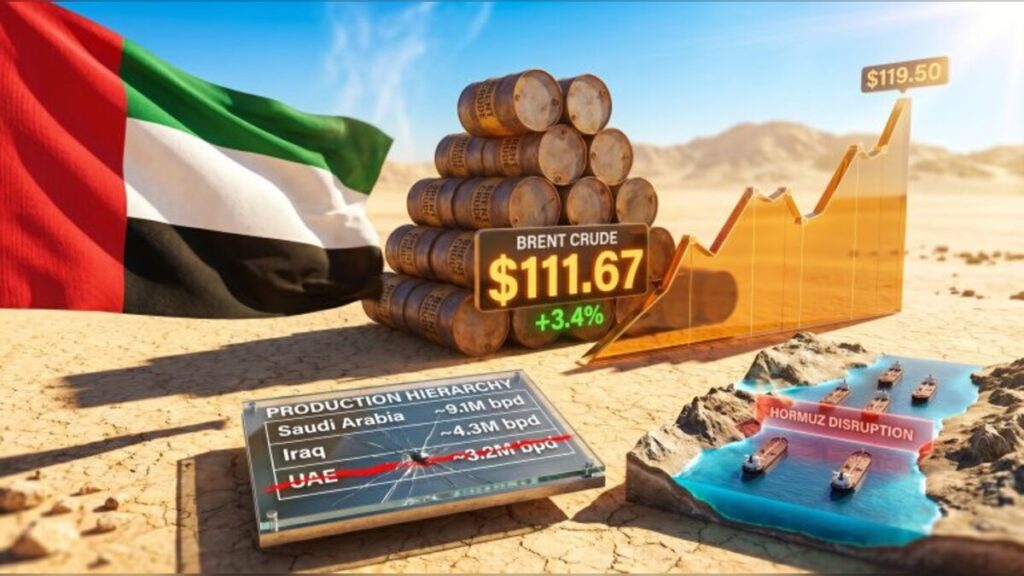
Energy markets have been buzzing after analysis from the BBC explored what could happen if the United Arab Emirates were to step away from the oil cartel system that helps coordinate global crude production.
Even the suggestion alone has been enough to stir debate among traders, policymakers, and oil-dependent economies.
At the centre of the discussion is not just oil supply, but how much influence a single producer can have when it starts questioning collective rules that have shaped the energy market for decades.
Why the UAE Matters in the Global Oil System
The UAE is one of the key players in global oil production and a major voice within OPEC and its broader alliance system.
Its role is not just about how much oil it produces, but also about how it aligns with agreed production limits that help stabilise prices worldwide.
In recent years, tensions have occasionally surfaced between countries with growing production capacity and the quota system meant to keep supply balanced.
Some members have argued that their expanding output potential is not fully reflected in agreed limits.
That’s where the UAE becomes particularly important—it has invested heavily in boosting production capacity, which makes its position inside production agreements more complicated.
What Departure Would Actually Change
If a major producer like the UAE were to step away from coordinated production rules, the immediate effect would likely be uncertainty in global oil markets.
Oil prices could become more volatile because one of the stabilising forces—collective supply management—would weaken.
Traders tend to react quickly to any sign that coordination inside major producer groups is breaking down.
Beyond prices, the influence of the cartel system itself could be reduced.
The oil market might shift further toward a more competitive, less coordinated structure where individual countries prioritise their own output strategies.




That could benefit producers with spare capacity, but it might make long-term planning more difficult for import-dependent countries.
A Broader Pattern of Strain Inside Oil Alliances
This isn’t the first time questions have been raised about unity within global oil agreements.
Over the years, there have been disagreements over quotas, production targets, and responses to global demand shocks.
Some members prefer tighter control to support higher prices, while others push for higher output to capture market share.
These competing priorities often sit beneath the surface of formal agreements.
Energy analysts have long noted that as global demand shifts—especially with the rise of renewable energy—the internal pressure on oil alliances is likely to increase.
Impact and Consequences
A UAE departure, even as a hypothetical scenario, would carry wide-ranging consequences.
For oil markets, the biggest impact would be price instability.
Traders rely on predictable supply decisions, and any breakdown in coordination could lead to sudden spikes or drops in crude prices.
For producing countries, it could trigger a strategic rethink.
Some might follow a more independent path, while others could push harder to maintain collective discipline.
For importing nations, especially developing economies, higher volatility could translate into fuel price fluctuations, inflation pressure, and budget uncertainty.
More broadly, it could weaken the long-standing influence of coordinated oil groups in shaping global energy policy.
What’s Next in the Discussion
For now, the situation remains analytical rather than immediate.
The BBC-style breakdown reflects possible outcomes rather than confirmed policy changes.
However, markets will continue watching signals from major producers closely, especially around production meetings and quota negotiations.
Any hint of disagreement among key members will likely be interpreted as a sign of deeper structural shifts in global energy governance.
Summary
The idea of the UAE potentially stepping away from coordinated oil production agreements has raised questions about the future of global energy stability.
While still a theoretical scenario, it highlights ongoing tensions within producer alliances and the challenges of balancing national production ambitions with collective market control.
Bulleted Takeaways
- BBC analysis explores potential UAE exit from oil cartel arrangements
- UAE is a major oil producer and key influence in global supply coordination
- Departure could increase oil price volatility worldwide
- Cartel influence over global oil markets would likely weaken
- Tensions exist between production quotas and growing output capacity
- Oil alliances have faced internal disagreements for years
- Global energy transition is adding pressure to traditional oil systems
- Importing countries could face higher economic uncertainty if coordination weakens
- Markets remain sensitive to any signals from major producers
- Scenario remains speculative but highlights structural risks in oil governance

