
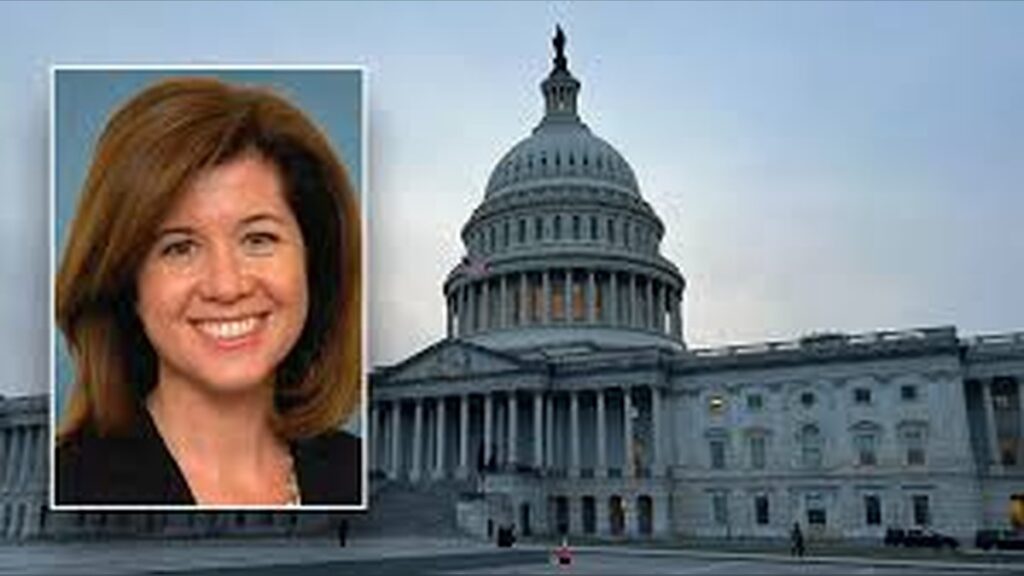
A political storm erupted after Donald Trump publicly urged Senate Republicans to remove Senate Parliamentarian Elizabeth McDonough, escalating tensions over a controversial spending bill that includes funding for immigration enforcement and a proposed White House ballroom project.
The demand came through a lengthy post on Truth Social, where Trump accused McDonough of political bias and claimed she has consistently worked against Republican priorities while favoring Democrats.
Budget Battle Ignites Over $1 Billion ICE Funding Package
At the heart of the dispute is a reconciliation bill tied to roughly $1 billion in funding for Immigration and Customs Enforcement (ICE), Border Patrol, and related infrastructure spending.
The bill also reportedly includes funding linked to Trump’s broader administrative priorities.
Trump argued that McDonough’s objections to certain line items are obstructing what he views as necessary reforms and national security investments.
His post framed the situation as part of a larger political struggle over how Washington operates.
Reconciliation bills are especially powerful because they allow legislation to pass the Senate with a simple majority instead of the usual 60-vote threshold needed to overcome a filibuster.
Who the Senate Parliamentarian Is and Why the Role Matters
The Senate Parliamentarian is not an elected official but a procedural referee who interprets Senate rules and determines whether legislation complies with budget reconciliation guidelines.
Elizabeth McDonough currently holds the position and plays a central role in applying the “Byrd Rule,” which limits what can be included in reconciliation bills.
That rule, named after Senator Robert Byrd, blocks provisions that do not directly impact federal spending or revenue.
It also prevents major policy changes—like immigration reform or Social Security restructuring—from being passed through budget reconciliation.
The “Byrd Bath” and How Bills Get Reshaped
Before a reconciliation bill can advance, it undergoes what is informally called a “Byrd Bath,” where the parliamentarian reviews each provision line by line.
In past years, McDonough has significantly altered major legislation through this process.




One notable example came in 2022, when she struck down parts of President Joe Biden’s Build Back Better proposal, including immigration-related provisions.
Now, she is positioned to review Trump-aligned spending proposals, which could again lead to sections being removed or modified if they violate Senate rules.
Political Reactions Split Across Washington
Senate Majority Leader John Thune described Trump’s demand as “concerning,” warning that removing or undermining the parliamentarian could complicate efforts to pass legislation even within the Republican majority.
Despite Republican control of 53 Senate seats, internal divisions remain over spending levels and transparency, particularly regarding funding for security and enforcement programs.
Some GOP lawmakers have also questioned the scale and clarity of proposed allocations, especially relating to how funds would be spent and overseen.
Historical Precedent for Overruling or Replacing Parliamentarians
While the parliamentarian is expected to remain neutral, the role is not formally protected from removal.
Historically, Senate leaders have replaced parliamentarians during disputes over major budget decisions.
A well-known example occurred in 2001 when then-Majority Leader Trent Lott removed Parliamentarian Robert Dove amid disagreements over a budget package tied to President George W. Bush’s tax cuts.
After the replacement, the legislation proceeded more smoothly.
This precedent is now being referenced in discussions about whether McDonough could face similar pressure.
Impact and Consequences
The dispute raises broader concerns about the balance between political power and institutional rules in the Senate.
If the parliamentarian’s authority is weakened or removed, reconciliation could become more politically driven and less procedurally constrained.
That shift could make it easier for the majority party to pass large-scale spending or policy changes without bipartisan support, potentially increasing legislative volatility.
At the same time, critics warn it could erode trust in Senate procedures, turning what is meant to be a neutral referee role into a political battleground.
What’s next?
The reconciliation bill is still moving through procedural review, and McDonough’s rulings will determine which provisions survive.
Senate leadership will then decide whether to accept those decisions or challenge them.
Republican lawmakers are expected to continue internal negotiations as they try to secure enough unity to pass the bill under reconciliation rules.
Meanwhile, Trump’s public pressure adds political urgency, potentially influencing how aggressively Senate Republicans pursue procedural changes or confront the parliamentarian’s authority.
Summary
Donald Trump has called for the removal of Senate Parliamentarian Elizabeth McDonough amid disputes over a reconciliation bill involving ICE funding and other spending priorities.
The conflict highlights the tension between Senate procedural rules and political ambitions, with the Byrd Rule and reconciliation process at the center of the fight.
Bulleted Takeaways
- Trump urged Senate Republicans to fire Parliamentarian Elizabeth McDonough
- Dispute centers on a $1 billion ICE and Border Patrol funding bill
- McDonough enforces the Byrd Rule in budget reconciliation cases
- Reconciliation allows bills to pass with a simple Senate majority
- The “Byrd Bath” process reviews and removes non-compliant provisions
- Past rulings have reshaped major legislation, including Biden’s Build Back Better
- Senate leadership has expressed concern over Trump’s comments
- Historical precedent exists for replacing parliamentarians
- Debate highlights tension between political goals and Senate procedural rules
- Outcome could influence future use of budget reconciliation in the Senate

