
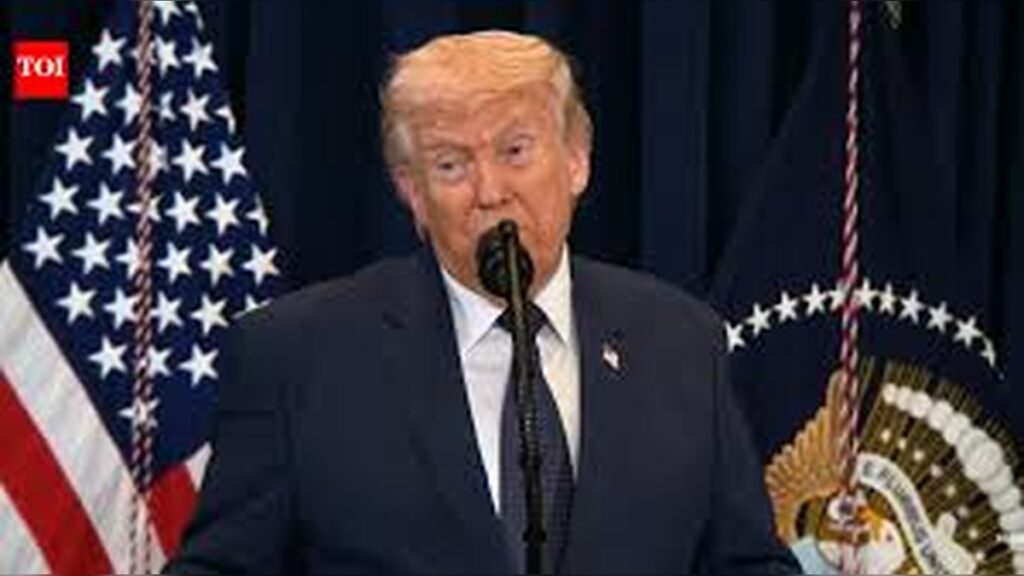
Global oil markets took a sharp turn Wednesday after President Donald Trump suggested that negotiations between Washington and Tehran may finally be nearing a breakthrough.
His comments instantly cooled fears that have gripped energy traders for weeks and sent crude prices tumbling in midday trading.
West Texas Intermediate crude futures dropped more than 6%, sliding to roughly $97.74 a barrel.
Brent crude, the international benchmark closely watched by global markets, also sank nearly 6% to around $104.62 per barrel.
The sudden drop reflected growing optimism that tensions around the Strait of Hormuz could soon ease.
Why the Strait of Hormuz Matters So Much
The Strait of Hormuz is not just another shipping lane.
It is one of the world’s most strategic energy chokepoints, carrying a massive share of global oil and liquefied natural gas exports every day.
Countries across Asia, Europe, and even North America depend heavily on energy shipments passing through those narrow waters.
Over the last several weeks, the standoff between Iran and the United States has disrupted shipping activity in the region.
Iran has maintained pressure through blockades and threats around Hormuz, while Washington responded with restrictions targeting Iranian ports and trade activity.
Even limited interruptions in the area have historically caused immediate spikes in energy prices because traders fear shortages could ripple through the entire global economy.
Trump’s Comments Shift Market Sentiment
Speaking to reporters, Trump said discussions with Iran were entering the “final stages,” a phrase that quickly grabbed Wall Street’s attention.
The remarks followed reports that the White House recently paused plans for renewed military strikes against Iranian targets after requests from Gulf Arab allies seeking more room for diplomacy.
Investors interpreted the comments as a possible signal that the administration sees a path toward reopening maritime routes and reducing tensions in the Gulf.
The reaction was swift. Oil traders who had spent weeks pricing in worst-case supply disruptions suddenly shifted toward expectations of a diplomatic settlement.
Still, many analysts caution that markets may be moving too quickly on optimism alone.
Markets Have Been on Edge for Weeks
The conflict between Washington and Tehran has created extreme volatility across energy markets.
Nearly every statement from either side has triggered dramatic price swings.
One day, hopes of negotiations push prices lower.
The next, new military threats or shipping disruptions send them climbing again.




This uncertainty has left traders struggling to determine whether diplomacy is genuinely advancing or whether the market is simply reacting emotionally to political headlines.
Financial institutions and energy analysts continue warning that the underlying risks have not disappeared.
Citibank Warns the Crisis Could Still Escalate
Despite Wednesday’s sharp decline in oil prices, some major analysts believe the danger remains serious.
Citibank warned clients earlier this week that investors may be underestimating the likelihood of prolonged disruptions in the Strait of Hormuz.
According to the bank’s projections, Brent crude could still climb toward $120 per barrel if instability continues.
Citi analysts argued that Iran may continue interfering with shipping routes for an extended period, even while negotiations continue behind closed doors.
That warning highlights the fragile nature of the current market optimism.
Worst-Case Scenarios Could Send Oil Near $200
Energy consulting firm Wood Mackenzie offered an even more dramatic outlook.
In a new analysis published Wednesday, the firm suggested oil prices could approach $200 per barrel if the Strait of Hormuz remains effectively closed through the remainder of the year.
Such a scenario would likely trigger severe economic consequences worldwide, including higher transportation costs, inflation spikes, and pressure on already strained supply chains.
However, Wood Mackenzie also outlined a far more positive possibility.
If the U.S. and Iran manage to finalize a peace agreement quickly and reopen Hormuz by June, Brent crude prices could eventually fall toward $80 per barrel by the end of 2026.
Gulf Nations Continue Pushing for Diplomacy
Several Gulf Arab countries have reportedly urged both sides to avoid a wider military conflict.
Nations in the region are particularly vulnerable because their economies rely heavily on stable oil exports and uninterrupted maritime trade.
Saudi Arabia, the United Arab Emirates, and Qatar have all historically favored de-escalation during periods of U.S.-Iran confrontation, fearing broader instability could damage regional economies and security.
The latest diplomatic push appears partly driven by concerns that prolonged conflict would not only affect oil markets but also international shipping, tourism, and investment across the Middle East.
Impact and Consequences
The recent oil market volatility is already affecting businesses and consumers globally.
Airline companies, shipping firms, manufacturers, and transportation sectors closely monitor fuel prices because even small increases can significantly raise operating costs.
If tensions continue:
- Gasoline and diesel prices could rise sharply worldwide.
- Inflation pressures may intensify in major economies.
- Global shipping delays could worsen supply chain problems.
- Developing nations heavily dependent on imported fuel may face economic strain.
On the other hand, a successful diplomatic agreement could stabilize energy markets and ease inflation concerns that have worried central banks for months.
For consumers, that could eventually translate into lower fuel and transportation costs.
What’s Next?
Attention now shifts to the actual progress of negotiations between Washington and Tehran.
Investors will closely watch for:
- Any formal announcement of a diplomatic framework.
- Changes in naval activity around the Strait of Hormuz.
- Statements from Iranian officials.
- Updates from Gulf Arab mediators.
- Signs that commercial shipping routes are reopening safely.
If no concrete developments emerge soon, market confidence could fade quickly and oil prices may rebound again.
At the same time, any renewed military escalation would likely send crude prices sharply higher almost immediately.
Summary
Oil prices plunged Wednesday after President Donald Trump signaled that negotiations with Iran may be nearing completion.
Traders reacted positively to hopes that tensions surrounding the Strait of Hormuz could finally ease, reducing fears of major supply disruptions.
Despite the market optimism, analysts remain cautious.
Financial institutions and energy experts warn that the situation remains unstable and could still escalate if diplomacy breaks down.
For now, global markets are balancing between two dramatically different futures: one involving lower oil prices and renewed stability, and another involving prolonged conflict and potentially record-breaking energy costs.
Bulleted Takeaways
- Oil prices dropped more than 6% after Trump said Iran talks are in the “final stages.”
- Brent crude fell near $104 per barrel while WTI slipped below $98.
- The Strait of Hormuz remains central to global energy supply concerns.
- Analysts warn markets may be overly optimistic about a quick resolution.
- Citibank believes Brent could still rise to $120 if disruptions continue.
- Wood Mackenzie says oil could approach $200 in a worst-case scenario.
- Gulf nations are pushing aggressively for diplomacy and de-escalation.
- Traders are now waiting for real progress at the negotiating table.

