
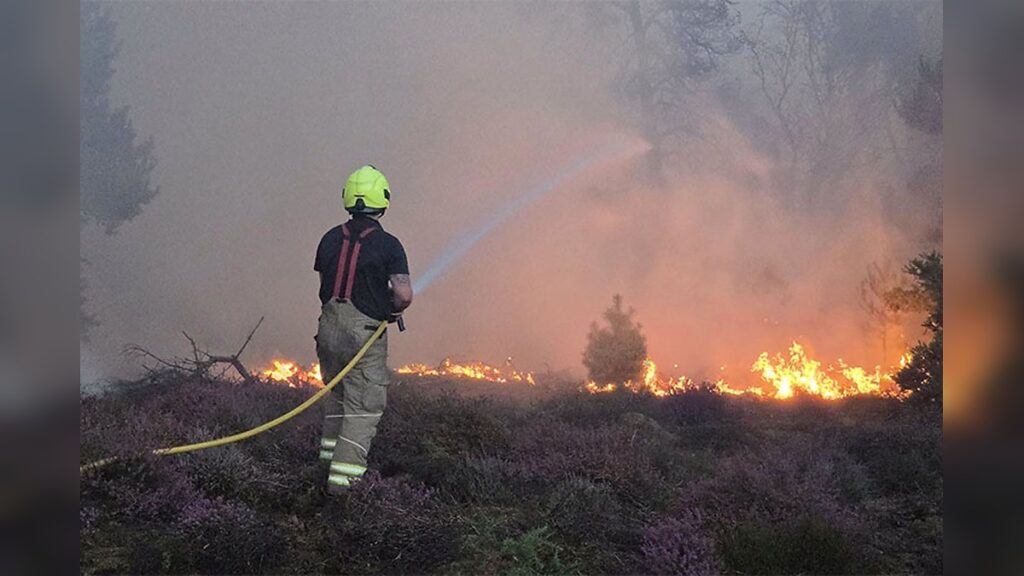
Emergency services in Suffolk are battling a rapidly expanding wildfire that has grown more than tenfold within hours, prompting a major incident declaration and the evacuation of hundreds of residents and holidaymakers along the county’s coastline.
The blaze, which started on Dunwich Heath near the National Trust’s Coastguard Cottages at approximately 5:30 p.m. the previous evening, has spread aggressively across dry heathland.
Fire officials initially estimated the affected area at around 24 acres early in the morning, but by midday the wildfire had consumed approximately 247 acres—an area comparable to around 140 football pitches.
Authorities have warned that the situation remains highly dynamic as shifting weather conditions continue to influence the fire’s direction.
Hundreds Forced to Leave Homes and Holiday Parks
The escalating emergency has led to widespread evacuations across the affected area.
Overnight, approximately 200 caravans at a nearby holiday park were emptied as firefighters worked to protect visitors from the advancing flames.
Changing wind conditions later prompted further evacuations, with residents living closest to the fire instructed to leave their homes.
Around 48 people, including families with young children and pet owners, were relocated to Westleton Village Hall after being evacuated late at night.
Many of those displaced described a calm and supportive atmosphere despite the disruption, with holidaymakers expressing relief that everyone had been safely moved away from the danger.
Firefighters Reinforce Response as Conditions Shift
Around 100 firefighters remain on the frontline, supported by specialist equipment as efforts continue to contain the fast-moving blaze.
Suffolk Fire and Rescue Service has requested additional national firefighting resources to strengthen operations after officials acknowledged that crews have been working under extremely demanding conditions.
Chief Fire Officer John Lacey told evacuees that firefighters are exhausted after battling the blaze continuously but remain focused on preventing further spread.
Emergency crews expect firefighting operations to continue for at least another 24 to 48 hours.
Officials Reassure Public Over Sizewell Nuclear Station
Although the wildfire has spread in the general direction of the nearby Sizewell nuclear complex, emergency authorities insist there is currently no threat to the operational Sizewell B nuclear power station.
Fire officials said the site’s distance from the flames, combined with the fire’s movement, means there is no immediate risk.
However, they stressed that conditions could change and that the situation is being closely monitored.




EDF, which operates Sizewell B, confirmed that power station operations remain unaffected while adding that it is maintaining close communication with emergency services.
The company also noted that comprehensive emergency response plans are already in place to deal with a range of potential incidents, including fires.
At the nearby Sizewell C construction project, officials similarly assessed the current wildfire risk as low.
Witnesses Describe Explosions and Walls of Flames
People who witnessed the wildfire during the early hours described dramatic scenes as flames swept across the heathland.
One runner passing through the area shortly after dawn said he heard repeated explosions while bushes and trees erupted into flames.
He described seeing a lengthy fire front moving across the landscape and spoke of the emotional impact of watching one of Suffolk’s best-known natural habitats being consumed.
Witnesses also highlighted the devastating consequences for local wildlife and the historic heathland ecosystem, with thick smoke visible across miles of coastline.
Public Urged to Avoid Area
Authorities have advised members of the public to stay away from the affected section of the Suffolk coast while emergency operations continue.
Residents living nearby have also been urged to keep windows and doors closed due to heavy smoke drifting across surrounding communities.
Road access remains restricted in parts of the area to ensure emergency vehicles can move freely while crews continue containing hotspots.
Heatwave Fuels Rising Wildfire Risk Across Britain
The Suffolk emergency comes as Britain experiences one of its most severe wildfire seasons in recent years, driven by prolonged heatwaves and exceptionally dry conditions.
More than 200 wildfires have been recorded across the country during the past two weeks, with over 700 incidents attended by fire services across England and Wales so far this year.
Fire chiefs continue to warn that southern and eastern England remain particularly vulnerable as vegetation becomes increasingly dry.
The Met Office has classified wildfire conditions in several regions as “exceptionally severe,” raising concerns that even small fires could spread rapidly.
London, Scotland and Northern England Also Hit by Fires
Firefighters have also been responding to multiple significant blazes elsewhere across the UK.
In east London, crews tackled separate grass fires in Romford and Rainham that destroyed around 40 acres of land combined.
Elsewhere, major wildfire incidents remain active around Dovestone Reservoir in Greater Manchester, where public access has been suspended while emergency crews work to control hotspots.
Scotland has also experienced destructive wildfires in the Cairngorms, with extensive damage reported to forests, heather and grasslands despite progress in containing the flames.
Drought and Extreme Temperatures Intensify National Emergency
The widespread fires coincide with one of the driest periods in decades, with half of England officially designated as being in drought.
The affected regions include London and Hertfordshire, East Anglia, the Thames Valley, Hampshire and the Isle of Wight, Devon and Cornwall, the West Midlands, and Wessex.
Temperatures climbed above 35 degrees Celsius during the latest heatwave, contributing to rapidly drying vegetation and increasing pressure on water supplies.
Environmental officials have warned that continued hot, dry weather could have lasting consequences for ecosystems, agriculture and the wider economy, while farming leaders fear harvests may suffer some of their poorest yields in years.
Health authorities have also cautioned that 2026 could record the highest number of heat-related deaths since official monitoring began, highlighting the broader impact of Britain’s prolonged spell of extreme weather.
